

If there is one breed where pet insurance for Labrador Retrievers pays for itself more reliably than almost any other, it is the Lab. Not because Labs are uniquely unhealthy — they are a reasonably robust large breed — but because the specific conditions they are genetically predisposed to are among the most expensive to treat in veterinary medicine. Hip dysplasia surgery, elbow dysplasia surgery, bloat surgery, and the gastrointestinal emergencies that follow their tendency to eat non-food items can each run into thousands of dollars. A policy that costs $40 to $70 per month can pay for itself in a single claim.
Choosing the right pet insurance for Labrador Retrievers means understanding not just what policies cover in general, but what Labs specifically are likely to claim — and which policy terms most affect that coverage.
This guide covers what pet insurance actually covers, what to look for specifically for a Lab, when to enroll, how to compare policies, and what the common exclusions mean in practice. It does not recommend specific providers — policy terms, pricing, and coverage change frequently — but gives you the framework to evaluate any policy you are considering.
If you are still in the research stage and have not yet chosen a puppy, browse our available AKC health-tested Lab puppies — every puppy comes from OFA-cleared parents, which meaningfully reduces the inherited conditions that make insurance claims most likely.
- Why Pet Insurance for Labrador Retrievers Matters More Than for Most Breeds
- The Most Important Rule for Pet Insurance for Labrador Retrievers – When to Enroll
- What Pet Insurance for Labs Should Cover
- Key Policy Terms to Understand Before You Compare
- How Much Does Pet Insurance Cost for a Labrador?
- Is Pet Insurance for Labrador Retrievers Worth It?
- What to Look for When Comparing Pet Insurance for Labrador Retrievers
- Our Available Lab Puppies
- Frequently Asked Questions
Why Pet Insurance for Labrador Retrievers Matters More Than for Most Breeds
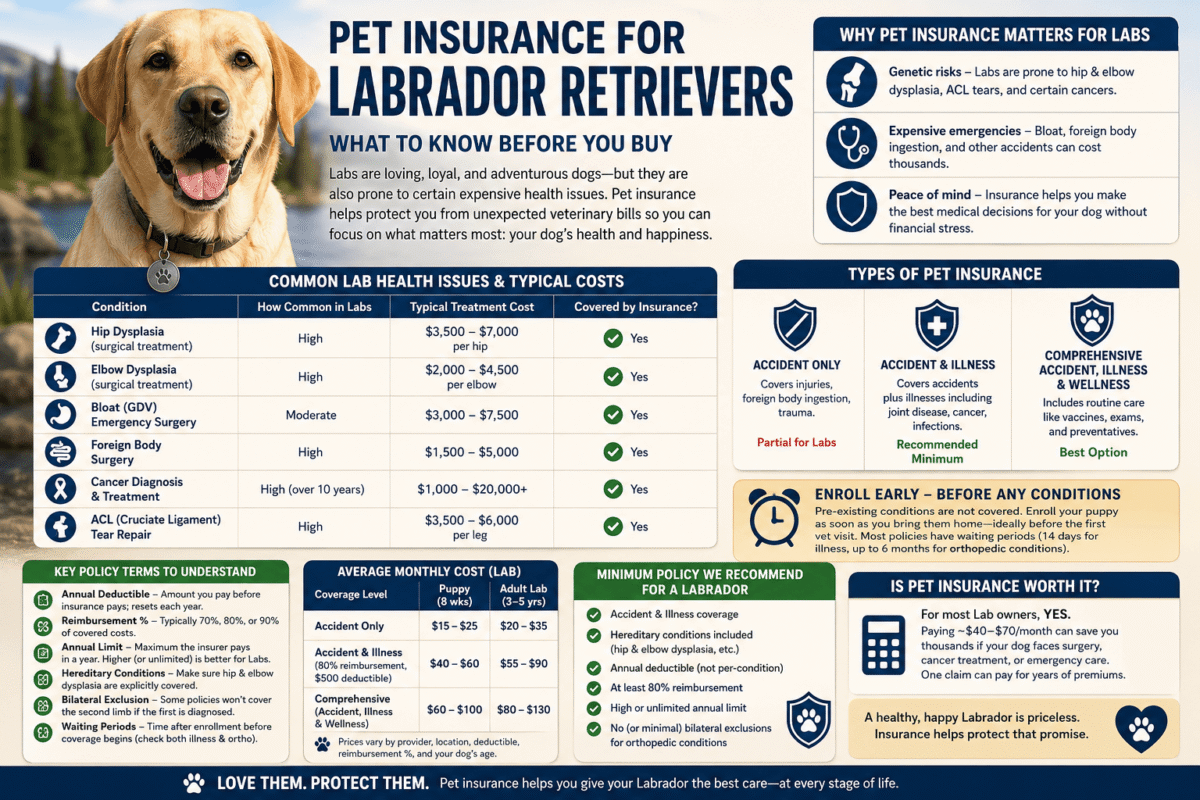
Most breeds have some hereditary health predispositions. What makes Labs different is the combination of the specific conditions they face, the cost of treating them, and the fact that many Labs will encounter at least one of these conditions during their 10 to 14 year life. Understanding what you are insuring against makes the policy comparison significantly more meaningful:
| Condition | Lab Prevalence | Typical Treatment Cost | Coverable by Insurance? |
|---|---|---|---|
| Hip dysplasia — surgical treatment | High — OFA data identifies Labs as one of the more commonly affected large breeds | $3,500 – $7,000 per hip | ✅ Yes — if enrolled before diagnosis |
| Elbow dysplasia — surgical treatment | High — often co-occurs with hip dysplasia in the same dog | $2,000 – $4,500 per elbow | ✅ Yes — if enrolled before diagnosis |
| Bloat — GDV emergency surgery | Moderate — elevated risk as a deep-chested breed | $3,000 – $7,500 | ✅ Yes — emergency coverage |
| Gastrointestinal foreign body surgery | High — Labs eat non-food items regularly | $1,500 – $5,000 | ✅ Yes — accident coverage |
| Cancer diagnosis and treatment | High in Labs over 10 years | $1,000 – $20,000+ | ✅ Yes — illness coverage, variable by plan |
| Cruciate ligament tear (CCL) | High — Labs are among the most commonly affected breeds | $3,500 – $6,000 per leg | ✅ Yes — if enrolled before diagnosis or injury |
| Ear infections — chronic | Very high | $100 – $400 per episode | ✅ Yes — illness coverage, though premiums may rise |
| Obesity-related conditions | Very high — Labs are the most obesity-prone breed | Variable | ⚠️ Varies — some policies exclude conditions secondary to obesity |
The Most Important Rule for Pet Insurance for Labrador Retrievers – When to Enroll
The single most important thing to understand about pet insurance is that pre-existing conditions are excluded. A condition that is diagnosed, treated, or even noted in your dog’s veterinary records before the policy is taken out will not be covered — in most cases, ever. This is not a loophole or a technicality. It is the fundamental structure of how pet insurance works, and it has major implications for Labs specifically.
Hip dysplasia is the clearest example. If your Lab is diagnosed with hip dysplasia at 18 months and you take out insurance at 20 months — after the diagnosis — the surgery will not be covered. The diagnosis is a pre-existing condition from that point forward. The same logic applies to elbow dysplasia, cruciate ligament tears, ear infections that become chronic, and any other condition your dog has already been seen for.
The correct time to enroll is immediately after your puppy comes home — before the first veterinary visit if possible, or at minimum before any conditions are noted. Some insurers have a waiting period of 14 days for illness and up to 6 months for orthopedic conditions — meaning a condition diagnosed during that waiting period may still be excluded. Factor the waiting period into your timing.
In our experience working with Lab buyers, the owners who most regret not taking out insurance earlier are the ones whose Lab was diagnosed with hip dysplasia or a cruciate tear at 18 to 24 months — exactly the age when these conditions are most commonly identified in young Labs, and exactly the point at which insurance would have covered the full surgical cost.
What Pet Insurance for Labs Should Cover
Not all pet insurance policies are equivalent. There are three broad categories — and for a Labrador Retriever, only the most comprehensive option genuinely addresses the breed’s specific risk profile:
| Policy Type | What It Covers | Suitable for a Lab? |
|---|---|---|
| Accident only | Injuries, foreign body ingestion, trauma — no illness coverage | ⚠️ Partial — covers foreign body surgery and injuries but not dysplasia, cancer, or chronic conditions |
| Accident and illness | Accidents plus illness including cancer, joint disease, infections, hereditary conditions | ✅ Recommended minimum for Labs — covers the most significant cost risks |
| Comprehensive — accident, illness, and wellness | Everything above plus routine care — vaccinations, annual exams, heartworm prevention | ✅ Best option if the premium fits your budget — reduces all veterinary costs |
Key Policy Terms to Understand Before You Compare
Pet insurance policies vary significantly in structure. These are the terms that matter most when comparing options for a Labrador Retriever:
Annual deductible. The amount you pay out of pocket before the policy begins paying. Deductibles are typically either annual (reset each year) or per-condition (applied separately to each new condition). An annual deductible is generally more advantageous for Labs — who may have multiple health events in a given year — than a per-condition deductible that resets every time a new problem is identified.
Reimbursement percentage. Most policies reimburse 70%, 80%, or 90% of covered costs after the deductible. A 90% reimbursement policy costs more per month but leaves you responsible for a smaller portion of a large bill. For a Lab facing a $6,000 hip surgery, the difference between 70% and 90% reimbursement is $1,200 out of pocket — worth factoring in when comparing premiums.
Annual limit. The maximum the policy will pay out in a given year. Some policies offer unlimited annual coverage; others cap at $5,000, $10,000, or $15,000. For Labs — where a single hip surgery followed by a cruciate tear in the same year is not an unlikely scenario — an unlimited or high annual limit is meaningfully better than a capped policy.
Hereditary and congenital condition coverage. This is the most important clause for Labs specifically. Hip dysplasia and elbow dysplasia are hereditary conditions — many policies exclude hereditary conditions entirely, or require an upgrade to a more expensive tier to include them. Read this clause carefully before assuming joint disease is covered. If a policy does not explicitly include hereditary conditions, it may not cover the most expensive Lab-specific risks.
Bilateral condition exclusion. Some policies exclude the second limb when a bilateral condition — such as hip dysplasia affecting both hips — is diagnosed. If a Lab is diagnosed with hip dysplasia in one hip, some insurers will exclude the other hip as a related pre-existing condition at renewal. Ask specifically about bilateral exclusions before enrolling.
Waiting periods. Most policies have a 14-day waiting period for illness and a longer waiting period — sometimes 6 months — for orthopedic conditions. This matters significantly for Labs. If your puppy shows signs of elbow dysplasia at 10 months and you enrolled at 8 months but the orthopedic waiting period is 6 months, the condition may still fall within the exclusion window. Know your waiting periods before you enroll, not after a claim is denied.
How Much Does Pet Insurance Cost for a Labrador?
Pet insurance premiums for Labrador Retrievers vary by provider, your location, the dog’s age at enrollment, the deductible you choose, and the reimbursement percentage selected. As a general guide for 2026:
| Coverage Level | Approximate Monthly Premium — Lab Puppy | Approximate Monthly Premium — Adult Lab (3–5 years) |
|---|---|---|
| Accident only | $15 – $25 | $20 – $35 |
| Accident and illness — 80% reimbursement, $500 deductible | $40 – $60 | $55 – $90 |
| Comprehensive — accident, illness, and wellness | $60 – $100 | $80 – $130 |
Premiums increase with age — a policy enrolled at 8 weeks will cost significantly less per month throughout the dog’s life than the same policy taken out at 3 years. This is another reason to enroll as early as possible: the premium advantage compounds over the dog’s lifetime.
Is Pet Insurance for Labrador Retrievers Worth It?
The honest answer on pet insurance for Labrador Retrievers is: for most Lab owners, yes — with caveats.
The case for insurance is strongest when your Lab is young and healthy, you enroll before any conditions develop, and you choose a policy that genuinely covers hereditary conditions. In that scenario, you are paying $40 to $70 per month for coverage that could return $5,000 to $15,000 in a single claim event. Given that approximately 25% of Labs will experience a significant orthopedic condition during their lifetime, and that foreign body ingestion is a near-universal Lab experience, the actuarial case for insuring a Lab is strong.
The case is weaker if you are enrolling an older Lab who already has a health history — pre-existing exclusions may leave the most likely cost events uncovered, reducing the value of the policy significantly. In that case, a frank conversation with your veterinarian about your specific dog’s risk profile will give you better guidance than a general recommendation.
One alternative worth considering: a dedicated veterinary savings fund. Some owners prefer to set aside $100 to $150 per month into a dedicated account rather than pay insurance premiums. This works well if the dog stays healthy — and poorly if a major claim event occurs early in the dog’s life before the fund has accumulated sufficient reserves. Insurance is fundamentally protection against the timing risk of that scenario.
What to Look for When Comparing Pet Insurance for Labrador Retrievers
Given the volume of pet insurance providers currently in the US market, the comparison process can feel overwhelming. These are the questions that matter most for a Labrador specifically:
| Question | Why It Matters for Labs |
|---|---|
| Does the policy explicitly cover hereditary conditions including hip and elbow dysplasia? | The most important question — if hereditary conditions are excluded, the policy does not cover the most significant Lab-specific cost risks |
| What is the orthopedic waiting period? | A 6-month orthopedic waiting period means joint conditions diagnosed in the first 6 months are not covered — enroll before bringing your puppy home if possible |
| Is the annual limit capped or unlimited? | Labs can have multiple expensive events in a single year — a capped annual limit may be exhausted mid-year |
| Is the deductible annual or per-condition? | Annual deductibles are generally more advantageous for Labs than per-condition deductibles |
| Does the policy have a bilateral condition exclusion? | Particularly important for hip dysplasia — which commonly affects both hips |
| How does the insurer handle premium increases after a claim? | Some insurers significantly increase premiums after large claims — this affects the long-term value of the policy |
Our Available Lab Puppies
Every puppy from Labrador Today comes from OFA health-tested parents — the most important foundation for reducing the inherited health risks that make pet insurance so relevant for Labs. Full health documentation is provided with every puppy, and we are always happy to discuss what health testing means for your puppy’s long-term risk profile.
- Black Lab Puppies
- Yellow Lab Puppies
- Chocolate Lab Puppies
- White English Cream Lab Puppies
- Silver Lab Puppies
- Red Fox Lab Puppies
For further reading:
- Common Labrador Health Problems and How to Avoid Them
- How Long Do Labrador Retrievers Live?
- First Year Cost of Owning a Labrador
- Average Cost of a Labrador Puppy
- How to Choose a Labrador Breeder
👉 Browse All Available Puppies
👉 Contact Us With Any Questions About Lab Health and Ownership Costs
Frequently Asked Questions
What is the best pet insurance for a Labrador Retriever?
We do not recommend specific providers — the pet insurance market changes frequently and the best policy for your Lab depends on your budget, your Lab’s age, your location, and what coverage level you need. What we can tell you is what to look for: hereditary condition coverage is non-negotiable for Labs — hip dysplasia, elbow dysplasia, and cruciate ligament tears must be covered or the policy does not address your most significant cost risks. Compare policies that include hereditary and congenital conditions, check the bilateral clause carefully (some policies exclude the second joint once one is claimed), and verify the orthopedic waiting period — many policies have a 6-month waiting period for orthopedic conditions. Use an independent comparison site to compare current offerings side by side with these criteria as your filter.
Is $50 a month a lot for pet insurance?
For a Lab puppy enrolled at 8 weeks with accident and illness coverage including hereditary conditions, $50 per month is at the lower end of the realistic range — many comprehensive Lab policies run $60 to $80 per month for puppies depending on your location and the deductible level chosen. A $50 policy is not necessarily inadequate — it may reflect a higher annual deductible or 70% reimbursement rather than 80 or 90%. The monthly premium is only meaningful in the context of the deductible, reimbursement percentage, and what conditions are actually covered. A $40 policy that excludes hereditary conditions provides almost no protection for a Lab’s most likely significant costs.
What pet insurance do most vets recommend?
Vets generally avoid endorsing specific providers — their primary advice is to get comprehensive coverage that includes hereditary and congenital conditions, enrolled as early as possible before any conditions develop. Most veterinary practices accept all pet insurance policies since reimbursement goes directly to the owner rather than the practice — the vet submits an itemised invoice and the owner claims from their insurer. The practical veterinary advice is consistent: enroll before your puppy’s first orthopaedic issue is identified, choose the highest reimbursement percentage your budget allows, and read the bilateral clause before signing.
Do vets actually accept pet insurance?
Yes — virtually all veterinary practices accept pet insurance, but the process works differently from human health insurance. You pay the vet bill in full at the time of treatment, then submit a claim to your insurer with the itemised invoice. Your insurer reimburses you the covered percentage minus your deductible. Some insurers now offer direct payment to certain practices — but the standard model is pay first, claim back. This means you need access to the full treatment cost upfront before reimbursement arrives, which is worth factoring into your emergency fund planning alongside the insurance policy.
What are the downsides of pet insurance?
The main downsides: premiums increase with age — significantly so after 7 to 8 years when Lab health costs become most likely. Pre-existing conditions are excluded — any condition identified before or during the waiting period will not be covered for the life of the policy. The bilateral clause can eliminate coverage for the second joint after the first is claimed — important for Labs prone to bilateral hip or elbow dysplasia. Annual or lifetime payout caps can leave you exposed on major conditions. And for healthy Labs that never face a significant claim, you may pay more in premiums than you recover. Pet insurance is a risk management tool — it pays off when you need it and costs you when you do not, exactly like any other insurance product.
What to do instead of pet insurance?
The most common alternative is a dedicated veterinary savings account — setting aside the monthly premium equivalent into a ring-fenced savings account rather than paying an insurer. This works well if your Lab stays healthy — you build a fund that earns interest and remains accessible. The risk is that a major claim early in the dog’s life — a hip dysplasia diagnosis at 18 months, for example — arrives before the fund has had time to build. For Labs specifically, where surgical costs of $4,000 to $8,000 in the first two years are a realistic possibility, the savings account approach carries more risk than it does for lower-risk breeds. A hybrid approach — a high-deductible policy for catastrophic costs plus a savings account for routine costs — balances the risk and cost more efficiently than either approach alone.
At what point is pet insurance not worth it?
Pet insurance becomes less financially compelling when: your Lab is older than 7 or 8 years and premiums have risen significantly with age; your Lab has an existing health history that pre-existing exclusions will cover most likely future costs; you have substantial savings that could cover a major veterinary bill without financial hardship; or your Lab’s specific health history suggests they are lower risk than the breed average. It is also worth reviewing your policy annually in later years — if the annual premium approaches or exceeds what you could realistically claim given your Lab’s age and pre-existing exclusions, adjusting coverage level or switching to accident-only may make more financial sense.
What is the most expensive dog breed to insure?
Large breeds with high rates of hereditary orthopaedic conditions and shorter lifespans — French Bulldogs, English Bulldogs, Great Danes, and Bernese Mountain Dogs — are consistently among the most expensive to insure. Labs are not at the extreme end of insurance cost despite their hereditary conditions — their relatively long lifespan and robust general health keeps premiums more moderate than brachycephalic breeds or giant breeds with very short lifespans. Among retrievers, Labs typically cost slightly more to insure than Golden Retrievers due to their higher rates of orthopaedic claims.
Is pet insurance worth it for a Labrador Retriever?
For most Lab owners, yes — particularly when enrolled before any conditions develop. Labs are predisposed to hip dysplasia, elbow dysplasia, cruciate ligament tears, bloat, and foreign body ingestion — all of which can require surgical treatment costing thousands of dollars. A comprehensive policy that covers hereditary conditions, enrolled at 8 weeks, provides meaningful financial protection against the most likely significant cost events in a Lab’s life. The case weakens for older Labs with existing health histories where pre-existing exclusions may cover most likely cost events.
When should I get pet insurance for my Labrador puppy?
As soon as your puppy comes home — ideally before the first veterinary visit. Pre-existing conditions are excluded from all pet insurance policies, and conditions noted at the first veterinary visit can become immediate exclusions. The earlier you enroll, the lower the premium will be for the duration of the dog’s life, and the broader the coverage before any health history has accumulated. The orthopedic waiting period — often 6 months — means even early enrollment does not guarantee immediate coverage for joint conditions.
Does pet insurance cover hip dysplasia in Labradors?
It depends on the policy. Hip dysplasia is a hereditary condition — many standard pet insurance policies exclude hereditary conditions unless you specifically select a policy or tier that includes them. Read the policy’s hereditary and congenital condition clause carefully before enrolling. A policy that does not explicitly cover hereditary conditions will not cover hip dysplasia treatment regardless of when you enrolled. This is the most important clause to verify for Labs specifically.
How much does pet insurance cost for a Labrador?
A comprehensive accident and illness policy for a Lab puppy with 80% reimbursement and a $500 annual deductible typically runs $40 to $60 per month in 2026. Premiums increase with age — a Lab enrolled at 3 years pays meaningfully more per month than the same coverage taken out at 8 weeks. Comprehensive policies that include wellness care add $20 to $40 per month to these estimates. The specific premium depends on your location, the provider, your chosen deductible, and reimbursement percentage.
What conditions are most commonly claimed by Lab owners?
Based on veterinary and insurance industry reporting, the most commonly claimed conditions in Labrador Retrievers are orthopedic conditions (hip dysplasia, elbow dysplasia, cruciate ligament tears), gastrointestinal foreign body ingestion, ear infections, skin and allergy conditions, and cancer in older dogs. All of these are coverable under a comprehensive accident and illness policy with hereditary condition coverage — provided the policy was enrolled before any of these conditions were diagnosed.
Can I get pet insurance for an older Labrador?
Yes — most insurers offer coverage for older Labs, though premiums are significantly higher and pre-existing condition exclusions become more limiting as the health history grows. For a Lab that has already been diagnosed with hip dysplasia or has had a cruciate repair, those conditions will be excluded — along with anything the insurer considers related to those conditions. An honest conversation with an insurer about your specific dog’s health history before enrolling will clarify what coverage is actually available. For older Labs with significant health histories, a dedicated savings fund may provide more usable financial protection than a policy with extensive exclusions.
