

Asking is a Labrador Retriever right for me is the most important question you can ask before buying or adopting a Lab — and the fact that you are asking it rather than simply reacting to how cute Lab puppies are puts you ahead of a significant portion of Lab buyers. Labs are the most popular dog breed in the United States for good reasons, but they are not the right dog for every household. This guide gives you the honest picture — what is genuinely wonderful about Labs, what is genuinely challenging, and the specific lifestyle factors that determine whether a Lab will thrive in your home or become a source of frustration for both of you.
- What Labrador Retrievers Are Actually Like to Live With
- The Honest Pros of Owning a Labrador Retriever
- The Honest Cons of Owning a Labrador Retriever
- Who Should NOT Get a Labrador Retriever
- Lifestyle Fit – Quick Comparison
- Is a Labrador Retriever Right for Me? – The Honest Self-Assessment
- Labs and Specific Living Situations
- What No One Tells You Before Getting a Lab
- Browse Our Available Lab Puppies
- Frequently Asked Questions
What Labrador Retrievers Are Actually Like to Live With
Labs are warm, loyal, people-oriented dogs that form deep bonds with their families and generally extend that warmth to everyone they meet. They are not aloof, not independent, and not content to spend long stretches alone. A Lab is a dog that wants to be with you — in the same room, on the same walk, in the same car. This devotion is one of the things their owners love most about them.
It is also one of the things that makes a Lab a poor match for households where the dog will spend the majority of the day alone. That is not a criticism of busy households — it is simply an honest characteristic of the breed.
They are large, athletic dogs with coats that shed year-round and twice annually in dramatic quantities. They eat a lot, they need significant daily exercise, and they have a puppy phase — particularly in adolescence between 6 and 18 months — that is energetic, mouthy, and demanding in a way that consistently surprises first-time Lab owners.
One of the most common conversations we have with new owners happens around the six-month mark. The calm, manageable puppy they brought home suddenly becomes a powerful, bouncy adolescent with what seems like unlimited energy and selective memory of everything they learned in puppy class. Almost every new owner asks whether they have done something wrong. They have not — this stage is entirely normal, and it passes. But you have to get through it first, and getting through it requires exercise, consistency, and realistic expectations.
The good news is that a well-exercised, well-trained Lab at 2 to 3 years old is one of the most rewarding companion dogs available — settled, loyal, endlessly affectionate, gentle with children, and reliable in almost any situation. The owners who struggle with Labs are almost always the ones who underestimated what the first two years required.
The Honest Pros of Owning a Labrador Retriever
Temperament consistency. The Labrador Retriever has been the most registered breed with the American Kennel Club for over three decades — and the primary reason cited by owners is not their appearance but their temperament. No large breed offers more consistent, reliable character across a wider range of individuals. Random aggression, unpredictable reactivity, and temperament instability are genuinely rare in Labs from quality breeding programs.
Trainability. Labs are among the most trainable dogs in the world — a fact confirmed not just by the experience of millions of owners but by the organizations that select working dogs professionally. Guide dog organizations, service dog programs, search and rescue teams, and detection units disproportionately choose Labs because their combination of food motivation, people-orientation, and stable temperament makes them consistently excellent at learning complex tasks.
In our own experience, Labs that get consistent daily training from 8 weeks are noticeably easier to live with by 12 months than those where training was sporadic. The breed’s trainability is real — but it does not activate on its own.
Versatility. A Lab can be a devoted family companion, a capable hunting dog, a therapy or service dog, a competitive field trial dog, a dock diving competitor, or a hiking partner — often within the same individual dog. Very few breeds can genuinely occupy all of these roles. This adaptability means a Lab can grow with your lifestyle in ways that more narrowly bred dogs cannot.
Reliability with children. Labs are consistently cited by family dog experts and experienced trainers as one of the most reliably safe large breeds for families with children of all ages. Their patience with toddlers, enthusiasm with older children, and gentle default temperament with people generally is real and well-documented. This is not universal — individual dogs vary and training matters — but as a breed characteristic it is one of the most consistent things about Labs.
Sociability. Labs are not guard dogs. They are not suspicious of strangers. A well-socialized Lab moves through the world with confidence and openness that makes them genuinely easy to take places — to dog-friendly restaurants, parks, camping trips, and social situations where a reactive or anxious dog would be a liability.
Health predictability. Labs are a relatively healthy large breed with a median lifespan of approximately 12 years — placing them among the longer-lived large breeds. Their key hereditary health concerns — hip dysplasia, elbow dysplasia, PRA, EIC — are well-documented and actively screened for by responsible breeders. Unlike some breeds where hereditary problems are still being identified, the Lab’s health profile is well-mapped and verifiable before you commit to a puppy. For more, read our guide on common Labrador health problems.
The Honest Cons of Owning a Labrador Retriever
The adolescent phase is real and demanding. Between approximately 6 and 18 months, a Lab puppy becomes an adolescent Lab — larger, stronger, more energetic, and in some ways less responsive than the small puppy you started with. Mouthy behaviour, counter-surfing, pulling on leash, and what can only be described as selective amnesia about everything learned in puppy class are all common during this period.
This is the phase when many Labs are surrendered to rescue organizations by owners who were not prepared for it. In our experience, the owners who navigate this phase well are almost always the ones who were told about it in advance — not the ones who were reassured it would not be that bad. Daily exercise is the most effective management tool. The phase ends. But you have to get through it first.
They need more exercise than most people expect. An adult Labrador Retriever needs 60 to 90 minutes of genuine exercise daily — not brief garden access or a short walk around the block, but sustained activity that allows them to run, swim, retrieve, or otherwise use their body properly.
An under-exercised Lab is a destructive Lab. Chewing, digging, barking, and restlessness are almost always symptoms of insufficient physical outlet rather than behavioral problems in their own right. If your lifestyle realistically cannot accommodate 60 to 90 minutes of active exercise daily, a Lab is not the right breed for you. Read our guide on Labrador exercise needs by age for what is required at each life stage.
They shed — a lot. Labs shed moderately year-round and dramatically twice a year during seasonal coat blowouts. Yellow and cream hair shows on dark surfaces; black hair shows on light surfaces; chocolate hair manages to show on both. Weekly brushing minimum, daily during blowout periods, manages the volume but does not eliminate it. Read our Labrador grooming guide for what to expect and what tools actually help.
They are food-obsessed and obesity-prone. Research published in Cell Metabolism identified a POMC gene mutation in approximately 23% of Labrador Retrievers that impairs the normal feeling of fullness — meaning nearly one in four Labs may never feel genuinely satisfied after eating. Studies suggest up to 59% of dogs seen in veterinary practices are overweight or obese, and Labs are consistently among the most over-represented breeds in that figure.
Obesity is the most common and most preventable health problem in Labs — and the one with the most significant impact on lifespan. Measured meals, no free-feeding, and consistent portion discipline are non-negotiable. Read our guide on how much Labs eat for the full picture.
They cannot be left alone for long periods. Labs are social dogs that develop separation anxiety more readily than many independent breeds. A Lab left alone for 8 to 10 hours daily will not thrive — and will likely make this known through destructive behaviour, excessive vocalisation, or signs of genuine distress.
This is not a training failure; it is a breed characteristic. If your household is empty for long stretches on a regular basis, a Lab is not the right dog for that household unless you have robust solutions in place — a dog walker, doggy daycare, or a companion dog.
They are expensive to own properly. The first year of Lab ownership typically costs $3,000 to $7,500 including the puppy price. Ongoing annual costs run $1,500 to $3,000 for a healthy, well-maintained Lab. Veterinary costs for joint disease — the most common inherited condition — can add thousands more without pet insurance. Read our guide on the first year cost of owning a Labrador for the full breakdown.
They eat things they should not. This is not a minor quirk — it is a genuine breed trait. Labs ingest non-food items with enthusiasm and regularity: socks, toys, corn cobs, children’s craft supplies, entire loaves of bread left on counters. Counter-surfing is a Lab speciality. Gastrointestinal foreign body surgery is one of the most common emergency procedures in Labs. Management — keeping things out of reach and supervising access until reliable house manners are established — is the only effective solution.
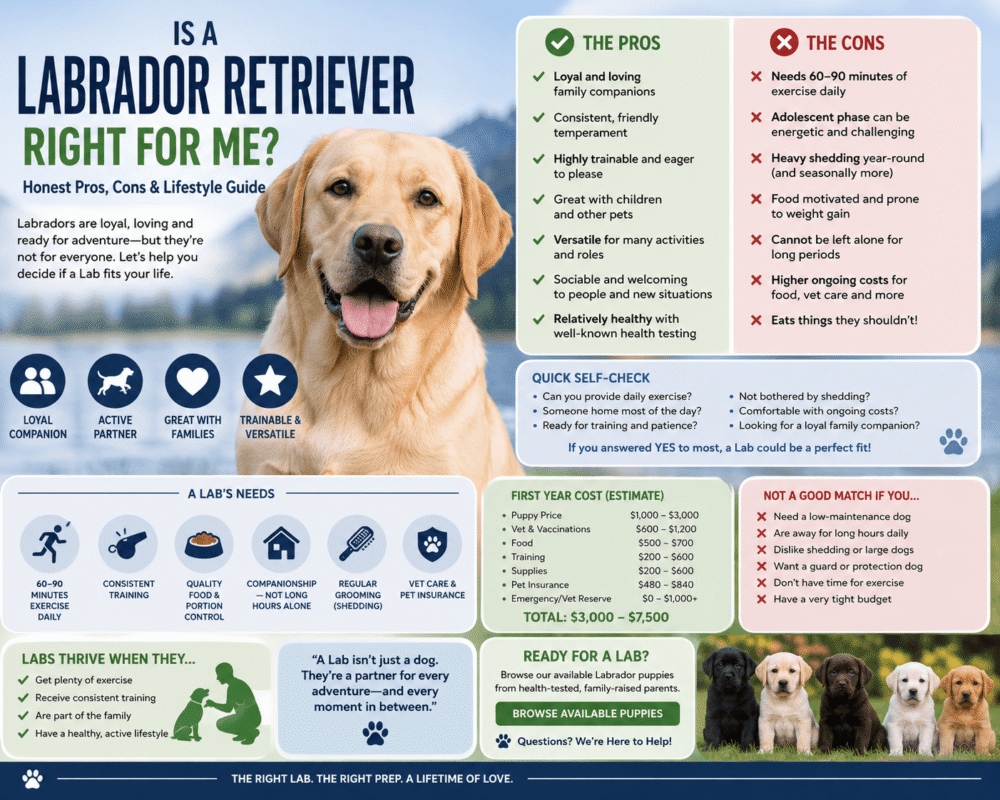
Who Should NOT Get a Labrador Retriever
This section is worth reading carefully. Not because Labs are difficult dogs — they are not — but because the mismatch between a Lab’s actual needs and a buyer’s actual lifestyle is the most common source of problems in Lab ownership. If any of the following describes your household honestly, a different breed is worth considering.
People who want a guard dog. Labs greet strangers with enthusiasm rather than suspicion. Their default is warmth, not wariness. A Lab will alert bark occasionally — but as a deterrent or protection dog they are genuinely ineffective, and selecting one for this purpose will leave both the owner and the dog in a poor situation.
People who are away from home for 8 to 10 hours daily. This is the single most common lifestyle mismatch for Labs. A Lab that spends the majority of every day alone will develop behavioral problems — not because they are poorly trained but because they are a social breed experiencing chronic isolation. Dog walkers and daycare help, but they are not a complete substitute for the kind of company a Lab genuinely needs.
People who want a low-maintenance dog. Labs require daily exercise, consistent training through adolescence, portion-controlled feeding, weekly grooming, regular veterinary care, and active management of their tendency to eat things they should not. They are not high-maintenance compared to many breeds — but they are not self-sufficient either. A buyer expecting a dog that largely looks after itself will be disappointed.
People who strongly dislike pet hair. This sounds like a minor point until you have lived with a Lab for a week. The shedding is consistent, year-round, and biannually dramatic. It gets into everything — upholstery, clothing, food, car interiors. If this is genuinely something you cannot tolerate, a low-shedding breed is a more honest choice than hoping the brushing will manage it fully. It will not.
People wanting a calm puppy from week one. Lab puppies are not calm. They are enthusiastic, mouthy, energetic, and in possession of very sharp teeth. The calm, settled adult Lab that most buyers are picturing is a 2 to 3 year old dog — not an 8-week-old puppy and certainly not a 10-month-old adolescent. If your lifestyle requires a settled, low-impact dog from the start, a rescue adult Lab or a lower-energy breed is worth considering over a puppy.
Very low-energy or elderly households without active support. Labs can be wonderful companions for older owners — but only with a realistic plan for meeting their exercise needs. A retired owner who walks 60 to 90 minutes daily and has family support for the more demanding periods is a good Lab match. An elderly owner without the physical capacity to meet a Lab’s exercise requirement, and without support systems in place, is setting both themselves and the dog up for frustration. A lower-energy breed, or an older rescue Lab, is a more honest starting point for that household.
People with very limited budgets. The first year of Lab ownership costs $3,000 to $7,500. Ongoing annual costs run $1,500 to $3,000. An unexpected orthopedic or emergency event can add $3,000 to $7,000 without pet insurance. A Lab is not the right dog for a household where these costs would create genuine financial hardship — not because Labs are not worth it, but because a dog whose veterinary needs cannot be met is a dog who will suffer.
Lifestyle Fit – Quick Comparison
| Lifestyle | Good Fit? | Note |
|---|---|---|
| Apartment with genuinely active owner | ✅ Yes | Exercise commitment is what matters, not square footage |
| House with garden but inactive owner | ❌ No | A garden is not exercise — a Lab needs structured daily activity |
| Family with children of any age | ✅ Yes | One of the most reliably family-safe large breeds available |
| First-time dog owner | ✅ Yes — with preparation | Show or companion-line Labs are forgiving; adolescence requires realistic expectations |
| Full-time worker away 8 to 10 hours daily | ❌ No — without solutions | Dog walker, daycare, or companion dog needed to make this work |
| Active outdoor household — hiking, hunting, sport | ✅ Excellent | Labs are outstanding outdoor companions across all these activities |
| Elderly owner with active lifestyle and support | ✅ Possibly | An adult rescue Lab may be a better fit than a puppy for this household |
| Person who strongly dislikes pet hair | ❌ No | Labs shed year-round — this will not change with grooming management |
| Household wanting a guard or protection dog | ❌ No | Labs are sociable and trusting — not a deterrent or protection breed |
Is a Labrador Retriever Right for Me? – The Honest Self-Assessment
| A Lab Is Likely Right for You If… | A Lab Is Probably Not Right for You If… |
|---|---|
| You can commit to 60 to 90 minutes of genuine daily exercise | Your realistic daily schedule allows only short walks or garden access |
| Someone is home for most of the day, or robust dog care is in place | Your household is empty for 8 to 10 hours daily with no alternative arrangement |
| You have children and want a patient, reliable family dog | You want a low-shedding dog — Labs shed significantly year-round |
| You are willing to invest in training consistently during the first two years | You want a calm, settled dog from week one — adolescence requires patience and time |
| You want a loyal, people-oriented companion who integrates into family life | You want a dog that is content with minimal human interaction or long periods alone |
| You can manage portion discipline and keep the dog lean throughout life | Your budget does not have room for $1,500 to $3,000 in ongoing annual ownership costs |
| You want a versatile dog for outdoor activities, hunting, or dog sports | You have strong feelings about pet hair on furniture, clothing, and floors |
| You are prepared for the full 10 to 14 year commitment financially and emotionally | You want a guard dog or a breed with natural wariness of strangers |
Labs and Specific Living Situations
Apartments and smaller homes. Labs can live in apartments — but only if the exercise commitment is genuinely met. A Lab in an apartment with two substantial daily walks and regular access to outdoor space for running is more settled than a Lab in a house with a garden who gets minimal structured exercise. The apartment is not the problem; insufficient exercise is. If your apartment lifestyle realistically supports 60 to 90 minutes of daily active exercise, a Lab can work. If it does not, a different breed is a more honest choice.
First-time dog owners. Labs — particularly females from English show or companion lines — are among the most recommended breeds for first-time owners. Their forgiving nature with training mistakes, consistent temperament, and high motivation to please make the learning curve of first-time dog ownership more manageable than with reactive, independent, or high-drive breeds. The caveat is the adolescent phase — first-time owners who are not prepared for it find it significantly harder than experienced owners. Read our guide on the best Labrador for first-time owners for the recommended combination.
Families with toddlers. English Cream or show-line Yellow Labs are the most consistently recommended choice for families with very young children — their earlier maturity and lower boisterousness during adolescence makes the combination significantly more manageable than a field-line Lab with a 2-year-old in the house. Supervision between any dog and toddlers is always required regardless of breed.
Active outdoor households. Labs are outstanding dogs for active households — hiking, swimming, camping, hunting, and dog sports all align naturally with their physical capability and drive. Field-line Labs have the highest drive and endurance for demanding outdoor use. Companion-line Labs are enthusiastic outdoor partners without the intensity that makes field dogs challenging in a home environment.
Households with other pets. Labs are generally excellent with other dogs and manageable with cats when properly introduced. Their social tolerance is one of their most consistent characteristics. Read our guide on Labs and other pets for introduction guidance by species.
What No One Tells You Before Getting a Lab
The gap between the Lab people imagine and the Lab they actually get is one of the most consistent themes in Lab rescue — and it almost always comes down to the same few surprises. The adolescent phase is longer and more demanding than buyers expect. The exercise requirement is higher than buyers expect. The shedding is more than buyers expect. And the emotional need — the way a Lab genuinely needs to be with people rather than simply tolerating them — is something many buyers discover only after bringing one home.
None of these things are reasons not to get a Lab. They are reasons to go in with accurate expectations. A Lab owner who knew exactly what they were signing up for and chose it anyway is a Lab owner who will love the breed unconditionally for the full decade-plus of their dog’s life. A Lab owner who was surprised by these things is a Lab owner who may find themselves in a difficult situation during the adolescent phase with fewer resources than they need to navigate it.
The best preparation is honest information — which is what this guide is for. If after reading it a Lab still sounds like the right dog for your household, the odds are good that it is. If some of the cons gave you pause, that pause is worth taking seriously before you commit to a 10 to 14 year relationship with a large, energetic, deeply social dog.
Browse Our Available Lab Puppies
If you have read this guide and a Lab sounds right for your household, we would love to help you find the right puppy. Every puppy from Labrador Today comes from OFA health-tested parents, is raised in a family home environment from birth, and is matched with buyers who understand what Lab ownership actually involves.
- Black Lab Puppies
- Yellow Lab Puppies
- Chocolate Lab Puppies
- White English Cream Lab Puppies
- Silver Lab Puppies
- Red Fox Lab Puppies
For further reading before you decide:
- Best Labrador for First-Time Owners
- Which Color Lab Is the Calmest?
- Male vs Female Labrador
- English Lab vs American Lab
- How to Choose a Labrador Breeder
- Average Cost of a Labrador Puppy
- First Year Cost of Owning a Labrador
👉 Browse All Available Puppies
👉 Contact Us With Any Questions Before You Decide
Frequently Asked Questions
Is a Labrador Retriever a good dog for a first-time owner?
Yes — with the right expectations. Labs from show or companion lines are among the most forgiving breeds for first-time owners. Their consistent temperament, high trainability, and people-orientation makes the learning curve of first dog ownership more manageable than with reactive or independent breeds. The honest caveat is the adolescent phase between 6 and 18 months — first-time owners who are not prepared for the energy, mouthiness, and selective hearing of a Lab adolescent find it harder than experienced owners. Preparation makes the difference. Read our guide on the best Labrador for first-time owners.
Are Labrador Retrievers good apartment dogs?
Labs can live comfortably in apartments if — and only if — the exercise commitment is genuinely met. A Lab in an apartment with two substantial daily walks and regular off-leash running is more settled than a Lab in a house with a garden who gets minimal structured exercise. The apartment is not the limiting factor; insufficient exercise is. If your apartment lifestyle can realistically accommodate 60 to 90 minutes of daily active exercise, a Lab can work well. If it cannot, a lower-energy breed is a more honest choice.
How much exercise does a Labrador need every day?
An adult Labrador Retriever needs 60 to 90 minutes of genuine daily exercise — not garden access or brief walks, but sustained activity. Swimming, retrieving, running, and structured walks all count. An under-exercised Lab channels that unspent energy into destructive behaviour — chewing, counter-surfing, digging, and restlessness — that is almost always a symptom of insufficient exercise rather than a behavioral problem in its own right. Read our full guide on Labrador exercise needs by age.
Are Labs good with children?
Yes — Labs are consistently cited among the most reliably safe large breeds for children of all ages. Their patience with toddlers, enthusiasm with older children, and gentle default temperament make them outstanding family dogs. English Cream or show-line Yellow Labs are the most consistently recommended for families with very young children due to their earlier maturity and calmer adolescent phase. Supervision between any dog and toddlers is always required regardless of breed.
Do Labrador Retrievers do well alone?
Not for extended periods. Labs are highly social dogs that bond deeply with their families and can develop separation anxiety when left alone for long stretches regularly. A Lab that is alone for 8 to 10 hours daily without alternative social contact will not thrive — and the behavioral consequences of chronic isolation are significantly harder to address than to prevent. If your household is empty for long periods daily, robust solutions need to be in place — a dog walker, daycare, or a companion dog — before bringing a Lab home.
Do Labs have a favorite person?
Labs form deep bonds with their entire family rather than attaching exclusively to one person — but they do tend to show a preference for the person who feeds them, trains them, and spends the most consistent time with them. This is not the single-person devotion of a breed like the Greyhound or Shiba Inu. A Lab will genuinely love every member of the household — while quietly noting who gives the best treats.
What is the 5 minute rule for Labradors?
The 5 minute rule is a puppy exercise guideline — 5 minutes of structured exercise per month of age, twice daily, until skeletal maturity at around 12 to 18 months. An 8-week-old puppy gets 10 minutes twice daily. A 6-month-old gets 30 minutes twice daily. This protects developing growth plates from the repetitive impact that can contribute to joint problems in large breeds. Free play in the garden does not count — the rule applies to structured walking and running on hard surfaces. Read our full guide on Labrador exercise needs by age.
Can Labradors be left alone for 4 hours?
Most adult Labs can manage 4 hours alone without significant distress — 4 hours is within the range that a well-settled adult Lab can handle with adequate exercise beforehand. The problems begin at 6 to 8 hours and become serious at 8 to 10 hours daily on a consistent basis. Puppies under 6 months should not be left alone for more than 2 hours at a time — their bladder control and emotional regulation are not developed enough to handle longer periods. A dog walker or midday check-in makes a significant difference for households where 4 to 6 hours alone is unavoidable.
What is the leading cause of death in Labradors?
Cancer is the leading cause of death in Labs over 10 years of age — as in most dog breeds at that life stage. Musculoskeletal disorders and age-related organ failure are the next most common. Labs that maintain a lean weight throughout life, receive regular veterinary care, and come from health-tested parents consistently reach the longer end of the 10 to 14 year lifespan range. Read our full guide on how long Labrador Retrievers live and our guide on common Labrador health problems.
Are Labradors happier in pairs?
Many Labs thrive with a companion dog — particularly households where the owners are away during the day. A second dog provides social engagement, reduces separation anxiety, and gives the Lab an outlet for play and interaction during hours when humans are not available. That said, a second dog is not a substitute for human attention and exercise — and adding a second Lab to a household that is struggling with one is not a reliable solution. If your Lab is well-exercised and settled, a companion dog can genuinely improve their quality of life. If your Lab is under-exercised and anxious, the second dog inherits the same problems.
Are Labs more aggressive than Pitbulls?
No — Labrador Retrievers are consistently among the least aggressive dog breeds in temperament assessments. Labs score exceptionally well on the American Temperament Test Society’s evaluations — among the highest pass rates of any breed. Pitbull-type dogs also score well on temperament tests when properly socialized and from responsible breeding programs, but Labs have a longer and more consistent track record specifically as family dogs in a wide range of household situations. Unprovoked aggression is genuinely rare in Labs from quality breeding programs.
The three most consistently reported challenges by Lab owners are: the adolescent phase (6 to 18 months of high energy, mouthiness, and selective training retention), the daily exercise requirement (60 to 90 minutes — non-negotiable for a settled indoor Lab), and the shedding (year-round moderate shedding with two heavy seasonal blowouts). None of these are reasons not to get a Lab — but all three consistently surprise owners who went in without accurate expectations.
