
English Lab vs American Lab is a comparison that confuses a lot of buyers — mostly because neither term appears in the AKC breed standard. They are both Labrador Retrievers. Same breed, same registration, same fundamental temperament profile. But the differences between a well-bred English-type Lab and a well-bred American-type Lab are real enough that they genuinely affect which one you should bring home.
This guide covers everything you need to make the right call — build, temperament, energy, trainability, health, price, and how to identify which type you are actually buying. Browse our available Lab puppies from both English and American lines once you have made your decision.
- English Lab vs American Lab – The Key Distinction
- English Lab vs American Lab – Quick Comparison
- How They Look – English Lab vs American Lab Build
- Temperament – English Lab vs American Lab
- Trainability – Which Is Easier to Train?
- Health – English Lab vs American Lab
- Price – English Lab vs American Lab
- Color and Type — How They Relate
- How to Tell Which Type You Are Buying
- Which Should You Choose?
- Mixed-Type Labs — What About In Between?
- Our Available English and American Line Labs
- Frequently Asked Questions
English Lab vs American Lab – The Key Distinction
The split comes down to what breeders selected for over decades of separate development:
| Factor | English-Type Lab (Show Lines) | American-Type Lab (Field Lines) |
|---|---|---|
| Primary breeding purpose | Conformation showing — structure, appearance, and even temperament for the show ring | Hunting and field work — drive, athleticism, and stamina to work all day in the field |
| Geographic origin | British and European show lines — UK Kennel Club conformation standards | American field and hunting lines — AKC field trial and hunting retriever programs |
| AKC registration | Registered as Labrador Retriever — same breed standard applies | Registered as Labrador Retriever — same breed standard applies |
| Common alternate names | English Lab, English Cream Lab (if pale yellow), Show Lab, European Lab, British Lab | American Lab, Field Lab, Working Lab, Hunt Lab |
English Lab vs American Lab – Quick Comparison
| Trait | English-Type Lab | American-Type Lab |
|---|---|---|
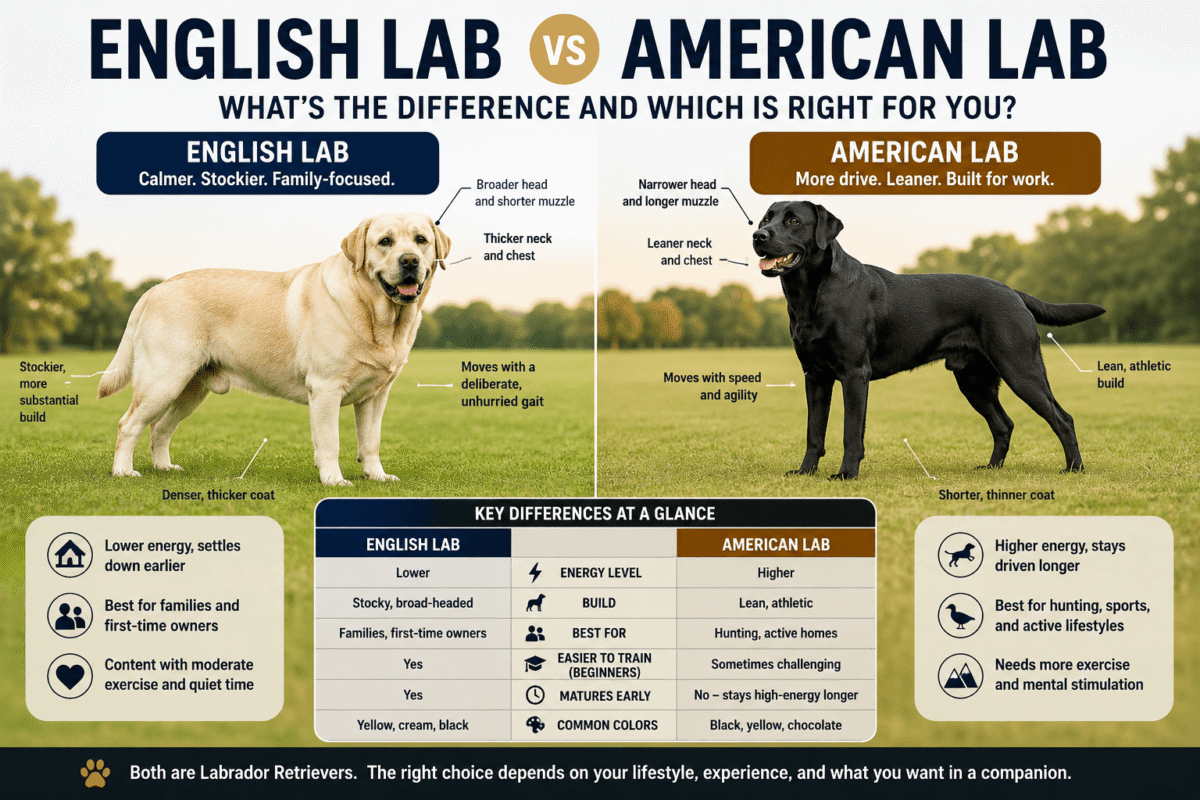
| Build | Stockier, broader head, shorter muzzle, barrel chest, heavier bone | Leaner, narrower head, longer muzzle, longer legs, more athletic frame |
| Weight | Often toward the heavier end of breed standard — males 75–90 lbs common | Typically within or below standard — males 65–80 lbs |
| Energy level | Lower — more settled indoors, content after moderate daily exercise | Higher — needs significant daily exercise and mental stimulation |
| Maturity | Earlier — most settle into calm adult temperament by 18 months to 2 years | Slower — some field-line Labs stay in high-energy adolescent phase until 3 years |
| Temperament | Gentle, calm, patient — excellent default indoor temperament | Driven, alert, enthusiastic — excellent working temperament |
| Trainability — basic obedience | Easier for beginners — less distracted, settles into routines faster | More easily distracted early on — drive is an asset once channeled |
| Trainability — advanced work | Fully capable — but lower natural drive means less raw material for demanding field work | More natural aptitude for demanding retrieving, scent work, and field trial tasks |
| Best for | Families, first-time owners, apartment dwellers, therapy and emotional support roles | Hunters, field trial competitors, active outdoor families, experienced dog owners |
| Common coat colors | Yellow, English Cream, black — Chocolate less common in show lines | Black most common, Yellow, Chocolate — all three AKC recognized colors |
| Price range | $1,500 – $3,000 from reputable breeders — English Cream lines at higher end | $1,000 – $2,500 — field champion bloodlines at higher end |
How They Look – English Lab vs American Lab Build
This is usually the easiest way to tell them apart at a glance:
| Physical Feature | English-Type Lab | American-Type Lab |
|---|---|---|
| Head | Broad, blocky, pronounced stop between forehead and muzzle — the classic “blocky Lab” look most people picture | Narrower, more refined, longer muzzle — looks more like a working gun dog |
| Neck and chest | Thick neck, deep barrel chest — substantial and powerful appearance | Longer neck, deeper but narrower chest — more streamlined for speed and endurance |
| Body and legs | Shorter legs relative to body, sits lower to the ground, moves with deliberate gait | Longer legs, taller for their weight, moves with speed and agility |
| Coat | Dense, plush double coat — often thicker and more substantial than field-line Labs | Dense but less plush — functional rather than show-oriented |
| Overall impression | Substantial, powerful, gentle-looking — the dog most people picture when they think “Labrador” | Athletic, alert, driven-looking — clearly a working dog |
Temperament – English Lab vs American Lab
This is where the choice matters most for the majority of buyers:
| Temperament Factor | English-Type Lab | American-Type Lab |
|---|---|---|
| Indoor energy level | Lower baseline — English Labs settle more readily indoors and are content after moderate daily exercise. A bored English Lab is less destructive than a bored field-line Lab | Higher baseline — needs significantly more physical and mental exercise to settle indoors. An under-exercised field-line Lab will find its own entertainment |
| Adolescent phase | Shorter and more manageable — most English-type Labs settle into their adult temperament by 18 months to 2 years | Longer and more intense — field-line Labs can stay in an excitable, driven adolescent phase until 2.5 to 3 years |
| Reactivity to stimuli | Lower — English Labs are generally less reactive to environmental stimuli, other dogs, and distractions | Higher — field-line Labs are alert and responsive to movement, scent, and sound. This is a feature in hunting; a challenge in a family home |
| Affection and people orientation | Both types are deeply people-oriented and affectionate — this is a breed-wide characteristic not a type-specific one | Both types are equally devoted to their families — the difference is energy level and drive, not loyalty or affection |
| With children | Both types are excellent with children. English Labs are slightly more physically manageable during adolescence due to lower energy and earlier maturity | Outstanding with children once mature — the extended adolescent energy is the main management challenge in young families |
Trainability – Which Is Easier to Train?
| Training Scenario | English-Type Lab | American-Type Lab |
|---|---|---|
| Basic obedience — first-time owner | Easier — lower drive means less distraction during training sessions. Settles into routines faster and responds more consistently to basic commands in the first year | More challenging early on — drive and reactivity can make it harder to maintain focus in early training. Consistency and exercise management are essential |
| Advanced field and hunt work | Capable but lacks the natural drive that makes field work intuitive — can be trained for hunting but requires more motivation than a field-line Lab | More natural aptitude — the drive that makes early training challenging is exactly what makes field Labs outstanding hunting and retrieving dogs once channeled |
| Therapy and service dog work | Excellent — lower reactivity, earlier maturity, and calm temperament make English-type Labs highly suitable for therapy, emotional support, and service dog programs | Capable but the higher drive requires more management in low-stimulation therapy environments |
| Dog sports — agility, scent work, dock diving | Capable and willing — lower natural drive may limit ceiling in competitive dog sports | Outstanding — field-line Labs have the drive, athleticism, and focus for competitive dog sport performance |
| Response to positive reinforcement | Both types respond exceptionally well to food-based positive reinforcement from 8 weeks — no meaningful difference in reinforcement sensitivity between the two types | Both types are equally food motivated and responsive to positive reinforcement — the difference is in distraction management, not responsiveness |
Health – English Lab vs American Lab
Both types share the same breed-wide health concerns. The Orthopedic Foundation for Animals (OFA) tracks health data across the breed regardless of type — always verify OFA clearances for both parent dogs before purchasing:
| Health Factor | English-Type Lab | American-Type Lab |
|---|---|---|
| Hip and elbow dysplasia | Both types are affected — OFA or PennHIP hip evaluation and OFA elbow evaluation required for both parent dogs regardless of type | Both types are affected equally — health testing the parents is the most important step regardless of type |
| Obesity risk | Higher risk — English Labs’ lower activity level combined with the Lab’s characteristic love of food makes obesity a serious concern if feeding is not measured and managed | Lower risk of obesity — higher natural activity level keeps field-line Labs leaner. But Labs of any type will overeat if given the opportunity |
| Joint injuries | Lower risk from athletic activity — English Labs’ more moderate exercise level reduces acute joint injury risk | Higher risk from field work — Labs pushed hard in hunting before skeletal maturity is reached are at higher risk of joint injury and long-term joint problems |
| Exercise-Induced Collapse (EIC) | Less relevant clinically — English Labs rarely engage in the sustained high-intensity exercise that triggers EIC events | More relevant — field-line Labs used in sustained high-intensity hunting and field trial conditions can be affected. EIC DNA testing is important for field-line breeding stock |
| Lifespan | 10 to 14 years — no meaningful type-based lifespan difference in Labs | 10 to 14 years — no meaningful type-based lifespan difference |
Price – English Lab vs American Lab
| Source | English-Type Lab | American-Type Lab |
|---|---|---|
| Reputable breeder — companion lines | $1,500 – $2,500 — English Cream and show-line Labs command a premium due to high demand | $1,000 – $1,800 — standard companion-line American-type Labs are typically priced lower than English show lines |
| Specialty or imported lines | $2,500 – $4,000+ for imported European bloodlines or documented show champion lineage | $1,500 – $2,500+ for field champion or hunt test titled bloodlines |
| Why the English premium exists | High consumer demand — particularly for English Cream — combined with limited availability of genuinely English-type breeding programs drives prices upward | More breeders producing American-type Labs historically — more supply keeps base prices lower than English show lines |
For a full breakdown of what drives Lab pricing at all levels, read our guide on the average cost of a Labrador puppy.
Color and Type — How They Relate
Color and type are not the same thing — but they often correlate in practice:
| Color | Most Common Type Association | What It Means |
|---|---|---|
| English Cream / White | English show lines — almost exclusively | The pale ivory coat is a product of English and European show breeding — if you see “English Cream” it is almost certainly English-type regardless of the breeder’s location |
| Yellow | Both types — varies by breeder | Yellow Labs exist in both English show lines and American companion lines — the type depends on the breeding program, not the color alone |
| Black | American field lines — most common — but also in English show lines | The most common field-trial and hunting dog color is Black — but English-type breeders also produce excellent Black Labs from show lines |
| Chocolate | Both types — less common in show lines | Chocolate Labs appear in both types but are less prevalent in English show breeding programs than in American companion and field lines |
How to Tell Which Type You Are Buying
Many breeders use the terms “English Lab” and “American Lab” loosely — or avoid them entirely. Here is how to assess which type a puppy actually is:
| What to Ask or Check | What to Look For |
|---|---|
| Photos of both parent dogs | English-type: broad blocky head, substantial build, lower-set body. American-type: narrower head, longer legs, more athletic frame. A photo of both parents tells you more than any description |
| Registered names and pedigree | UK Kennel Club registered ancestors or imported European dogs in the pedigree strongly suggest English-type lines. AKC field champion or Master Hunter titled ancestors indicate American field lines |
| Ask the breeder directly | Ask whether the breeding program selects primarily for conformation and temperament (English-type) or hunting drive and athleticism (American-type) — reputable breeders will answer clearly |
| What the breeder’s previous litters are doing | Ask where previous puppies went — if most went to hunters and field trial homes, the line is likely American-type. If most went to families and therapy dog programs, likely English-type |
| Energy level of the dam (mother) | The dam’s energy level and build during your visit or video call is one of the most reliable indicators of what her puppies will grow into |
Which Should You Choose?
| Choose an English-Type Lab If… | Choose an American-Type Lab If… |
|---|---|
| You are a first-time dog owner | You hunt or want a working gun dog |
| You have young children or toddlers | You have an active outdoor lifestyle and want a dog to match |
| You live in an apartment or smaller home | You want a dog for competitive field trials, agility, or scent work |
| You want a calmer dog that settles earlier | You are an experienced dog owner comfortable with higher drive |
| You want a therapy or emotional support dog | You have significant outdoor space and an active daily routine |
| You specifically want an English Cream coat | You want maximum athletic endurance for demanding outdoor activity |
Mixed-Type Labs — What About In Between?
Many Labs in the US fall between these two poles — companion-line Labs from American breeding programs that were not selected specifically for hunting drive but also not for show ring conformation. These are often the most practical family dogs available — moderate energy, good temperament, AKC registered, health tested — without the extremes of either type.
If you are not hunting and do not specifically want the blocky English build or the pale English Cream coat, a well-bred companion-line Lab from a health-tested American program often represents the best value and the most balanced family temperament available.
Our Available English and American Line Labs
- White English Cream Lab Puppies — English show lines
- Yellow Lab Puppies — English and companion lines available
- Black Lab Puppies — companion and field lines available
- Chocolate Lab Puppies — companion lines
- Silver Lab Puppies
- Red Fox Lab Puppies
Contact us to discuss which line best matches your lifestyle — we can advise on English vs American type based on your family situation, activity level, and what you want from your Lab day to day.
👉 Browse All Available Puppies
👉 Contact Us to Discuss Which Type Is Right for You
Frequently Asked Questions
What is the difference between an English Lab and an American Lab?
English Labs come from British and European show lines — stockier build, broader head, calmer temperament, lower energy, earlier maturity. American Labs come from field and hunting lines — leaner, more athletic, higher drive, longer adolescence. Both are the same AKC breed with the same registration. The difference is in what each breeding program selected for over decades of separate development.
Are English Labs calmer than American Labs?
Generally yes — particularly during adolescence. English Labs mature earlier and have a lower baseline energy level, making them easier to manage indoors and during training. American Labs stay in a higher energy, more driven phase longer — which suits hunters and active owners but can be challenging in a family home during years one and two.
Which Lab type is better for first-time owners?
English-type Labs. Their calmer temperament, earlier maturity, and lower drive makes the puppy and adolescent stages significantly more manageable for owners without prior experience. Read our full guide on the best Labrador for first-time owners.
Is an English Cream Lab the same as an English Lab?
Yes — with a clarification. English Cream refers to a pale ivory coat shade within the Yellow color classification. All English Cream Labs are English-type Labs from show or European lines. But English-type Labs also come in Black and occasionally Chocolate — not all English Labs are cream colored. The “English Cream” name describes both the color and the type simultaneously in common usage.
Do English Labs and American Labs have different health issues?
They share the same breed-wide health concerns — hip dysplasia, elbow dysplasia, eye conditions, and obesity risk. English Labs are more prone to weight gain due to their lower activity level. American Labs used in field work have a higher risk of joint injuries from high-intensity activity before skeletal maturity. Health testing both parent dogs — OFA or PennHIP hips, OFA elbows, CAER eyes, EIC DNA — is essential regardless of type.
Which is a better hunting dog — English Lab or American Lab?
American-type Labs from field lines are better hunting dogs by design. Their higher drive, athleticism, and natural retrieving intensity make them significantly more suited to serious waterfowl and upland hunting than English show-line Labs. English-type Labs can be trained for hunting but lack the natural drive that makes field-line Labs instinctive gun dogs.
How can I tell if a Lab puppy is English or American type?
Ask for photos of both parent dogs — build and head shape tell you more than any description. Ask the breeder whether the program selects for conformation and temperament or hunting drive. Look for UK Kennel Club ancestry in the pedigree for English-type confirmation. Assess the dam’s energy level and build during your video call — puppies will closely resemble their parents.
