

Understanding Labrador exercise needs by age is one of the most important things a Lab owner can get right — and one of the areas where well-intentioned owners most commonly make mistakes in both directions. Too little exercise produces a destructive, difficult-to-manage Lab. Too much exercise during puppyhood causes joint damage that shortens your dog’s active life significantly. Getting this right from the start protects both your dog’s health and your household’s sanity.
This guide covers exactly how much exercise a Lab needs at every life stage — from 8 weeks through senior years — including the types of exercise appropriate at each age, what to avoid, and the signs that tell you whether your Lab is getting too much or too little. Browse our available Lab puppies if you are still in the planning stage.
- Labrador Exercise Needs by Age – Quick Reference
- The 5-Minute Rule – Why It Matters for Lab Puppies
- Exercise by Age – Detailed Guide
- Signs Your Lab Is Getting Too Little Exercise
- Signs Your Lab Puppy Is Being Over-Exercised
- Exercise and Joint Health – What the Evidence Shows
- Exercise and Weight – The Lab Obesity Risk
- Our Available Lab Puppies
- Frequently Asked Questions
Labrador Exercise Needs by Age – Quick Reference
| Age | Daily Exercise | Best Type | Key Restriction |
|---|---|---|---|
| 8 to 12 weeks | 5 minutes per session — 2 to 3 sessions daily | Free play indoors and in safe garden — self-directed | No forced exercise — no stairs, jumping, or long walks |
| 3 to 4 months | 15 minutes per session — 2 to 3 sessions daily | Short leash walks, free garden play, gentle fetch on soft ground | No running on hard surfaces, no repetitive jumping |
| 4 to 6 months | 20 minutes per session — 2 sessions daily | Leash walks, free play, swimming — excellent low-impact option | No forced running, no jumping up or down from heights |
| 6 to 12 months | 30 minutes per session — 2 sessions daily | Longer walks, swimming, off-leash free run on soft ground | Still avoid sustained running, agility jumps, and repetitive high-impact activity |
| 12 to 18 months | 45 minutes per session — 2 sessions daily | Longer walks, jogging introduced gradually, swimming, fetch | Avoid intense sustained running until skeletal maturity is confirmed |
| 18 months to 7 years | 60 to 90 minutes daily — split into 2 sessions | Running, swimming, fetch, hiking, dog sports — full range | Monitor weight — Labs prone to obesity if exercise reduces without adjusting food intake |
| 7 years plus — senior | 30 to 60 minutes daily — adjusted to individual | Gentle walks, swimming — low impact preferred | Watch for joint stiffness after exercise — reduce intensity before reducing duration |
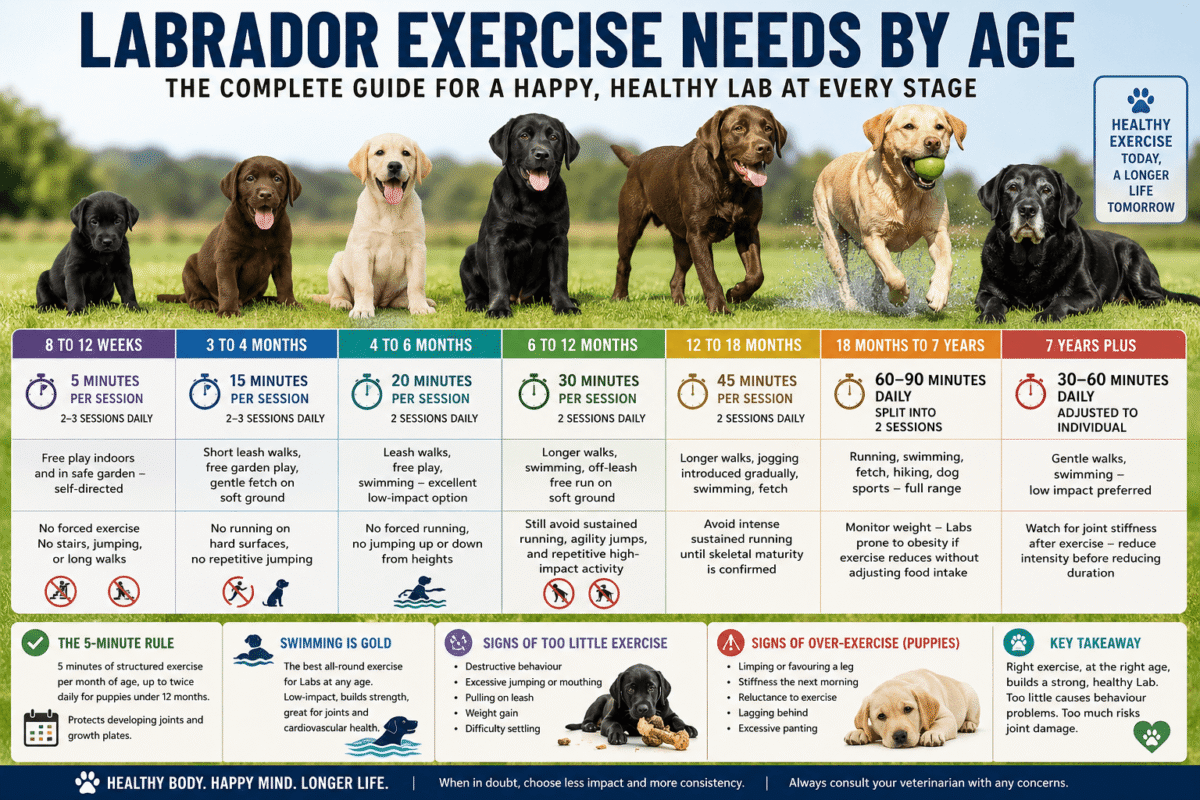
The 5-Minute Rule – Why It Matters for Lab Puppies
The 5-minute rule is the most widely used guideline for puppy exercise and the most commonly ignored by enthusiastic new Lab owners:
5 minutes of exercise per month of age, up to twice daily.
A 3-month-old Lab puppy should have no more than 15 minutes of structured exercise per session. A 4-month-old puppy no more than 20 minutes. This is not because young Labs do not want more — they absolutely do. It is because their skeletal system cannot safely absorb more.
| Why the 5-Minute Rule Exists | What Happens When It Is Ignored |
|---|---|
| Growth plates — the soft cartilage areas at the ends of long bones — remain open and vulnerable to damage until 12 to 18 months in Labs | Repeated impact on open growth plates causes micro-damage that can lead to permanent joint malformation — the same kind of damage that leads to early-onset hip and elbow dysplasia |
| Labs are large-breed dogs — their joints carry significant weight relative to the cartilage protecting them during growth | Over-exercise in a large-breed puppy has a cumulative effect — a little too much daily exercise over weeks adds up to real structural damage. The consequences often do not show until the dog is 4 to 6 years old |
| Puppy fatigue is not always obvious — Labs push themselves past safe limits because of their drive and people-pleasing nature | A puppy that appears fine during exercise and crashes afterward, limps the following morning, or shows reluctance to exercise on subsequent days has been over-exercised |
Exercise by Age – Detailed Guide
8 to 12 Weeks – The Foundation Phase
| Factor | Detail |
|---|---|
| Recommended exercise | 5 minutes per session — 2 to 3 times daily. Free, self-directed play in a safe garden or indoor space. The puppy sets the pace and stops when tired |
| Best types | Short play sessions with age-appropriate toys — gentle tug, chasing a ball short distances, exploring the garden at their own pace. Mental stimulation through brief training sessions counts as tiring exercise at this age |
| What to avoid | Forced walks on leash, stairs (carry the puppy up and down stairs until at least 3 months), jumping on or off furniture, repetitive fetch on hard surfaces, running alongside a bike or jogging owner |
| Vaccination note | Until the primary vaccination course is complete — typically by 12 to 16 weeks — limit outdoor exposure to safe, uncontaminated areas. Carry the puppy in public spaces where unvaccinated dogs may have been |
| Sleep needs | 16 to 18 hours per day — scheduled rest is as important as exercise at this age. An overtired puppy bites harder, struggles to train, and has more accidents indoors |
3 to 6 Months – Gradual Introduction
| Factor | Detail |
|---|---|
| Recommended exercise | 15 to 20 minutes per session — 2 sessions daily. The puppy is now vaccinated and can explore more freely — introduce short leash walks on soft surfaces |
| Best types | Short leash walks on grass or dirt paths, free play in a garden or safe off-leash area, gentle swimming where available. Swimming is an outstanding exercise option for Labs at this age — full body workout with minimal joint impact |
| Introducing fetch | Short, low-repetition fetch sessions on grass are fine at this age — keep throws short and the number of retrieves to 5 to 10. Stop well before the puppy shows fatigue. Avoid fetch on concrete or asphalt |
| What to avoid | Running on hard surfaces, jumping on or off anything elevated, repetitive stair climbing, sustained trotting or running alongside a bicycle, agility equipment with any jumping component |
| Signs of enough exercise | A puppy that settles readily after exercise, naps well, and is not destructively restless indoors is getting appropriate exercise. Destructive indoor behaviour at this age almost always signals under-exercise |
6 to 12 Months – Building Endurance Carefully
| Factor | Detail |
|---|---|
| Recommended exercise | 30 minutes per session — 2 sessions daily. The Lab is growing rapidly and energy levels are at their peak during this phase — adequate exercise is critical for household manageability |
| Best types | Longer leash walks on varied terrain, off-leash free running on soft ground, swimming, fetch sessions of moderate length, basic agility without jumping components, mental stimulation through training |
| Swimming | The ideal exercise for Labs at every age but particularly during the growth phase — swimming provides intense cardiovascular and muscular exercise with virtually no joint impact. Most Labs take to water naturally |
| What to avoid | Sustained running on hard surfaces — pavement, roads, concrete. Repetitive jumping — in and out of cars, on and off furniture, over obstacles. High-repetition fetch sessions that push the puppy past fatigue |
| Growth plate closure | Growth plates in Labs typically close between 12 and 18 months — until closure is confirmed, sustained high-impact exercise carries real risk. If you are unsure, your veterinarian can confirm closure with an X-ray |
12 to 18 Months – Approaching Full Exercise Capacity
| Factor | Detail |
|---|---|
| Recommended exercise | 45 minutes per session — 2 sessions daily. Most Labs are approaching but have not yet reached full skeletal maturity — gradually increasing exercise duration is appropriate but sustained high-impact running should still be introduced carefully |
| Introducing jogging | Short jogging intervals can be introduced on soft surfaces from 12 months — grass, trails, packed dirt. Keep initial running sessions short and build gradually over weeks. Avoid road running until after 18 months |
| Best types | Longer walks and hikes, swimming, fetch, off-leash runs on soft ground, jogging intervals introduced gradually, basic obedience and training sessions |
| Mental exercise | Labs in adolescence benefit enormously from mental stimulation alongside physical exercise — training sessions, scent games, puzzle feeders, and enrichment activities all contribute to a calmer, more settled dog indoors |
18 Months to 7 Years – Full Exercise Capacity
This is the prime exercise window for Labs — once growth plates close and skeletal maturity is reached, the full range of exercise becomes available:
| Exercise Type | Suitability for Adult Labs |
|---|---|
| Daily walks — 30 to 60 minutes | ✅ Excellent — the foundation of adult Lab exercise. Two walks daily is the minimum for most adult Labs |
| Running and jogging | ✅ Excellent — Labs make outstanding running partners. Build mileage gradually and monitor for any limping or stiffness after runs. Avoid running in extreme heat |
| Swimming | ✅ Excellent — the best all-round exercise for Labs at any age. Highly recommended for any Lab with a history of joint issues |
| Fetch and retrieving | ✅ Excellent — combines exercise with the retrieving instinct Labs were bred for. Monitor for overheating during sustained fetch sessions in warm weather |
| Hiking | ✅ Excellent — Labs thrive on trail hiking. Carry water for both of you on longer hikes and check paws after rocky terrain |
| Dog sports — agility, dock diving, field work | ✅ Excellent — Labs are highly capable in dog sports. Warm up before and cool down after any structured sport session |
| Cycling alongside | ✅ Good — can cycle with your Lab once fully mature. Start slowly and build distance. Avoid hot pavement and always allow the dog to set the sustainable pace |
7 Years Plus – Senior Lab Exercise
| Factor | Detail |
|---|---|
| Recommended exercise | 30 to 60 minutes daily — adjusted to the individual dog’s energy level and joint health. Many Labs remain highly active well into their senior years — do not assume a dog needs less exercise based on age alone |
| Best types | Gentle leash walks at a pace the dog sets comfortably, swimming (outstanding for arthritic joints — the buoyancy removes weight-bearing stress), light fetch, calm off-leash exploration |
| Reducing intensity before duration | When a senior Lab begins to slow down, reduce the intensity of exercise before reducing the duration — a 45-minute gentle walk is better than a 20-minute fast walk for joint health and mental wellbeing |
| Signs of joint discomfort | Stiffness after rest, reluctance to go up stairs, slowing on walks, sitting down mid-walk, or lameness after exercise — all warrant a veterinary conversation about joint support, pain management, and exercise modification |
| Mental stimulation matters more | As physical exercise reduces, mental stimulation becomes increasingly important for senior Labs — training sessions, scent games, and calm enrichment activities keep the mind engaged and reduce the cognitive decline that can accompany under-stimulation in older dogs |
| Swimming for arthritis | Hydrotherapy and swimming are among the most effective exercises for Labs with hip or elbow arthritis — maintaining muscle mass around the joints while eliminating the impact that aggravates them |
Signs Your Lab Is Getting Too Little Exercise
| Sign | What It Indicates |
|---|---|
| Destructive behaviour indoors — chewing furniture, raiding bins, destroying toys rapidly | The most common sign of under-exercise in Labs — an outlet is being found for energy that has nowhere else to go |
| Excessive jumping, mouthing, and boisterous behaviour in the house | A Lab with unspent energy cannot settle — the behaviour that feels like hyperactivity or disobedience is almost always a physical need |
| Pulling relentlessly on leash | A Lab that has had adequate exercise before a walk is significantly calmer and easier to manage on leash than one going out with a full tank of unspent energy |
| Weight gain | Labs are highly prone to obesity — insufficient exercise combined with even a slightly generous food portion creates rapid weight gain that compounds joint stress and reduces lifespan |
| Difficulty settling — restless, seeking attention, unable to relax | A genuinely tired Lab settles easily and sleeps contentedly. A restless Lab that cannot settle indoors has not had enough physical outlet |
Signs Your Lab Puppy Is Being Over-Exercised
| Sign | What to Do |
|---|---|
| Limping or favouring a leg during or after exercise | Stop exercise immediately — rest for 24 to 48 hours. If limping persists or recurs on resuming exercise, contact your veterinarian |
| Stiffness the morning after exercise | A puppy that is stiff getting up after a night’s rest following an exercise session has been over-exercised — reduce duration and intensity and monitor |
| Reluctance to exercise on subsequent days | A puppy that was enthusiastic about exercise yesterday but reluctant today is telling you the previous session was too much — rest and reduce going forward |
| Lagging behind, slowing, or sitting down mid-exercise | A puppy that begins an exercise session eagerly but slows significantly or sits down has hit their limit — end the session immediately and carry or walk home slowly |
| Excessive panting and inability to recover quickly | A puppy that takes more than 5 to 10 minutes to return to a normal respiratory rate after exercise has been pushed past their aerobic capacity — reduce intensity |
Exercise and Joint Health – What the Evidence Shows
Hip and elbow dysplasia are the most significant inherited health concerns in Labrador Retrievers. The Orthopedic Foundation for Animals (OFA) tracks joint health data across the breed — Labs consistently show significant rates of hip and elbow dysplasia. While genetics are the primary driver, exercise management during the growth phase is the most significant environmental factor owners can control:
| Joint Health Factor | What Owners Can Control |
|---|---|
| Impact exercise during growth | Following the 5-minute rule and avoiding high-impact exercise before growth plate closure is the most direct way owners can protect joint health during development |
| Weight management | Every extra kilogram of body weight increases the load on hip and elbow joints — maintaining a healthy weight throughout life is as important for joint health as exercise management |
| Surface selection | Grass, dirt, and sand are significantly lower impact than concrete and asphalt. For daily walks and puppy exercise, softer surfaces meaningfully reduce cumulative joint stress over months and years |
| Swimming as exercise | Swimming provides full cardiovascular and muscular benefit with virtually no joint loading — for Labs with known joint risk factors or family history of dysplasia, swimming-heavy exercise programs are worth considering from puppyhood |
| Health testing the parents | The most important joint health decision is choosing a puppy from parents with OFA-cleared hips and elbows — verifiable at ofa.org. Good genetics combined with responsible exercise management gives a Lab the best possible joint health outcome |
Exercise and Weight – The Lab Obesity Risk
Labs are among the most obesity-prone dog breeds in the world — a genetic tendency toward food motivation combined with a people-pleasing nature that accepts any food offered makes them uniquely vulnerable to overfeeding. Exercise and caloric management are inseparable:
- A Lab at healthy weight should have a visible waist when viewed from above and ribs that are easily felt but not visible
- If exercise reduces — due to weather, injury, or owner schedule — food intake must reduce proportionally
- Obesity in Labs accelerates joint deterioration, reduces exercise capacity, shortens lifespan, and increases surgical risk for any procedure
- The AKC breed standard puts adult Lab weight at 55 to 80 lbs depending on sex — Labs significantly above this range are almost always carrying excess weight
Our Available Lab Puppies
Every puppy from Labrador Today comes with a care guide covering appropriate exercise for the first months, feeding schedules, and full breeder support for any questions about exercise management as your Lab grows:
- Black Lab Puppies
- Yellow Lab Puppies
- Chocolate Lab Puppies
- White English Cream Lab Puppies
- Silver Lab Puppies
- Red Fox Lab Puppies
For further reading on Lab health, training, and care:
- How to Train a Labrador Puppy
- Labrador Puppy First Week Home
- Best Labrador for First-Time Owners
- Average Cost of a Labrador Puppy
👉 Browse All Available Puppies
👉 Contact Us With Any Questions About Lab Exercise and Health
Frequently Asked Questions
How much exercise does a Labrador need by age?
The general guideline is 5 minutes of structured exercise per month of age up to twice daily for puppies under 12 months — so a 3-month-old puppy needs 15 minutes per session, a 6-month-old 30 minutes. Adult Labs from 18 months need 60 to 90 minutes daily split into two sessions. Senior Labs need 30 to 60 minutes adjusted to their individual energy and joint health.
What is the 5-minute rule for Lab puppies?
The 5-minute rule means 5 minutes of structured exercise per month of age, up to twice daily. A 2-month-old puppy gets 10 minutes per session. A 4-month-old gets 20 minutes. This limit exists to protect open growth plates — the soft cartilage at the ends of long bones that remains vulnerable to impact damage until 12 to 18 months in Labs. Exceeding this guideline regularly risks permanent joint damage that may not show until the dog is 4 to 6 years old.
Can you over-exercise a Labrador puppy?
Yes — and it is one of the most common mistakes new Lab owners make. Labs push themselves past their safe limits because of their drive and eagerness to please. Signs of over-exercise include limping during or after activity, morning stiffness, reluctance to exercise on subsequent days, and sitting down or lagging mid-session. If any of these appear, rest for 24 to 48 hours and reduce exercise duration and intensity going forward.
What is the best exercise for a Labrador puppy?
Free, self-directed play on soft surfaces — grass, indoor carpet, soft dirt — is the safest and most appropriate exercise for young Lab puppies. Swimming is excellent at any age from 3 to 4 months onwards — it provides full cardiovascular and muscular exercise with virtually no joint impact. Short leash walks on grass are appropriate from 12 to 16 weeks after vaccination. Avoid hard surfaces, jumping, and sustained running until after 12 months.
How much exercise does an adult Labrador need?
A healthy adult Lab between 18 months and 7 years needs 60 to 90 minutes of active exercise daily — ideally split into two sessions. This is a minimum for most Labs — many highly active Labs thrive with more. An adult Lab that regularly gets less than 60 minutes of active exercise daily will almost always develop behavioural problems related to under-exercise — destructive behaviour, boisterousness indoors, and difficulty settling.
How do I exercise a senior Labrador?
Gentle daily walks at a pace the dog sets comfortably, swimming, and calm off-leash exploration are the best exercises for senior Labs. Reduce intensity before reducing duration — a 45-minute gentle walk is better for joint health and mental wellbeing than a shorter intense session. Watch for stiffness after rest, reluctance on stairs, or lameness after exercise — these warrant a veterinary conversation about joint support and exercise modification.
Does swimming count as exercise for Labs?
Yes — and it is arguably the best exercise available for Labs at any age. Swimming provides intense cardiovascular and full-body muscular exercise with virtually no joint loading. It is particularly valuable for puppies (where joint impact protection matters most), for Labs with known hip or elbow issues, and for seniors where impact exercise has become uncomfortable. Most Labs take to water naturally and enthusiastically.
