

The Labrador puppy first week home sets the foundation for everything that follows — the habits formed in the first seven days are the hardest to undo later, and the routines you establish now will shape your dog’s behaviour for the next 10 to 14 years. Most new owners focus on how exciting this week will be — and it is — but understanding what to expect and what to prioritize makes the difference between a smooth transition and a stressful one.
This guide covers exactly what happens in the first week, day by day, including the first night, housetraining, crate introduction, what is normal behaviour and what is not, and the foundation routines that experienced Lab owners start immediately. If you are still choosing your puppy, browse our available Lab puppies first.
- Before Your Puppy Arrives – Preparation Checklist
- Labrador Puppy First Week Home – Day 1 Arrival
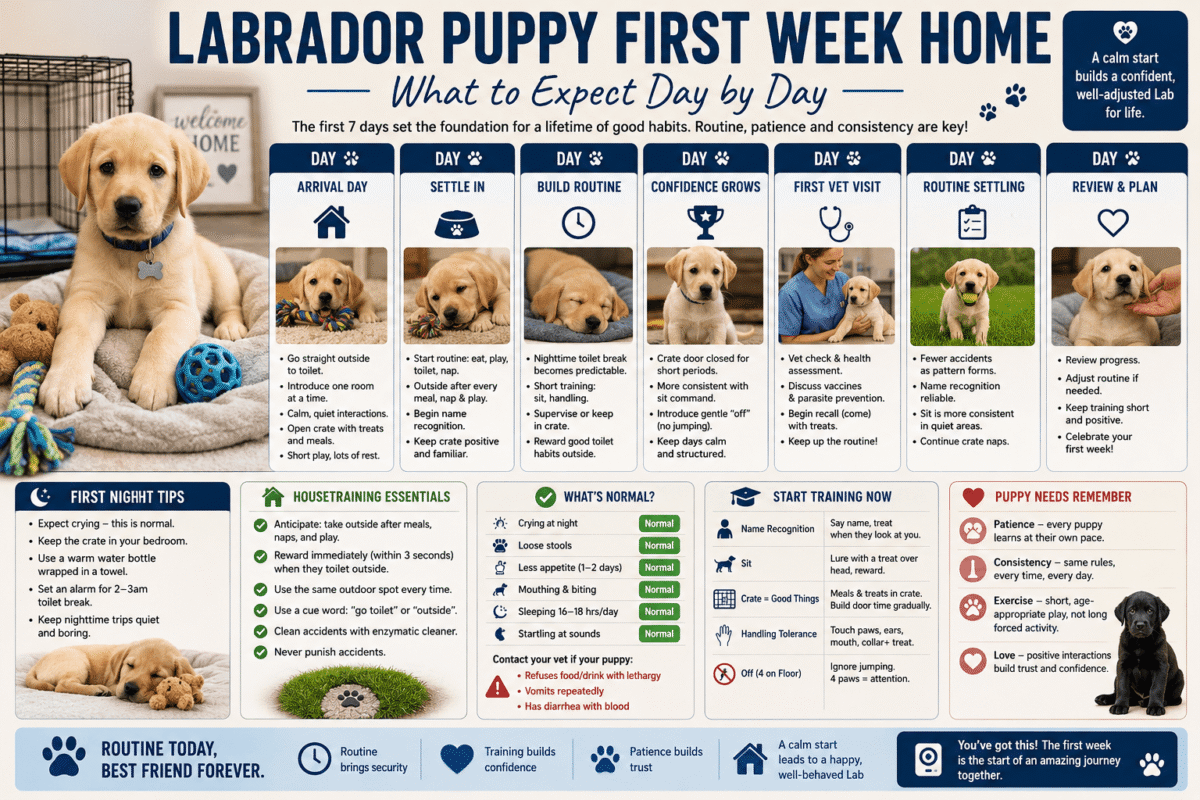
- The First Night – What to Expect and How to Handle It
- Days 2 to 4 – Establishing Routine
- Housetraining During the Labrador Puppy First Week Home
- Normal Puppy Behaviour in the First Week
- What to Start Training in the First Week
- Days 5 to 7 – Finding Your Rhythm
- Labrador Puppy First Week Home – Day by Day at a Glance
- What the Second Week Brings
- Our Available Lab Puppies
- Frequently Asked Questions
Before Your Puppy Arrives – Preparation Checklist
Your labrador puppy first week home goes significantly smoother when the house is ready before the puppy arrives:
| Item | Detail | Why It Matters |
|---|---|---|
| Crate — appropriately sized | Large enough for the adult dog to stand, turn, and lie flat. Use a divider to reduce size for a puppy — too much space allows toileting in one corner and sleeping in another | The single most useful tool for housetraining and safe management during the first months |
| Puppy-proofed area | Remove or secure anything at floor level — electrical cords, toxic plants, shoes, children’s toys, rugs you do not want chewed | Labs explore with their mouths — everything at floor level is fair game in the first weeks |
| Food — same brand as the breeder | Confirm the exact food the puppy has been eating and purchase it before arrival — most breeders provide a small sample to bridge the transition | Abrupt food changes cause digestive upset in puppies. Maintain the same food for at least two weeks before any transition |
| Water bowl and food bowl | Heavy ceramic or stainless steel bowls — Labs will carry and play with lightweight plastic bowls | Water available at all times. Food measured and scheduled — never free-fed |
| Collar and ID tag | Correctly fitted — two fingers should fit between the collar and the puppy’s neck | ID tag should be on the collar from day one in case of accidental escape |
| Leash | 4 to 6 foot standard leash — not a retractable leash for a puppy | Retractable leashes teach puppies to pull and make loose leash training significantly harder |
| Enzymatic cleaner | Nature’s Miracle or equivalent — specifically formulated to break down the proteins in pet urine | Standard household cleaners do not fully remove the scent that draws puppies back to the same spot |
| Veterinarian booked | First vet appointment booked within the first week of arrival — the AKC recommends establishing a veterinary relationship within the first few days of bringing a puppy home | Early vet check confirms health status, establishes the vaccination and parasite prevention schedule, and begins the vet relationship |
| Family rules agreed | Decide before the puppy arrives: furniture access, bedroom access, which rooms are off-limits, what words to use for commands | Inconsistency between family members is one of the leading causes of training confusion in the first months |
Labrador Puppy First Week Home – Day 1 Arrival
Arrival day is one of the most significant days of your puppy’s life — they have just been separated from their mother and littermates for the first time. The priority is calm, gentle transition — not excitement:
| Arrival Day Priority | What to Do | What to Avoid |
|---|---|---|
| First outdoor toilet stop | Take the puppy directly to the designated outdoor toilet area before bringing them inside — even if they do not go, the routine starts here | Do not take a detour through the house first — the toilet spot is the very first stop |
| Calm, controlled introductions | Introduce the puppy to the home environment gradually — one room at a time. Keep initial interactions calm and quiet | Do not overwhelm the puppy with a crowd of excited people on arrival day — large gatherings and noisy greetings cause stress in a puppy already adjusting to major change |
| Children and the puppy | Supervise every interaction between young children and the puppy from the first moment. Teach children to sit calmly on the floor and let the puppy come to them | Do not allow children to chase, pick up, or crowd the puppy — these interactions create fear associations in the first 24 hours that are hard to undo |
| Crate introduction | Put the puppy’s first meal inside the crate with the door open. Toss treats inside throughout the afternoon. Let the puppy enter and exit voluntarily — do not close the door yet | Do not push the puppy into the crate or close it before any positive association is established |
| Normal activity level | Keep the day calm — play in short sessions, followed by sleep. Puppies at 8 weeks sleep 16 to 18 hours per day and need frequent rest | Do not over-stimulate with long play sessions — an overtired puppy bites harder, regresses on toilet training, and struggles to settle |
The First Night – What to Expect and How to Handle It
The first night is the moment most new owners dread — and with good reason. A puppy that has slept in a warm pile of littermates every night of its life will be distressed alone in a crate for the first time. Here is what to expect and how to handle it:
| First Night Factor | What Actually Happens | What Helps |
|---|---|---|
| Crying and whining | Normal — and almost universal. The puppy is communicating distress about the loss of its littermates and a completely unfamiliar environment. This does not mean you have done something wrong | Place the crate in your bedroom — your presence and scent nearby significantly reduces distress. A warm, well-wrapped water bottle in the crate mimics the body warmth of littermates. A worn item of your clothing adds familiar scent |
| Midnight toilet break | An 8-week puppy cannot hold their bladder overnight — expect to take them outside once or twice between bedtime and morning. Set an alarm for 2am to 3am rather than waiting for crying | Take the puppy outside quietly and calmly — no play, no stimulation. Toilet, reward quietly, and return to the crate immediately. Keep the interaction as boring as possible so it does not become a reinforced reason to wake you |
| Early morning waking | Puppies wake early — 5am to 6am is common in the first weeks regardless of when they went to sleep. This gradually normalises as the puppy matures and bladder capacity increases | Consistent response — take outside for toilet immediately on waking, regardless of how early it is. The morning toilet routine is one of the most important consistency points in the first week |
| How long until nights improve | Most Labs significantly settle overnight by the end of the first or second week. By 10 to 12 weeks most puppies can make it through the night with one late-night toilet break. Full overnight holding typically arrives between 12 and 16 weeks | Consistency is the key variable — puppies who receive calm, immediate, unrewarding midnight toilet breaks settle faster than those who receive extended attention or are brought into the bed |
Days 2 to 4 – Establishing Routine
Routine is the most powerful tool during the labrador puppy first week home. A predictable daily schedule reduces anxiety, accelerates housetraining, and gives the puppy the structure that makes every other aspect of training easier:
| Time | Activity | Notes |
|---|---|---|
| First thing in the morning | Immediately outside for toilet — before anything else | This is the highest-probability accident moment of the day. Do not check your phone, make coffee, or let the puppy wander first |
| Morning meal | First meal of the day — measured portion, in or near the crate | Feed 3 times daily at 8 weeks — morning, midday, evening. Remove the bowl after 15 minutes whether or not it is finished |
| After every meal | Outside for toilet within 5 to 10 minutes of finishing eating | Eating stimulates digestion and reliably triggers the need to toilet — anticipate this every single time |
| Morning play and training | Short play session — 10 to 15 minutes. One 3 to 5 minute training session — name recognition, sit | Keep training sessions brief and positive — end on a success every time |
| Morning nap | Crate rest — 1 to 2 hours | Puppies at 8 weeks need 16 to 18 hours of sleep per day — scheduled nap time in the crate prevents overtiredness and helps crate acceptance |
| After every nap | Immediately outside for toilet | Waking from sleep is the second-highest probability accident moment — go outside before any play or interaction |
| Midday meal | Second meal — measured portion | Followed immediately by outdoor toilet opportunity |
| Afternoon play and training | Second short play session and training session | Vary the environment slightly — garden, different room, mild outdoor exposure if vaccinations allow |
| Afternoon nap | Crate rest — 1 to 2 hours | A rested puppy trains better, bites less, and settles more easily in the evening |
| Evening meal | Third meal — no later than 6pm if possible | Feeding earlier in the evening gives the puppy more time to digest and toilet before bedtime — reducing overnight accidents |
| Evening play | Calm play — avoid high stimulation in the hour before bedtime | An overtired, over-stimulated puppy takes longer to settle in the crate at bedtime |
| Bedtime toilet | Last outdoor toilet of the evening — immediately before crate for the night | This is the most important toilet opportunity of the day for reducing overnight accidents — do not skip it |
Housetraining During the Labrador Puppy First Week Home
| Housetraining Principle | Detail |
|---|---|
| The golden rule — anticipate, do not react | Preventing accidents is far more effective than responding to them. Take outside after every meal, every sleep, and every play session — before an accident can happen |
| Reward immediately and specifically | Bring treats outside. Reward within 3 seconds of the puppy finishing toileting outdoors — not when you get back inside. The immediacy of the reward is what creates the association |
| Supervise constantly or crate | If you are not actively watching the puppy, they should be in the crate. Unsupervised access to the house is how accidents happen and bad habits form in week one |
| Use the same outdoor spot every time | The scent of previous toileting triggers the behaviour — consistency with the location accelerates housetraining significantly in the first week |
| Use a consistent cue word | Say “go toilet” or “outside” in a calm, consistent tone when the puppy begins toileting outdoors — this eventually becomes a command that you can use to trigger toileting on cue |
| Clean accidents correctly | Use an enzymatic cleaner on every accident — standard household cleaners leave residual scent that draws puppies back to the same spot. Clean immediately and thoroughly |
| Never punish accidents | Punishment after the fact teaches the puppy to hide toileting from you — not to go outside. If you catch the puppy mid-accident, calmly interrupt and take outside immediately. Say nothing negative |
Normal Puppy Behaviour in the First Week
Understanding what is normal prevents unnecessary alarm — and helps you identify what actually requires attention:
| Behaviour | Normal or Concern? | What to Do |
|---|---|---|
| Crying and whining — especially at night | ✅ Normal — universal in the first week | Calm presence nearby, warm crate, consistent routine. This resolves within 1 to 2 weeks for most puppies |
| Loose stools | ✅ Normal — transition stress and food/water change commonly causes loose stools in week one | Maintain the same food as the breeder. If loose stools persist beyond 3 to 4 days or contain blood, contact your veterinarian |
| Reduced appetite on day one or two | ✅ Normal — stress of transition commonly reduces appetite briefly | Offer meals at scheduled times. If the puppy is not eating by day 3 or is lethargic, contact your veterinarian |
| Mouthing and biting everything | ✅ Normal — this is how puppies explore their world | Redirect to appropriate toys immediately. Never allow biting of hands or clothing — stop play and remove attention for 10 to 15 seconds every time |
| Sleeping 16 to 18 hours per day | ✅ Normal — puppies at 8 weeks sleep most of the day | Schedule naps — do not let the puppy become overtired from too much stimulation. A rested puppy learns faster and bites less |
| Startling at household sounds | ✅ Normal — the home environment is entirely new | Remain calm — your calm response tells the puppy the sound is not alarming. Do not coddle fearful reactions as this reinforces them |
| Not eating or drinking and lethargic | ⚠️ Concern — contact veterinarian | Lethargy combined with not eating or drinking beyond 24 hours warrants a veterinary call — do not wait |
| Vomiting repeatedly | ⚠️ Concern — contact veterinarian | One vomit can be stress-related — repeated vomiting within the first week requires veterinary attention |
| Diarrhoea with blood | ⚠️ Concern — contact veterinarian immediately | Bloody diarrhoea in a young puppy requires same-day veterinary attention |
What to Start Training in the First Week
| Training Focus | How to Do It in Week One |
|---|---|
| Name recognition | Say the puppy’s name in a happy tone — reward with a treat the instant they look at you. Repeat 10 to 20 times throughout the day. This is the foundation of all future training |
| Sit | Hold a treat at the puppy’s nose and slowly move it back over their head — their bottom naturally lowers. The moment it touches the floor say “Sit” and reward. 5 repetitions per session, 2 to 3 sessions per day |
| Crate as positive space | Feed every meal inside the crate. Toss treats inside throughout the day. Let the puppy enter and exit freely before closing the door. Build to closed-door sessions of 5 minutes, then 15, then 30 |
| Handling tolerance | Touch paws, ears, mouth, and collar daily — pair every touch with a treat. This is not training in the traditional sense but it is one of the most valuable things you can do in week one |
| Off — four paws on floor | When the puppy jumps up, immediately turn away and remove all attention. Four paws on the floor gets attention and a treat. The American Veterinary Society of Animal Behavior recommends positive reinforcement as the most effective and humane training approach for puppies. Start this from day one — jumping is charming at 8 weeks and a problem at 8 months |
Days 5 to 7 – Finding Your Rhythm
By the end of the first week most families begin to find their rhythm — the puppy starts anticipating the toilet routine, crate acceptance improves, and the overnight crying reduces. Here is what to focus on in the second half of week one:
| Focus Area | What to Assess and Build On |
|---|---|
| Toilet pattern | You should begin to notice a pattern to when your puppy needs to toilet — most puppies need to go within 10 to 20 minutes of eating, immediately on waking, and every 1 to 2 hours during active periods. Adjust your schedule to anticipate this pattern specifically |
| Crate progress | By day 5 most puppies will enter the crate voluntarily for meals and treats. Begin closing the door for short periods — 10 to 15 minutes — while you are in the room. Build to 30 minutes by the end of the week |
| First training responses | Name recognition should be reliable by the end of week one. Sit should be producing a consistent response in low-distraction environments. Celebrate these early successes — they are the building blocks of everything to come |
| Overnight improvement | Nights two through seven typically show gradual improvement — crying reduces, the midnight toilet break becomes more routine. If the puppy is still highly distressed by night four or five, review crate introduction and ensure the crate is positioned correctly in your bedroom |
| First vet visit | If not already done, the first vet appointment should happen within the first week. Confirm the vaccination schedule, discuss parasite prevention appropriate for your region, and register the puppy in the practice |
Labrador Puppy First Week Home – Day by Day at a Glance
| Day | Main Priority | Training Focus |
|---|---|---|
| Day 1 | Calm arrival, first toilet stop, gentle introduction to home and crate | Name recognition begins — crate as positive space |
| Day 2 | Establish toilet routine — outside after every meal, sleep, and play | Name recognition — sit introduction |
| Day 3 | Settle overnight routine — midnight toilet break becomes predictable | Sit — handling tolerance — Off |
| Day 4 | Maintain consistent daily schedule — nap times in crate becoming routine | Sit more reliable — crate door closed for short periods |
| Day 5 | First vet appointment if not already done | Begin leave it introduction — recall (come) introduction |
| Day 6 | Toilet pattern becoming more predictable — fewer indoor accidents | Name recognition reliable — sit reliable in low distraction |
| Day 7 | Review the week — what is working, what needs adjustment | Consistent short training sessions — crate accepted for naps |
What the Second Week Brings
Once the labrador puppy first week home is behind you, the second week builds on everything established. Most families notice:
- Overnight crying significantly reduces or stops entirely
- Toilet accidents become less frequent as the schedule becomes consistent
- The puppy begins to recognise their name reliably
- Sit becomes a consistent response in low-distraction environments
- Crate acceptance improves noticeably — the puppy may begin going in voluntarily
- The puppy starts to show their emerging personality more clearly
For a full week-by-week training guide through the first year, read our guide on how to train a Labrador puppy. For guidance on what to look for when choosing a breeder, read our guide on how to choose a Labrador breeder.
Our Available Lab Puppies
Every puppy from Labrador Today comes with a detailed care guide for the first week, a feeding schedule, and full breeder support — we are reachable with any question that comes up in the first days and weeks after your puppy arrives home.
- Black Lab Puppies
- Yellow Lab Puppies
- Chocolate Lab Puppies
- White English Cream Lab Puppies
- Silver Lab Puppies
- Red Fox Lab Puppies
👉 Browse All Available Puppies
👉 Contact Us With Any First Week Questions
Frequently Asked Questions
What should I expect the first week with a Labrador puppy?
Expect crying at night, frequent toilet accidents, high sleep needs, and a period of adjustment as the puppy settles into their new environment. The first week is about building routine, establishing the crate as a positive space, beginning housetraining, and starting name recognition and basic commands. It is often more demanding than new owners expect — but the foundations laid in week one make every subsequent week easier.
How do I handle my Lab puppy’s first night?
Place the crate in your bedroom so the puppy can sense your presence. Put a warm water bottle wrapped in a blanket inside to mimic littermate warmth. Set an alarm for 2am to 3am for a quiet, unrewarding toilet break — take the puppy out calmly, let them toilet, reward quietly, and return to the crate immediately. Expect crying — this is normal and resolves within one to two weeks for most Labs. Do not bring the puppy into your bed to stop the crying as this creates a habit that is very hard to break.
How often should an 8-week Lab puppy go outside for a toilet break?
Every 1 to 2 hours during waking hours — and immediately after every meal, sleep, and play session. An 8-week puppy has almost no voluntary bladder control and cannot hold for more than 2 hours while awake. Once outside for toilet, one midnight break is typically sufficient at 8 weeks — build to longer overnight intervals as the puppy matures.
Why is my Lab puppy not eating during the first week?
Reduced appetite on days one and two is very common — the stress of leaving the litter and arriving in an unfamiliar environment temporarily suppresses appetite in many puppies. Offer meals at scheduled times and remove the bowl after 15 minutes. If the puppy has not eaten meaningfully by day 3, is lethargic, or has vomiting alongside the reduced appetite, contact your veterinarian.
Should I let my Lab puppy cry in the crate at night?
A balanced approach works best. Your presence nearby in the bedroom significantly reduces distress — the crate does not need to be in another room. During the night, respond to crying by checking if the puppy needs a toilet break — if they have recently been out and toileted, a calm verbal reassurance without taking them out is appropriate. Avoid taking the puppy out of the crate in response to crying unless a toilet break is genuinely needed — this teaches the puppy that crying produces release from the crate.
When will my Lab puppy sleep through the night?
Most Labs sleep through the night — or close to it — by 10 to 12 weeks with consistent routine. Full overnight holding without a midnight break typically arrives between 12 and 16 weeks. The most important factors are consistent routine, crate positioned in your bedroom, last toilet break immediately before bed, and feeding the last meal no later than 6pm to allow digestion before overnight.
