

Male vs female Labrador is one of the most common questions buyers ask before reserving a puppy — and one of the most consistently misunderstood. Most buyers arrive with a strong preference formed by something they heard rather than how Labs actually behave. The honest answer is that sex matters less than breeding line, socialization, and individual temperament. But there are real differences worth knowing before you decide — and for some households, those differences genuinely matter.
This guide covers everything you need to make the right call — size, temperament, trainability, health, behavior with other dogs, hunting suitability, and what the evidence actually supports versus what is commonly repeated myth. Browse our currently available male and female Labrador puppies across all six color variations once you have made your decision.
- Male vs Female Labrador – Quick Comparison
- Size and Build – Male vs Female Labrador
- Temperament – Male vs Female Labrador
- Training – Is a Male or Female Lab Easier to Train?
- Male vs Female Lab with Children
- Male vs Female Lab with Other Dogs
- Male vs Female Lab for Hunting
- Health Differences – Male vs Female Labrador
- Does Lab Color Affect the Male vs Female Decision?
- Which Should You Choose – Male or Female Lab?
- Available Male and Female Lab Puppies
- Frequently Asked Questions
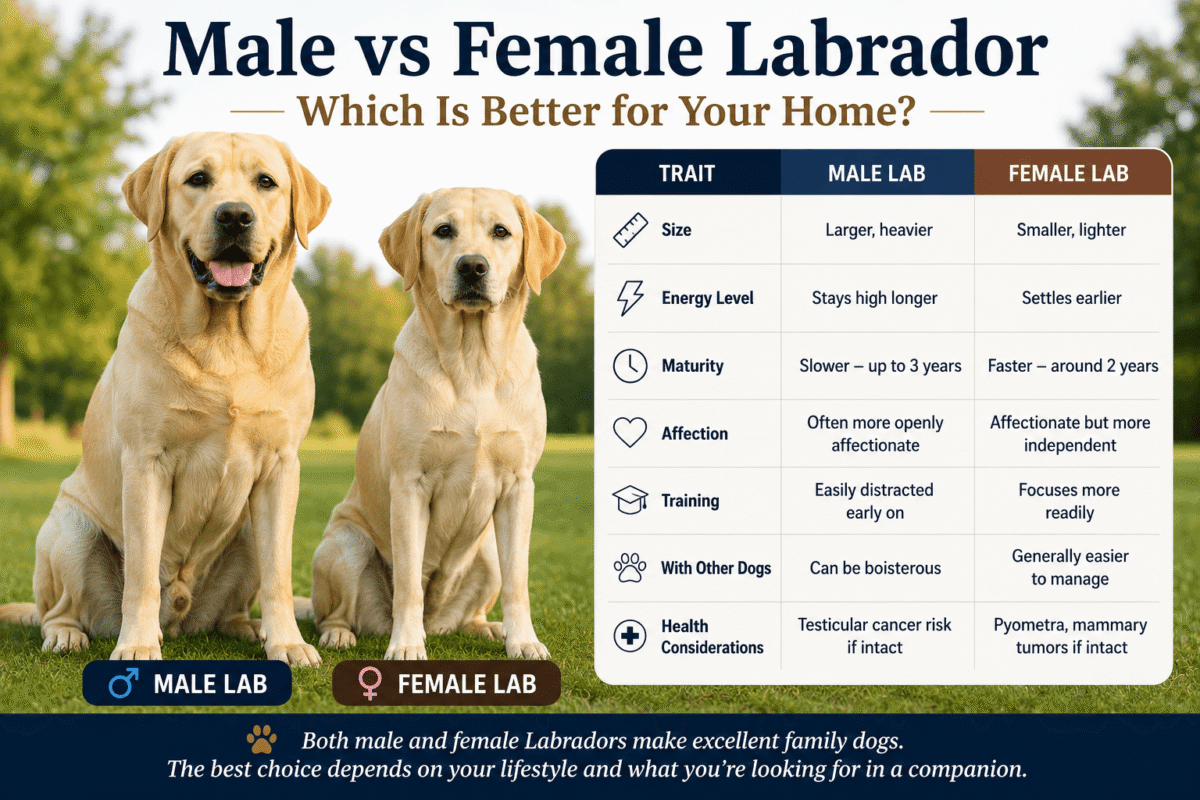
Male vs Female Labrador – Quick Comparison
| Trait | Male Lab | Female Lab |
|---|---|---|
| Weight | 65–80 lbs — often exceeds 80 lbs in English lines | 55–70 lbs — more consistent to standard |
| Height | 22.5–24.5 inches at the shoulder | 21.5–23.5 inches at the shoulder |
| Energy level | Stays higher longer — adolescence extends to 2.5–3 years | Settles earlier — adolescence generally done by 18 months to 2 years |
| Maturity | Slower — up to 3 years | Faster — around 18 months to 2 years |
| Affection style | Often more openly demonstrative — follows, leans, seeks contact | Affectionate but more selective — comes to you on her terms |
| Early training focus | More easily distracted — especially 6 to 18 months | Focuses more readily — responds more consistently to commands earlier |
| With other dogs | Can be boisterous and competitive with other males | Generally easier to manage — occasional same-sex tension with other females |
| With children | Enthusiastic — may accidentally knock over small children during adolescence | Slightly more careful around young children — less boisterous physically |
| Health risks if intact | Testicular cancer, benign prostatic hyperplasia | Pyometra, mammary tumors — risk significantly reduced by early spaying |
| Neutering / spaying timing | Current evidence suggests waiting to 12–18 months may reduce joint risk | Same recommendation — discuss timing with your veterinarian |
Size and Build – Male vs Female Labrador
The size difference between male and female Labs is real and consistent. The American Kennel Club breed standard puts males at 65 to 80 pounds and females at 55 to 70 pounds — but in practice, males from stockier English show lines regularly exceed 80 pounds, and females from the same lines tend to stay closer to the top of their range.
For most families this size difference is aesthetic rather than practical. But it matters in specific situations:
| Situation | Why Size Matters | Better Choice |
|---|---|---|
| Household with toddlers or elderly family members | An 80-pound male in full adolescent enthusiasm can knock over a toddler or older adult without any aggressive intent | Female — smaller, less physically imposing during adolescence |
| Apartment or condo living | A larger male takes up more space in smaller living environments | Female — more manageable size in compact spaces |
| Smaller or older owner managing the dog on leash | An adolescent male pulling on leash is significantly harder to control than a female of the same age | Female — particularly during the first two years |
| Hunting and fieldwork requiring physical endurance | A male’s larger frame can be an advantage in demanding cold-water retrieves and rough terrain hunting | Either — both sexes are capable working dogs; males have a slight endurance edge in extreme conditions |
Temperament – Male vs Female Labrador
This is where most buyers have the strongest opinions — and where the reality is most nuanced. Both sexes share the same fundamental Labrador temperament — loyal, people-oriented, trainable, and gentle. The differences are in timing and style rather than degree.
| Temperament Factor | Male Lab | Female Lab |
|---|---|---|
| Adolescent phase length | Extended — many males stay in an excitable, easily distracted adolescent phase until 2.5 to 3 years. This phase is real and can be genuinely challenging | Shorter — most females have settled into a calmer, more focused version of themselves by 18 months to 2 years |
| Affection expression | Often more openly demonstrative — males frequently follow their owners around more, lean against people, and seek physical closeness consistently throughout the day | Affectionate but more self-directed — females come to you on their terms rather than seeking constant contact. Neither more nor less loving — just a different style |
| Focus and attention | Males are more easily distracted — particularly by scent, other dogs, and environmental stimulation during adolescence. Once mature, focus is excellent | Females maintain focus more consistently from earlier — a practical advantage during training and in situations requiring attention |
| Independence | Generally more persistent in their people-seeking — males often struggle more with separation anxiety | Slightly more independent — content to settle in a different room, less likely to shadow your every movement |
| Consistency | Males can have more pronounced hormonal mood fluctuations if intact — neutered males are significantly more consistent | Intact females experience hormonal cycles that affect behavior — spayed females are highly consistent |
Training – Is a Male or Female Lab Easier to Train?
Female Labs have a practical edge in early training — not because they are smarter or more capable, but because they are less distracted. A female at 6 months is generally more focused in a training session than a male at the same age. She will follow a routine more readily and respond more consistently to commands in the first year.
Males catch up. By the time both sexes are fully mature the gap largely disappears — but those first 12 to 18 months feel noticeably different to most owners. If early trainability is a priority — particularly for first-time dog owners — the female’s more consistent early focus is a genuine advantage.
| Training Factor | Male Lab | Female Lab |
|---|---|---|
| Focus in early training sessions | More easily distracted — particularly 6 to 18 months — environmental scents and other dogs pull attention readily | More consistent focus from earlier — sessions run more smoothly in the first year |
| Response to positive reinforcement | Both sexes respond exceptionally well to food-based positive reinforcement from 8 weeks | Both sexes respond exceptionally well — no meaningful difference in reinforcement sensitivity |
| Maturity and training ceiling | Once mature — typically by 2.5 to 3 years — males are fully capable of advanced training including hunting, service, and therapy work | Reach training ceiling earlier — most females are capable of advanced training by 18 months to 2 years |
| Best for first-time owners | Manageable with consistent positive reinforcement and exercise — but the extended adolescence requires patience | More forgiving during the first year — widely recommended for first-time owners who want an easier early training experience |
For a full guide on the best Lab for first-time owners including sex, color, and line recommendations, read our guide on the best Labrador for first-time owners.
Male vs Female Lab with Children
Both male and female Labs are outstanding with children — it is a breed-wide characteristic rather than a sex-specific one. The differences that exist are primarily about the adolescent phase:
| Child Age Group | Male Lab Consideration | Female Lab Consideration |
|---|---|---|
| Babies and toddlers — 0 to 3 years | An adolescent male’s boisterous energy and larger size means more active supervision is needed — an 80-pound male at 10 months in full play mode can knock over a toddler without any aggressive intent | A female’s smaller size and earlier maturity makes the toddler period more manageable — she settles faster and is less physically imposing during her own adolescence |
| Young children — 4 to 8 years | Males are enthusiastic and playful — outstanding companions for active children in this age group who can hold their own physically | Both sexes are excellent with children in this range — females may be slightly more measured in physical play |
| Older children — 9 years and up | Males are fully devoted companions for older children — the extra energy is an asset rather than a challenge at this age | Both sexes form equally strong bonds with older children — no meaningful difference at this age |
For a complete guide to Lab temperament across all child ages, read our guide on Labrador Retriever temperament with children.
Male vs Female Lab with Other Dogs
If you already have a dog at home, sex can genuinely affect how well they get along — particularly with intact dogs. The general guidance from most experienced breeders and trainers is consistent:
| Household Situation | Recommendation | Why |
|---|---|---|
| Existing male dog — adding a second | Add a female | Opposite-sex pairs get along more reliably — competition and dominance tension is significantly less common between a male and female than between two males |
| Existing female dog — adding a second | Add a male | Same principle — opposite-sex pairing is the safer starting point. Two female Labs can sometimes clash more intensely than two males |
| Two males in the same household | Manageable — particularly if both are neutered early | Neutering significantly reduces same-sex competition but does not eliminate it entirely — monitor during adolescence and social maturity |
| Two females in the same household | Generally fine — monitor for competition | Female-female dynamics can occasionally be more intense than male-male — opposite-sex pairs remain the safer recommendation |
| Multi-dog household with existing opposite-sex pair | Either sex — assess individual temperament | Once a stable opposite-sex pair is established, adding a third dog should be assessed on individual temperament rather than defaulting to a sex rule |
Male vs Female Lab for Hunting
Both male and female Labs make outstanding hunting dogs — the hunting capabilities of the breed are not meaningfully sex-dependent. Field-line breeding, individual drive, and early training matter far more than sex. That said, some differences are commonly noted by hunters:
| Hunting Factor | Male Lab | Female Lab |
|---|---|---|
| Physical endurance in extreme conditions | Slightly larger frame can be an advantage in prolonged cold-water waterfowl retrieving in extreme conditions | Fully capable hunting dog — slightly less physical mass may be a minor disadvantage in the most demanding cold-water conditions |
| Drive and intensity | Males from field lines are often described as having more intensity and drive — particularly in the first few seasons | Females are described as more biddable and easier to control in the field — particularly during the first hunting season when steadiness is being trained |
| Consistency across the season | Consistent once trained — neutered males are highly reliable | Intact females can have cycles that affect availability and field focus during hunting season — spaying removes this variable entirely |
| Professional hunting dog programs | Both sexes are used equally in professional hunting dog programs — sex preference varies by individual trainer and hunting discipline | Many professional trainers express a preference for females in the first year of training due to their earlier focus and biddability |
Health Differences – Male vs Female Labrador
Both sexes share the same breed-wide health concerns — hip and elbow dysplasia, eye conditions, obesity risk, and EIC. Sex-specific health risks apply primarily to intact dogs. The Orthopedic Foundation for Animals (OFA) tracks health data across the breed regardless of sex — always verify health clearances for both parent dogs before purchasing.
| Health Factor | Male Lab | Female Lab |
|---|---|---|
| Intact-specific risks | Testicular cancer, benign prostatic hyperplasia — both eliminated by neutering | Pyometra (serious uterine infection), mammary tumors — risk significantly reduced by spaying before second heat |
| Neutering and spaying timing | Current evidence suggests waiting to 12 to 18 months of age may reduce risk of certain joint conditions — discuss timing with your veterinarian rather than defaulting to early neutering | Same recommendation applies — the relationship between early spaying and joint health in Labs is worth discussing with your vet |
| Weight management | Both sexes are highly prone to obesity — Labs will overeat without exception. Measure all portions regardless of sex | Both sexes equally prone — portion control is non-negotiable for all Labs |
| Lifespan | Average 10 to 14 years — no meaningful sex-based lifespan difference in Labs | Average 10 to 14 years — no meaningful sex-based lifespan difference |
Does Lab Color Affect the Male vs Female Decision?
Not directly — but breeding line does, and breeding line often correlates with color. The most important interaction between color, line, and sex for most buyers:
| Combination | What to Expect |
|---|---|
| English Cream female from show lines | The calmest and most settled combination available — ideal for first-time owners, families with toddlers, condo living, and buyers who want the easiest possible early experience |
| English Cream male from show lines | Calmer than American-line males — but the extended adolescence still applies. Larger and more boisterous than a female from the same line during years one and two |
| Black or Chocolate male from field lines | The most demanding combination — high energy, extended adolescence, strong drive. Outstanding hunting dog but requires experienced handling and committed daily exercise |
| Black or Chocolate female from field lines | Excellent hunting dog with more manageable early training — the most popular combination among serious hunters who want capability alongside biddability |
| Yellow male from companion lines | Gentle and patient — the extended adolescence is less pronounced from companion lines. A popular all-round family choice |
For a full breakdown of how breeding lines and colors interact with temperament, read our guide on which color Lab is the calmest.
Which Should You Choose – Male or Female Lab?
| Choose a Female Lab If… | Choose a Male Lab If… |
|---|---|
| You have toddlers or young children at home | You want a larger, more physically imposing companion |
| You are a first-time dog owner | You already have a female dog at home |
| You live in an apartment or condo | You want openly demonstrative, constant affection |
| You want easier early training | You are an experienced owner comfortable with a longer adolescence |
| You already have a male dog at home | You want a hunting dog with maximum drive and endurance |
| You want a dog that settles faster | You prefer a dog that seeks you out consistently throughout the day |
| A smaller, more manageable size matters | Size is not a concern in your household |
The most important thing: within the same litter, individual personality varies more than sex does. A calm, confident male from a good litter will be easier to live with than an anxious, reactive female — regardless of the general patterns above. If you can meet the litter before committing, choose the individual that matches your household’s energy rather than defaulting entirely to sex.
Available Male and Female Lab Puppies
We raise both male and female puppies across all six color variations — all from health-tested parents, raised in a home environment, and available for delivery anywhere in the USA and Canada.
- Black Lab Puppies — Male and Female
- Yellow Lab Puppies — Male and Female
- Chocolate Lab Puppies — Male and Female
- White English Cream Lab Puppies — Male and Female
- Silver Lab Puppies — Male and Female
- Red Fox Lab Puppies — Male and Female
👉 Browse All Available Puppies
👉 Contact Us to Discuss Which Sex Is Right for Your Family
Frequently Asked Questions
Are male or female Labradors calmer?
Female Labs tend to be calmer earlier — they mature faster and settle into a more focused temperament by around 18 months to 2 years. Males can stay in an energetic, easily distracted adolescent phase until 2.5 to 3 years. Once both sexes are fully mature, the difference in calmness is much smaller. Breeding line matters more than sex — an English Cream female from show lines is the calmest combination available.
Are female Labs easier to train than males?
Generally yes, especially in the first 12 to 18 months. Females are less easily distracted and respond more consistently to training earlier. Males catch up once they mature, but the first year feels noticeably different. For first-time owners who want an easier early training experience, a female is typically the better starting point.
Do male Labs get bigger than females?
Yes. Male Labs typically weigh 65 to 80 pounds — and often exceed 80 pounds from stockier English show lines. Females typically weigh 55 to 70 pounds. The height difference averages around one inch. The size difference is real and worth considering if space, physical management on leash, or young children in the household are concerns.
Is it better to get a male or female Lab as a second dog?
Opposite-sex pairs get along more reliably than same-sex pairs. If you already have a male, a female is typically the safer choice — and vice versa. Neutering and spaying reduces but does not eliminate same-sex tension. Assess individual temperament alongside sex when introducing any second dog to an existing household.
Which is more affectionate — male or female Labs?
Males are often described as more openly and consistently demonstrative — they follow their owners more, lean in more, and seek physical contact throughout the day. Females are equally loving but more self-directed about it — they come to you on their own terms rather than seeking constant contact. Both are deeply affectionate breeds — the difference is in style rather than degree.
Are male or female Labs better for hunting?
Both sexes make excellent hunting Labs — breeding line and individual drive matter far more than sex. Males from field lines are often described as having more intensity; females from field lines are described as more biddable and easier to steady in the early seasons. Many professional hunting dog trainers express a preference for females in the first year of training. For serious waterfowl and pheasant hunting, either sex from a proven field-line program will serve you well.
Should I spay or neuter my Lab — and when?
Current evidence suggests waiting until 12 to 18 months of age — skeletal maturity — may reduce the risk of certain joint conditions in Labs. This is a nuanced conversation that has evolved significantly in recent years. Discuss timing with your veterinarian based on your Lab’s sex, size, lifestyle, and individual health picture rather than defaulting to early neutering out of habit.
