

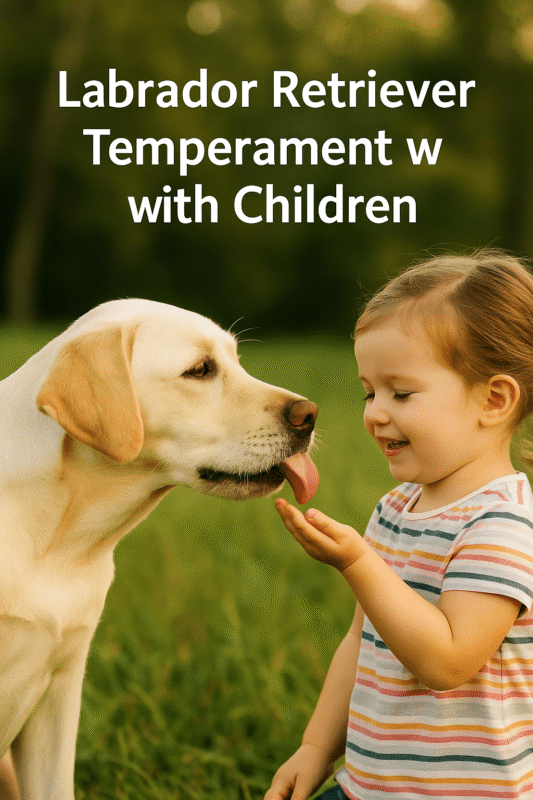
The Labrador Retriever temperament with children is perhaps the most important question any family asks before choosing a dog — and it is the question that has made the Labrador Retriever the most consistently popular breed in the United States for over three decades. The answer is not simply that Labs are gentle. It is that Labs are gentle for specific, well-understood reasons rooted in centuries of selective breeding — and understanding those reasons helps families raise Labs and children together more successfully.
This guide covers what drives Labrador temperament with children, what to realistically expect at different ages, how different Lab types and breeding lines affect behavior, and the practical steps that lead to a safe, joyful relationship between your Lab and your kids. Browse our currently available family-raised Labrador puppies if you are ready to find the right match for your household.
Why Labradors Are Consistently Rated the Best Family Dog with Children
The Labrador Retriever’s reputation with children is not marketing — it is the product of specific traits that were selected over generations of breeding and that remain consistent across the breed today. The American Kennel Club specifically cites the breed’s even temper and affectionate, patient nature as defining characteristics — qualities that translate directly into how Labs behave around children of all ages.
| Trait | Why It Developed | How It Benefits Children |
|---|---|---|
| Soft mouth | Originally bred to retrieve waterfowl without damaging the bird — gentle bite control was a core selection criterion for generations | Labs instinctively apply gentle pressure even when mouthing — far less likely to bite down hard even when startled or excited |
| High pain and stimulus tolerance | Working retrievers needed to focus despite cold water, rough terrain, and distracting environments — frustration tolerance was built in | Labs tolerate the clumsy hugs, tail grabs, and sudden movements of young children with a patience that is genuinely rare among dog breeds |
| People-oriented temperament | Bred to work in close partnership with humans — Labs seek out human company rather than independence | Labs actively choose to be near children — they do not merely tolerate them but genuinely enjoy the company and stimulation children provide |
| Low predatory drive | Selected against high prey drive — a dog that chased game rather than retrieved it was not useful | Labs are far less likely than many breeds to chase, nip, or respond to the fast movement of running children with predatory behavior |
| Even, stable temperament | Conformation breeding programs consistently selected for predictability and emotional stability | Labs are reliably the same dog today as they were yesterday — children can predict how their Lab will respond, which builds confidence and trust |
| High trainability | Bred to take and retain direction from handlers — food motivation and desire to please are deeply ingrained | Labs learn household rules, boundaries with children, and appropriate play quickly — and retain those lessons reliably |
Labrador Retriever Temperament with Children by Age Group
The Labrador’s behavior with children is not uniform — it adjusts naturally to the age and behavior of the child in front of them. Here is what families can realistically expect across different child age groups:
| Child Age Group | What Labs Typically Do | What Parents Should Know |
|---|---|---|
| Babies — 0 to 12 months | Labs typically show curiosity and gentle investigation — sniffing, staying close, occasionally licking | Always supervise — a well-intentioned Lab can accidentally knock over or step on an infant. Introduce your Lab to the baby’s scent before bringing the baby home. Give the Lab a safe space to retreat from the nursery when needed |
| Toddlers — 1 to 3 years | Labs tolerate the most unpredictable behavior at this age — sudden grabbing, ear pulling, unsteady approaches — with remarkable patience | Never leave unsupervised. Even the most patient Lab needs an exit route. Teach toddlers from the beginning not to approach the dog when eating or sleeping. Always supervise every interaction at this age regardless of the dog’s known temperament |
| Young children — 4 to 7 years | Labs begin to engage in active play — fetch, chase, and rough-and-tumble games — and form strong individual bonds with children in this age group | Labs may accidentally knock over smaller children during excited play — supervise outdoor play sessions. Begin teaching the child basic dog communication signals — a child who can read a dog’s body language is significantly safer |
| Older children — 8 to 12 years | Labs become true companions at this age — playing, exercising, and bonding deeply. Children in this range can begin participating in basic training with adult supervision | Involve children in feeding, grooming, and training — shared responsibility builds the bond and teaches the dog to respond to the child as a family authority figure |
| Teenagers | Labs treat teenagers as full family members — they are equally devoted to teenage children as adults in the household | Teenagers can take on more care responsibilities — walking, training, and feeding. A Lab that exercises with a teenager is a significantly more settled indoor companion |
How Breeding Line Affects Labrador Temperament with Children
Not all Labradors behave identically with children — and coat color alone is not what creates the differences. Breeding line is the most significant variable after individual genetics:
| Breeding Line | Temperament Tendency with Children | Best For |
|---|---|---|
| English show or conformation lines | Commonly described as calmer, more settled, and lower energy — particularly during adolescence. Adolescence is generally more manageable with show-line Labs | Families with very young children, first-time dog owners, quieter households, apartment or smaller home settings |
| American field or working lines | Higher energy, more driven — excellent family dogs but require more exercise and management during the first two years. More boisterous around young children than show-line Labs | Active families with older children, hunters, experienced dog owners who can meet the exercise demands consistently |
| Companion lines — mixed show and field | Most common — typically between the two extremes. Good family temperament with moderate energy | Most family situations — a good all-round choice for families with children of mixed ages |
These are commonly reported tendencies rather than guaranteed outcomes. Individual genetics, socialization from birth, and upbringing all play significant roles. For a full breakdown of how breeding lines and coat color interact with temperament, read our guide on which color Lab is the calmest.
Lab Color and Temperament with Children – What the Evidence Actually Shows
Many families ask whether Black, Yellow, or Chocolate Labs behave differently with children. The honest answer is that coat color alone is not a reliable predictor of temperament with children — breeding line, socialization, and individual genetics matter far more. That said, some tendencies are commonly reported across color and line combinations:
| Color | Commonly Reported Tendency with Children | Key Influencer |
|---|---|---|
| Black Lab | Even-tempered, focused, versatile — widely regarded as the most consistent Lab color across a range of family situations | Breeding line — show-line Black Labs are calmer; field-line Black Labs are more driven |
| Yellow Lab | Gentle and patient — particularly from English show or companion lines. Widely regarded as among the most tolerant with toddlers | Breeding line — English Cream Yellow Labs from show lines are often the most settled with very young children |
| Chocolate Lab | Playful and energetic — particularly from American field lines. Some breeders and owners describe Chocolate Labs as more boisterous during adolescence | Breeding line — this is more often a field-line vs companion-line difference than a coat color difference |
| English Cream / White Lab | Commonly described as the calmest variation — English show lines produce consistently settled, patient dogs with children of all ages | English show or European breeding line — the most reliable choice for very young children and first-time owners |
Labrador Retriever Temperament with Children – The Role of Socialization
A Labrador’s temperament with children is not fixed at birth — it is significantly shaped by the socialization experiences the puppy has between 4 and 16 weeks of age. The American Veterinary Society of Animal Behavior (AVSAB) identifies this period as having the single greatest influence on a dog’s future behavior — and how the puppy is raised during these weeks directly determines how confidently and calmly your Lab will interact with children for the rest of its life.
| Socialization Experience | Age Window | Effect on Temperament with Children |
|---|---|---|
| Exposure to children of different ages at the breeder | 4 to 8 weeks | Puppies raised around children from birth approach them with curiosity rather than fear — a critical foundation for lifelong confidence around kids |
| Positive handling — paws, ears, mouth, collar | 4 to 12 weeks | Puppies that are handled daily from birth accept physical contact from children — including the clumsy and unpredictable contact toddlers make — more readily |
| Exposure to household sounds, movement, and chaos | 4 to 16 weeks | Puppies raised in active family environments are less startled by the sudden noises, running, and unpredictable movement of children — critical for urban and suburban family Labs |
| Positive interactions with children in the new home | 8 to 16 weeks | The critical socialization window continues after the puppy arrives home — supervised, positive interactions with children in the first months are the most powerful shaping tool available to families |
This is why the breeder’s environment matters as much as the breed itself. A Lab puppy raised in a kennel with minimal human contact will behave very differently around children than a home-raised puppy that has been handled daily and socialized with a family from birth. Always ask your breeder specifically what children and household experiences the litter has had before 8 weeks.
Practical Safety Guidelines for Labs and Children
Even the most reliably family-friendly breed requires sensible safety practices. These are not precautions against Labs specifically — they are universal guidelines for safe dog-child relationships that apply regardless of breed:
| Rule | Why It Matters |
|---|---|
| Always supervise dogs and children under 8 years | The majority of dog bites to children occur in the home with a familiar dog during unsupervised moments — supervision is the single most effective safety measure available |
| Give the dog a safe retreat space — a crate or bed that is off-limits to children | A dog that can choose to leave a stressful situation is far less likely to feel cornered and react defensively. Every dog needs a space that is genuinely its own |
| Never disturb a dog that is eating, sleeping, or unwell | Even patient dogs are more likely to react defensively when startled from sleep or protecting food — teach children this boundary before they are around the dog unsupervised |
| Teach children to read dog body language | A child who recognizes a dog’s stress signals — whale eye, stiff body, tucked tail, turned head — can remove themselves from a situation before it escalates. This is a life skill |
| Never allow rough play that the dog cannot exit | Rough play that traps or corners a dog — even playfully — removes the dog’s ability to manage its own stress through avoidance. Always ensure the dog can leave any play situation |
| Exercise the dog before high-energy child interaction | A Lab that has had its exercise needs met is significantly more calm, settled, and tolerant during boisterous child play than an under-exercised dog. Exercise is the most underrated management tool |
How Labs Benefit Children Beyond Companionship
The relationship between children and Labrador Retrievers delivers documented developmental benefits that go significantly beyond having a family pet:
| Benefit | How Labs Deliver It |
|---|---|
| Emotional regulation and security | Labs provide consistent, unconditional positive attention — research consistently links pet ownership in childhood with improved emotional regulation and lower anxiety levels |
| Responsibility and routine | Involving children in feeding, grooming, and training gives them meaningful, age-appropriate responsibilities with visible, immediate outcomes |
| Physical activity | Children with dogs are consistently more physically active than children without — Labs motivate daily walks, outdoor play, and active exercise |
| Empathy development | Learning to read a dog’s emotional state, respect its needs, and consider its perspective builds the empathy and social awareness that transfer to human relationships |
| Non-judgmental companionship | Labs are consistently described by children as their best friend and confidant — a non-judgemental presence that provides comfort during difficult periods, including academic stress, social challenges, and family transitions |
Training Tips for a Lab That Will Live with Children
The foundation of a safe, harmonious household between a Lab and children is laid in the first weeks after the puppy arrives home. Here are the most important training priorities for family Labs:
| Training Priority | Why It Matters for Families with Children | When to Start |
|---|---|---|
| Sit before greetings | A Lab that sits before greeting a child cannot simultaneously jump on them — the most common way Labs accidentally knock over or frighten young children | Day one — 8 weeks |
| Off — four paws on the floor | Jumping on children is the most common unwanted Lab behavior in families — teaching Off with positive reinforcement prevents it from becoming a habit | Day one — 8 weeks |
| Leave it | Prevents the Lab from taking food, toys, or objects from children — essential in households with toddlers who cannot yet protect their own belongings | Week two onwards |
| Gentle — soft mouth with humans | Labs have soft mouths by breeding, but teaching Gentle reinforces appropriate pressure during play — particularly important with young children | Week one — 8 weeks |
| Place — go to your bed | Gives the Lab a reliable way to exit high-energy situations and provides parents a management tool when children’s play becomes too stimulating for the dog | Weeks two to four |
| Recall — come when called | A reliable recall allows parents to interrupt any interaction between child and dog instantly — the most important safety command in a family household | Week one — 8 weeks |
For a complete week-by-week training plan from day one, read our guide on how to train a Labrador puppy. For a full room-by-room preparation guide before your puppy arrives, read our guide on preparing for a Labrador puppy.
Signs Your Lab Is Happy with Your Children
| Positive Sign | What It Means |
|---|---|
| Seeks out children voluntarily | A Lab that chooses to be near children when it has the option to go elsewhere is demonstrating genuine enjoyment of their company |
| Relaxed body language around children — loose posture, wagging tail, soft eyes | Relaxed muscle tone and soft body language indicate comfort and positive association — not merely tolerance |
| Initiates play — bringing toys, nudging, inviting chase | A Lab that initiates play with children is actively engaging with them as social partners — one of the strongest indicators of a genuinely positive relationship |
| Settles near sleeping children | Labs that naturally position themselves near sleeping or resting children are demonstrating their bond and their natural inclination to be close to the people they love |
| Returns to children after space | A Lab that takes space when needed but returns voluntarily is managing its own stress well — a sign of emotional security in the relationship |
Signs Your Lab Needs More Space or Support
| Warning Sign | What to Do |
|---|---|
| Consistently avoiding children or leaving the room | Assess whether the dog has a safe retreat available — if it does and is still stressed, review child interaction quality and increase supervision and structure |
| Yawning, lip licking, or whale eye during child interaction | These are displacement and stress signals — the dog is communicating discomfort before it escalates. Interrupt the interaction and give the dog space |
| Stiff body posture or still tail during child play | A stiff, still dog during an otherwise active interaction is a warning signal — remove the child from the interaction calmly and immediately |
| Growling | Never punish a growl — it is the dog’s last communication before escalation and removing it through punishment removes the warning. Address the underlying cause instead |
| Snapping without contact | Seek professional help immediately from a qualified force-free trainer or veterinary behaviourist — this level of communication requires professional assessment |
Most warning signs in Labs with children are the result of management failures — insufficient exercise, no safe retreat space, or unsupervised interactions. They are almost always addressable with structured management and professional support before escalation occurs.
Finding a Lab That Will Excel with Your Children
The single most important decision for a family wanting a Lab that is outstanding with children is choosing the right breeder and breeding line — not the right color. A home-raised Lab puppy from a responsible breeder with documented health testing, socialized with children from birth, from a show or companion breeding line, will reliably give you the patient, gentle, family-oriented dog the breed is famous for.
At Labrador Today, every puppy is raised in a family home environment, handled and socialized with children from birth, and matched to families based on lifestyle and child ages. Browse our available family-raised Lab puppies across all six color variations:
- Black Lab Puppies for Sale
- Yellow Lab Puppies for Sale
- Chocolate Lab Puppies for Sale
- White English Cream Lab Puppies for Sale
- Silver Lab Puppies for Sale
- Red Fox Lab Puppies for Sale
👉 Browse All Available Puppies
👉 Contact Us to Find the Right Lab for Your Family
Frequently Asked Questions
Are Labrador Retrievers good with children?
Yes — Labrador Retrievers are consistently rated among the best family dog breeds for children of all ages. Their soft mouth, high pain tolerance, people-oriented temperament, low predatory drive, even emotional stability, and high trainability combine to produce one of the most reliably child-friendly dogs available. These traits were selectively bred over generations and remain consistent across the breed today.
Are Labs good with toddlers?
Yes — Labs are particularly well-suited to toddlers because of their high tolerance for unpredictable physical contact. Their instinctive soft mouth and frustration tolerance mean they respond to clumsy grabbing and sudden movements with patience rather than reactivity. All interactions between Labs and toddlers should be supervised — not because Labs are unpredictable but because all dogs and toddlers should always be supervised together, regardless of breed.
Can Labrador puppies hurt children?
Accidentally, yes — particularly in the puppy and adolescent phase. A boisterous 8-month-old Lab can easily knock over a toddler during excited play without any aggressive intent. This is a size and energy management issue rather than a temperament issue. Teaching sit before greetings, the Off command, and maintaining supervised interactions prevents the vast majority of accidental contact incidents.
Are female or male Labs better with children?
Both male and female Labs can be outstanding with children — the evidence does not clearly favor one sex over the other for family settings. Males tend to be slightly larger and more boisterous during adolescence; females tend to mature slightly earlier and can be slightly less physically imposing with toddlers. Individual temperament, breeding line, and training matter significantly more than sex. For a full comparison, read our guide on the best Labrador for first-time owners.
What age Lab is best for a family with young children?
8 weeks is the widely recommended age for bringing home a Lab puppy — the point at which the puppy has completed canine socialization with its mother and littermates and is developmentally ready to form primary bonds with its new family. This timing also maximizes the critical human socialization window between 8 and 16 weeks — the most influential period in the puppy’s development for its future behavior with children. Read our full guide on the best age to bring home a Labrador puppy.
Which Lab color is best with children?
Coat color is not a reliable predictor of behavior with children — breeding line matters far more. English-type Labs from show or conformation lines are commonly described as the calmest and most settled with very young children, regardless of color. For families with toddlers or first-time owners, English Cream or Yellow Labs from English show lines are frequently the most manageable choice. Read our full guide on which color Lab is the calmest.
How do I introduce my Lab puppy to my children?
Calmly and in a controlled environment. Bring the puppy home when the house is quiet if possible. Let the puppy approach the children at its own pace rather than having children rush toward it. Sit on the floor and let the puppy investigate. Supervise all interactions for the first several weeks and teach children the basic rules — no picking up, no chasing, no disturbing the dog when eating or sleeping — before the puppy arrives home. The first interactions set the tone for the entire relationship.
