

The Chocolate Lab is one of the most beloved and most misunderstood Labrador Retriever colors. Their rich brown coat is striking and immediately distinctive — but prospective buyers frequently arrive with either an inflated idea of their temperament challenges or a dismissive attitude toward the real energy and care commitment a Chocolate Lab requires. The honest picture is somewhere in between: Chocolate Labs are outstanding dogs for the right household — loyal, affectionate, enthusiastic, and deeply devoted to their families — but they are not the right choice for every buyer, and understanding why matters before you commit.
This guide covers everything you need to know — temperament, energy level, the lifespan research, health testing, cost, and what to look for in a reputable breeder. Browse our available Chocolate Lab puppies once you have read through.
What Is a Chocolate Lab?
| Question | Answer |
|---|---|
| What is a Chocolate Lab? | A Labrador Retriever with a rich brown coat — ranging from a pale cafe-au-lait brown to a deep dark chocolate. The chocolate coat is produced by two copies of the recessive b allele at the B locus (genotype bb) — both parents must carry at least one b allele for a chocolate puppy to be possible |
| Is Chocolate Lab a separate breed? | No — Chocolate Labs are Labrador Retrievers. Same breed, same AKC registration, same fundamental temperament profile as Black and Yellow Labs. The brown coat is a color variation within the breed |
| What does the AKC say? | The American Kennel Club recognizes Chocolate as one of the three official Labrador Retriever colors — alongside Black and Yellow. Chocolate Labs compete fully in all AKC events including conformation showing |
| Why are Chocolate Labs rarer than Black Labs? | The chocolate gene is recessive — both parents must carry the b allele for a chocolate puppy to be produced. A Black Lab carrying one b allele will not show the chocolate coat but can pass the gene to offspring. This recessiveness means chocolate puppies appear at lower frequency in many Lab litters |
| Can two Chocolate Labs produce Black puppies? | No — two Chocolate Labs (both bb) cannot produce a Black puppy. All puppies from a Chocolate × Chocolate pairing will be either Chocolate or Yellow, depending on the E locus genetics |
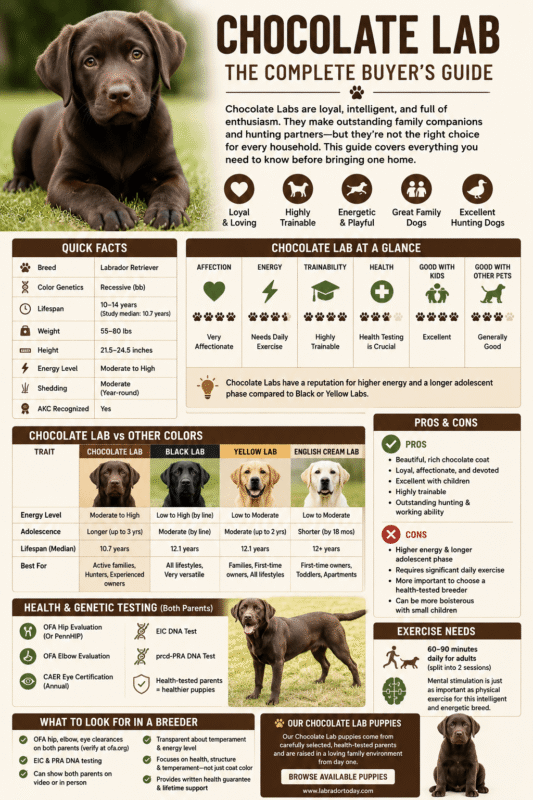
Chocolate Lab Temperament – The Honest Assessment
Chocolate Labs have a reputation for being more energetic and boisterous than Black or Yellow Labs — and research suggests this is more than just perception. The 2019 PLOS ONE study examining over 33,000 dogs found some marginal behavioral differences between Lab colors, with Chocolate Labs scoring slightly higher on some energy and reactivity measures than Black and Yellow Labs. The most widely accepted explanation is breeding practice rather than coat color directly:
| Temperament Factor | Chocolate Lab Reality |
|---|---|
| Energy level | Higher than English Cream or show-line Yellow and Black Labs on average — particularly during adolescence. Some breeders and owners report Chocolate Labs as more boisterous, more persistent, and more demanding of daily exercise than equivalent Yellow or Black Labs from comparable lines. This is a tendency observed across many lines, not an absolute rule — well-bred companion-line Chocolate Labs are manageable |
| Why the higher energy tendency exists | Research suggests that Chocolate Labs may have been selected in some breeding programs primarily for coat color rather than temperament — narrowing the gene pool and inadvertently reducing the selection pressure on calm, stable character that is standard in Black Lab programs. This is a historical breeding effect, not an inherent coat-color trait |
| Core character | Deeply loyal, affectionate, playful, and people-oriented — the fundamental Labrador temperament is fully present in Chocolate Labs. Their enthusiasm and energy are qualities their owners frequently describe as the very things they love most about the color |
| Adolescent phase | Often the longest and most demanding of the three recognized Lab colors — particularly from companion and working lines. Many Chocolate Labs remain in an energetic, boisterous adolescent phase until 2 to 3 years. Daily exercise is critical during this period |
| With children | Excellent — Chocolate Labs are devoted, playful, and patient with children. Their higher energy level is often an asset with active older children. Families with toddlers should be prepared for a more boisterous adolescent phase than with English Cream or Yellow Labs |
| With other pets | Generally good — Chocolate Labs are socially tolerant and manageable with other dogs and cats when properly introduced. Their higher energy can be overwhelming for very small or elderly resident pets during adolescence |
| Trainability | Highly trainable — food motivated and eager to please like all Labs. The higher energy level channels well into training when adequate daily exercise is provided first. An under-exercised Chocolate Lab is significantly harder to train than a well-exercised one |
Chocolate Lab Lifespan – What the Research Shows
The lifespan question is one of the most important things for prospective Chocolate Lab buyers to understand honestly:
| Research Finding | Detail |
|---|---|
| 2018 study — Canine Genetics and Epidemiology | Research by O’Neill et al. analyzing over 33,000 Labrador records found that Chocolate Labs had a median lifespan of 10.7 years — compared to 12.1 years for Black and Yellow Labs. This is a statistically significant difference of approximately 1.4 years |
| Why the difference exists | The researchers attributed the shorter lifespan primarily to the health consequences of selecting breeding stock for coat color in some Chocolate Lab programs — reducing the available gene pool and creating a narrower genetic base than in Black Lab programs where color selection pressure was less intense |
| Does this mean all Chocolate Labs die younger? | No — this is a median finding across a large population, not a sentence for any individual dog. A Chocolate Lab from a reputable, health-tested breeding program with a broad, well-selected gene pool is not necessarily at a lifespan disadvantage compared to a well-bred Black or Yellow Lab. The finding reflects historical breeding practices in some lines, not an inherent biological limitation |
| What it means for buyers | It reinforces the importance of choosing a Chocolate Lab from a breeder who health tests both parent dogs and selects for health and temperament alongside coat color. Avoiding breeders who select exclusively for coat color depth or shade is particularly important for Chocolate Labs |
| Realistic lifespan expectation | A well-bred Chocolate Lab from a reputable health-tested program: 10 to 14 years. The research average of 10.7 years reflects the population broadly — including many dogs from programs that did not prioritize health testing |
Chocolate Lab Health – What to Know
| Health Factor | Detail |
|---|---|
| Breed-wide concerns | Chocolate Labs share the same hereditary health concerns as all Labrador Retrievers — hip dysplasia, elbow dysplasia, Progressive Retinal Atrophy (PRA), Exercise-Induced Collapse (EIC), obesity risk, ear infections, and dental disease |
| Skin and coat conditions | Some Chocolate Labs are prone to skin sensitivity and coat conditions more than Black Labs — possibly related to the narrower gene pool in some Chocolate breeding programs. Ask about skin and coat history in the breeder’s specific lines |
| Obesity risk | Chocolate Labs are highly food motivated — the standard Lab obesity risk applies in full. Their higher energy level can make weight management somewhat easier than for less active Lab types, but measured meals and no free feeding remain essential |
| Required health tests — both parents | OFA or PennHIP hip evaluation, OFA elbow evaluation, CAER eye certification (annual), EIC DNA test, prcd-PRA DNA test — all verifiable at ofa.org before purchase. Health testing is particularly important for Chocolate Labs given the gene pool considerations discussed above |
| What health-tested Chocolate Labs look like | Both parents with OFA-cleared hips and elbows, current CAER eye certification, EIC and PRA DNA tests — all verifiable at ofa.org. A Chocolate Lab breeder who cannot show these clearances is not running the kind of program that addresses the lifespan concern |
How Much Does a Chocolate Lab Cost?
| Source | Typical Price | What You Get | Recommended? |
|---|---|---|---|
| Unverified private seller | $200 – $600 | Likely no health testing, no AKC papers — highest risk of inherited health problems and the gene pool issues associated with some Chocolate Lab lines | ❌ Avoid — particularly important for Chocolate Labs |
| Reputable companion-line breeder | $1,000 – $1,800 | AKC registration, OFA-tested parents, full health documentation, written health guarantee, lifetime breeder support | ✅ Recommended |
| Field-line Chocolate Lab breeder | $1,500 – $2,500 | Working bloodlines with proven drive — suitable for hunters wanting a Chocolate Lab specifically | ✅ For hunters wanting the distinctive chocolate coat on a working dog |
Is a Chocolate Lab Right for You?
| A Chocolate Lab Is an Excellent Choice If… | A Chocolate Lab May Not Be Right If… |
|---|---|
| You are an active family with time for daily exercise | You want the calmest possible Lab — English Cream from show lines is significantly more settled |
| You love the distinctive rich brown coat | You have toddlers and want a lower-energy adolescent phase — English Cream or Yellow Labs are more manageable |
| You want an enthusiastic, playful, high-energy companion | You have limited time for daily exercise — an under-exercised Chocolate Lab is a challenging household dog |
| You are an experienced dog owner comfortable with a longer adolescence | You are a first-time owner wanting the easiest possible first year |
| You want a capable hunting companion with a distinctive coat | You are concerned about the lifespan research and want to minimize that risk — prioritize the most rigorous health testing in any Chocolate Lab breeder you consider |
| You want a dog that matches an active outdoor lifestyle | You have very small or elderly resident pets who may be overwhelmed by a boisterous adolescent Chocolate Lab |
Chocolate Lab vs Other Lab Colors
| Color | Energy | Adolescence | Lifespan Research | Best For |
|---|---|---|---|---|
| English Cream | Low to moderate | Short — settles by 18 months | 12+ years from show lines | First-time owners, toddlers, apartments |
| Yellow Lab | Low to moderate | Moderate — settles by 2 years | ~12.1 years median | Families, first-time owners, all lifestyles |
| Black Lab | Low to high by line | Moderate — by line | ~12.1 years median | All families, hunters, most versatile |
| Chocolate Lab | Moderate to high | Longer — up to 3 years | ~10.7 years median — varies by program | Active families, hunters, experienced owners |
| Silver Lab | Moderate to high | Moderate to longer | Same as Chocolate — shares base color | Buyers wanting rare appearance, active households |
| Red Fox Lab | Moderate to high | Moderate | ~12.1 years — Yellow Lab base | Active families, hunters, distinctive coat |
Red Flags When Searching for a Chocolate Lab
| Red Flag | What It Signals |
|---|---|
| No OFA health testing on parents | Particularly important for Chocolate Labs — the gene pool and lifespan research makes health testing more critical here than for any other Lab color. A Chocolate Lab breeder without OFA clearances is not addressing the known concerns associated with the color |
| Selects breeding stock primarily for coat color depth | Selecting for the darkest possible chocolate coat above all else is exactly the breeding pressure that researchers identified as a contributor to Chocolate Lab health and lifespan outcomes. A breeder who emphasizes coat darkness over health and temperament is repeating the pattern the research identified |
| Cannot describe temperament of both parents specifically | Given the higher energy tendency in some Chocolate Lab lines, the parents’ individual temperament is particularly important to assess. Vague descriptions like “great dogs” are not sufficient |
| Always has Chocolate Lab puppies available | Reputable Chocolate Lab breeding programs plan limited litters carefully. A seller who always has chocolate puppies available is running a volume operation — exactly the kind of program most likely to select for coat color over health |
| Cannot show both parents on video | The energy level and temperament of both parents — particularly the dam — is the most reliable predictor of what the puppies will be like. Refusal to video both parents is a universal red flag |
What to Ask a Chocolate Lab Breeder
| Question | What a Good Answer Looks Like |
|---|---|
| Have both parents been OFA tested — hips, elbows, eyes, EIC, PRA? | Yes — certificates provided or verifiable at ofa.org by registered name. Both parents, not just one |
| How do you select your breeding stock — what criteria beyond coat color? | Clear answer about health testing, temperament assessment, and structural evaluation — not primarily coat color depth or shade |
| Can I see both the dam and sire on a live video call? | Yes — both dogs shown with energy level, build, and temperament visible. A calm, settled dam from a well-managed program is the strongest reassurance available for a Chocolate Lab buyer |
| Have you seen any skin or coat issues in your Chocolate Lab lines? | Honest answer — describes the history of their lines specifically rather than a generic assurance |
| What is the energy level of the current litter’s parents in the home? | Specific, honest description — an experienced Chocolate Lab breeder will tell you clearly whether the parents are moderate or high energy and what that means for the puppies |
Chocolate Lab Care – What to Know
| Care Area | Chocolate Lab Specific Note |
|---|---|
| Exercise | More daily exercise than most other Lab types — 60 to 90 minutes minimum for an adult, split into two sessions. The most common cause of difficult behaviour in Chocolate Labs is insufficient daily exercise. A tired Chocolate Lab is a well-behaved Chocolate Lab |
| Coat care | The chocolate coat shows lighter debris, dust, and yellow or cream hair visibly — and chocolate hairs are visible on both light and dark surfaces. Weekly brushing minimum, daily during seasonal blowouts. Bathing every 6 to 8 weeks keeps the coat at its richest color |
| Weight management | Standard Lab obesity prevention applies — measured meals, no free feeding, monthly body condition checks. Their higher activity level can make weight maintenance somewhat easier than for less active Lab types, but Labs of all colors will overeat if given the opportunity |
| Mental stimulation | Chocolate Labs’ higher energy benefits enormously from mental stimulation alongside physical exercise — training sessions, puzzle feeders, scent games, and retrieving activities channel their drive constructively and reduce restless indoor behaviour |
| Training | Exercise before training — an adequately exercised Chocolate Lab focuses significantly better in training sessions than one with unspent energy. Positive reinforcement from day one with consistent short sessions. Their drive channels well into structured training when energy is properly managed |
Our Available Chocolate Lab Puppies
Our Chocolate Lab puppies come from AKC-registered parents with full OFA health testing — raised in a family home environment with daily socialization. We select breeding stock for health, temperament, and structure alongside coat color — the approach the research identifies as essential for well-bred Chocolate Labs.
👉 Browse Available Chocolate Lab Puppies
👉 Contact Us to Ask About Current and Upcoming Litters
Also available:
- Black Lab Puppies
- Yellow Lab Puppies
- White English Cream Lab Puppies
- Silver Lab Puppies
- Red Fox Lab Puppies
For further reading:
- Which Color Lab Is the Calmest?
- How Long Do Labrador Retrievers Live?
- How to Choose a Labrador Breeder
- Common Labrador Health Problems
- Average Cost of a Labrador Puppy
Frequently Asked Questions
Are Chocolate Labs more hyper than other Labs?
Some breeders and owners report Chocolate Labs as more energetic and boisterous than equivalent Black or Yellow Labs — and research suggests marginal behavioral differences between colors may exist. The most widely accepted explanation is that some Chocolate Lab breeding programs selected primarily for coat color rather than temperament, reducing selection pressure on calm stable character. A well-bred Chocolate Lab from a reputable health-tested program is manageable — but their energy level is genuine and requires a real daily exercise commitment.
Do Chocolate Labs have a shorter lifespan?
Research published in Canine Genetics and Epidemiology found a median lifespan of 10.7 years for Chocolate Labs compared to 12.1 years for Black and Yellow Labs. This reflects historical breeding practices in some lines rather than an inherent biological limitation. A Chocolate Lab from a reputable, health-tested breeder who selects for health and temperament alongside coat color is not necessarily at a lifespan disadvantage. The research makes health testing more important for Chocolate Labs, not less.
Are Chocolate Labs good family dogs?
Yes — Chocolate Labs are devoted, playful, and loyal family companions. Their higher energy level is an asset for active families with older children. Families with toddlers should be prepared for a more boisterous adolescent phase than with English Cream or Yellow Labs — and should ensure daily exercise is genuinely manageable given their family schedule before choosing a Chocolate Lab.
How much does a Chocolate Lab puppy cost?
From a reputable companion-line breeder with AKC registration and full OFA health testing, expect to pay between $1,000 and $1,800. Field-line Chocolate Labs from working bloodlines typically range from $1,500 to $2,500. Given the lifespan and health research, buying from a thoroughly health-tested Chocolate Lab program is more important here than for any other Lab color — the cost difference between a tested and untested Chocolate Lab puppy is small compared to the potential veterinary costs of inherited health problems. Read our full guide on the average cost of a Labrador puppy.
Are Chocolate Labs good for first-time owners?
Chocolate Labs are manageable for motivated first-time owners who can commit to daily exercise and consistent training — but they are not the easiest starting point. First-time owners who want an easier first year are better served by an English Cream or Yellow Lab from show or companion lines. If a Chocolate Lab is specifically wanted, a female from a companion-line program with documented calm parent temperament is the most manageable Chocolate Lab option for a first-time owner. Read our full guide on the best Labrador for first-time owners.
What is the rarest Chocolate Lab color?
The palest cafe-au-lait or dilute chocolate shades are less common in standard Chocolate Lab litters — while the darkest, richest chocolate coats are most consistently sought after by buyers. Silver Labs are technically dilute Chocolate Labs (the chocolate coat diluted by the dd genotype) and are the rarest variation within the Chocolate Lab color family. Read our full guide on Silver Labs for more on the dilute variation.
How do I choose a reputable Chocolate Lab breeder?
Prioritize OFA health testing above all else — both parents should have OFA-cleared hips, elbows, CAER eye certification, EIC DNA test, and PRA DNA test, all verifiable at ofa.org. Ask specifically how the breeder selects breeding stock beyond coat color. A calm, settled dam with documented temperament is a strong positive signal. Avoid breeders who always have Chocolate Lab puppies available or who emphasize coat color darkness as a primary selling point. Read our full guide on how to choose a Labrador breeder.
