

Understanding the most common Labrador health problems before you bring a puppy home is one of the most useful things a prospective owner can do. Labs are generally a healthy, robust breed — but like all purebreds, they carry inherited predispositions to certain conditions that responsible breeding and attentive ownership can meaningfully reduce. The goal of this guide is not to alarm prospective owners but to give them an accurate picture of what to watch for, what to ask breeders, and what lifestyle choices protect their Lab’s health throughout a 10 to 14 year life.
Every puppy from Labrador Today comes from OFA health-tested parents — the most important foundation for avoiding the hereditary conditions covered in this guide.
- Symptom to Condition Guide – What Could Be Causing It
- Common Labrador Health Problems – Quick Reference
- When to Call a Vet Immediately – Lab Health Emergencies
- 1. Hip Dysplasia
- 2. Elbow Dysplasia
- 3. Obesity
- 4. Bloat – Gastric Dilatation-Volvulus (GDV)
- 5. Exercise-Induced Collapse (EIC)
- 6. Progressive Retinal Atrophy (PRA)
- 7. Cancer
- 8. Ear Infections
- 9. Dental Disease
- 10. Skin and Coat Conditions
- What Responsible Breeders Do to Reduce These Risks
- Lab Owner Prevention Checklist
- Estimated Treatment Costs – Common Labrador Health Problems
- Healthy Labrador Checklist
- Research References
- Our Available Lab Puppies
- Frequently Asked Questions
Symptom to Condition Guide – What Could Be Causing It
Many owners search for a symptom rather than a condition name. This table maps common signs to the most likely causes:
| Symptom You Notice | Most Likely Cause | Urgency |
|---|---|---|
| Limping — front leg | Elbow dysplasia, joint injury, paw injury | Veterinary assessment within 24 to 48 hours if persistent |
| Limping — back leg, stiffness after rest | Hip dysplasia, arthritis | Veterinary assessment — not an emergency unless sudden onset after injury |
| Head shaking, scratching at ear, ear odour | Ear infection | Veterinary assessment within a few days — sooner if severe |
| Sudden collapse during or after exercise | Exercise-Induced Collapse (EIC) — or GDV if accompanied by distended abdomen | Emergency if accompanied by bloated abdomen or distress. EIC-only — rest and reassess, vet same day |
| Distended abdomen, unproductive retching, restlessness | Bloat — Gastric Dilatation-Volvulus (GDV) | 🚨 Emergency — go to emergency veterinarian immediately |
| Rapid, unexplained weight gain | Obesity, hypothyroidism, Cushing’s disease | Veterinary assessment at next available appointment |
| Night blindness, bumping into things in low light | Progressive Retinal Atrophy (PRA) | Veterinary ophthalmology referral |
| Bad breath, yellow-brown tartar, reluctance to chew | Dental disease | Veterinary dental assessment — not an emergency but should not be delayed |
| New lump or mass anywhere on the body | Possible cancer — many lumps are benign but all new lumps warrant investigation | Veterinary assessment within a week — sooner if lump is growing rapidly |
| Persistent itching, licking paws, recurrent ear infections | Environmental or food allergy | Veterinary assessment — pattern of recurrence is the key signal |
| Excessive thirst and urination | Diabetes, Cushing’s disease, kidney disease | Veterinary assessment within a few days — bloodwork required |
Common Labrador Health Problems – Quick Reference
| Condition | Prevalence | Hereditary? | Preventable? | Key Action |
|---|---|---|---|---|
| Hip dysplasia | High | Yes — partially | Partially — health testing reduces risk | OFA-tested parents, lean weight, appropriate puppy exercise |
| Elbow dysplasia | High | Yes — partially | Partially — health testing reduces risk | OFA-tested parents, lean weight, appropriate puppy exercise |
| Obesity | Very high | Partially — POMC gene | Yes — fully preventable with portion control | Measured meals, no free feeding, regular weight checks |
| Bloat — GDV | Moderate | Partially | Partially — management reduces risk | Two meals daily, no exercise around mealtimes |
| Exercise-Induced Collapse (EIC) | Moderate | Yes — recessive gene | Yes — DNA test identifies carriers | DNA-tested parents, manage exercise intensity |
| Progressive Retinal Atrophy (PRA) | Moderate | Yes — recessive gene | Yes — DNA test identifies carriers | DNA-tested parents, CAER eye certification |
| Cancer | High in older Labs | Partially | Partially — lifestyle reduces risk | Lean weight, annual screening, prompt investigation of lumps |
| Ear infections | Very high | No — structural | Yes — largely preventable with care | Weekly ear inspection, dry after swimming |
| Skin and coat conditions | Moderate | Partially | Partially | Diet quality, parasite prevention, regular grooming |
| Dental disease | Very high | No | Yes — largely preventable | Daily brushing, annual veterinary dental checks |
When to Call a Vet Immediately – Lab Health Emergencies
Some symptoms require emergency veterinary care — do not wait for a regular appointment if you observe any of the following:
| Emergency Sign | Most Likely Cause | Action |
|---|---|---|
| 🚨 Distended or hard abdomen with unproductive retching and restlessness | Bloat — GDV | Emergency veterinarian immediately — this is fatal without surgery within hours |
| 🚨 Sudden collapse, inability to stand, or loss of consciousness | GDV, cardiac event, severe EIC, poisoning | Emergency veterinarian immediately |
| 🚨 Difficulty breathing — laboured, rapid, or shallow breathing at rest | Cardiac event, airway obstruction, pneumonia | Emergency veterinarian immediately |
| 🚨 Seizure — convulsions, uncontrolled shaking, loss of consciousness | Epilepsy, poisoning, brain event | Emergency veterinarian — especially if first seizure or lasting more than 2 minutes |
| 🚨 Suspected poisoning — chocolate, xylitol, grapes, raisins, rat poison | Toxic ingestion | Emergency veterinarian or animal poison control immediately — do not wait for symptoms |
| 🚨 Severe bleeding that does not stop with pressure within 5 minutes | Wound, internal injury | Emergency veterinarian immediately — apply pressure while travelling |
| 🚨 Eye injury — trauma, chemical contact, sudden vision loss | Injury, chemical burn, acute eye disease | Emergency veterinarian — eye injuries deteriorate rapidly without treatment |
Save your nearest emergency veterinary clinic’s number in your phone before you need it — in a genuine emergency, searching for the number costs critical time.
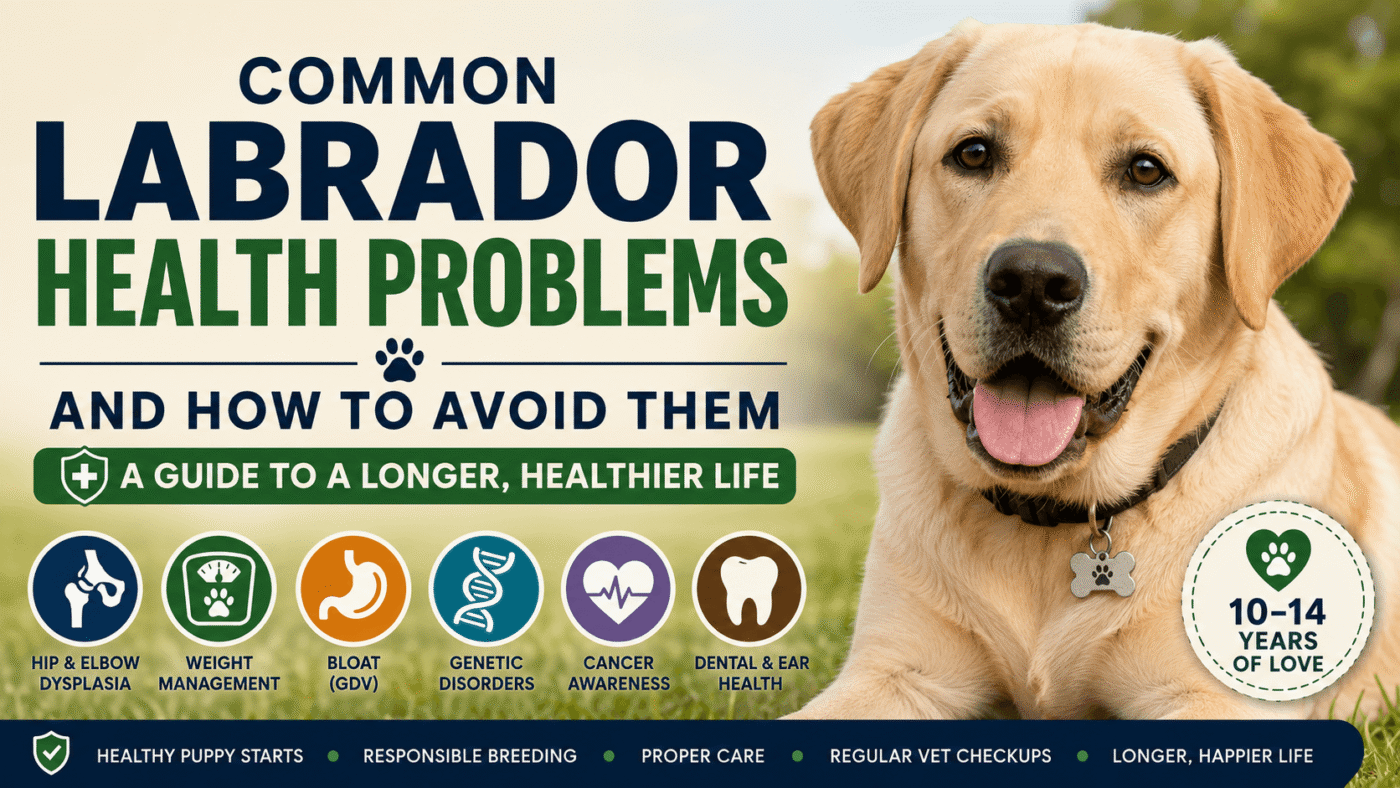
1. Hip Dysplasia
Hip dysplasia is among the most common and most discussed health problems in Labrador Retrievers. The Orthopedic Foundation for Animals (OFA) consistently identifies Labs as one of the more commonly affected large breeds — OFA data shows that a meaningful proportion of Labs evaluated have some degree of hip abnormality.
| Factor | Detail |
|---|---|
| What it is | Abnormal development of the hip joint — the ball and socket do not fit together correctly, causing wear, inflammation, pain, and progressive arthritis over time |
| Cause | Combination of genetic predisposition and environmental factors including weight, exercise type during puppyhood, and diet. Neither genetics nor environment alone determines outcome — both contribute |
| Signs | Stiffness after rest, reluctance to climb stairs or jump, reduced activity, a swaying or bunny-hopping gait in the hindquarters, muscle loss over the hindquarters in advanced cases |
| When signs appear | Some Labs show signs during puppyhood — others do not show clinical signs until middle age or senior years when arthritis has accumulated. The absence of early signs does not confirm healthy hips |
| How to reduce risk | Choose a puppy from parents with OFA or PennHIP hip clearances — verifiable at ofa.org. Maintain lean body weight throughout life. Follow the 5-minute exercise rule during puppyhood. Avoid high-impact exercise on hard surfaces before skeletal maturity |
| Management when diagnosed | Weight management, appropriate low-impact exercise (swimming is ideal), anti-inflammatory medication, joint supplements, and in severe cases surgical intervention. Early diagnosis allows more management options |
2. Elbow Dysplasia
| Factor | Detail |
|---|---|
| What it is | A group of developmental conditions affecting the elbow joint — including fragmented coronoid process, osteochondrosis, and ununited anconeal process — that cause pain, lameness, and progressive arthritis |
| Prevalence | OFA data consistently identifies Labs as one of the most commonly affected breeds for elbow dysplasia — in some OFA evaluations, elbow abnormalities are found at higher rates than hip abnormalities in Labs |
| Signs | Front leg lameness — often appearing between 4 and 12 months of age in affected puppies. Reluctance to extend the front legs, stiffness after rest, swelling around the elbow joint |
| How to reduce risk | OFA elbow evaluation on both parent dogs before breeding. Lean body weight. Avoiding repetitive high-impact exercise during growth. Large-breed puppy food with controlled calcium and phosphorus levels during the growth phase |
| Management when diagnosed | Weight management, controlled exercise, anti-inflammatory medication, and in some cases surgical intervention — earlier surgical treatment generally produces better outcomes |
3. Obesity
Obesity is the most common and most preventable health problem in Labrador Retrievers — and one of the most significant reducers of lifespan. A 2016 study published in Cell Metabolism identified a genetic mutation in the POMC gene in approximately 23% of Labs that impairs the normal feeling of fullness after eating — meaning nearly one in four Labs may be biologically predisposed to persistent food-seeking behaviour regardless of how much they have consumed.
| Factor | Detail |
|---|---|
| Prevalence | Extremely high — Labs are consistently identified as one of the most obesity-prone breeds in veterinary research. Studies suggest up to 59% of dogs seen in veterinary practices are overweight or obese |
| Consequences | Accelerated joint deterioration, increased cancer risk, cardiovascular stress, reduced exercise tolerance, shortened lifespan. Research suggests lean Labs live approximately 1.8 years longer than overweight counterparts |
| Signs of healthy weight | Ribs easily felt with light pressure but not visibly prominent. Clear waist visible from above. Slight abdominal tuck visible from the side. A Lab at healthy weight often looks thinner than owners expect |
| Prevention | Measured meals at scheduled times — never free-feed. Treats no more than 10% of daily caloric intake. Reduce portions after spaying or neutering. Regular weight checks at veterinary visits. Use a slow feeder bowl |
| Management when overweight | Reduce daily caloric intake by 10 to 20% and reassess body condition every 2 to 3 weeks. For significantly overweight Labs, a structured veterinary weight loss plan is more effective than simple portion reduction |
For a full guide on Lab feeding and portion management, read our guide on how much Labs eat.
4. Bloat – Gastric Dilatation-Volvulus (GDV)
| Factor | Detail |
|---|---|
| What it is | The stomach fills with gas and rotates on its axis — cutting off blood supply to the stomach and spleen. Without immediate emergency treatment, GDV is fatal within hours. It is one of the most serious emergencies in large breed dogs |
| Who is at risk | Deep-chested large breeds are at elevated risk — Labs fall into this category. Dogs that eat rapidly, eat one large meal daily, or exercise vigorously around mealtimes are at higher risk |
| Signs — know these immediately | Distended, hard, or visibly swollen abdomen. Unproductive retching — attempting to vomit without producing anything. Restlessness and distress. Drooling. Rapid deterioration. If you see these signs — go to an emergency veterinarian immediately, do not wait |
| Prevention | Feed two meals daily rather than one large meal. Do not exercise vigorously within 2 hours before or after eating. Use a slow feeder bowl to reduce eating speed. Avoid elevated food bowls — research has not confirmed the benefit and some evidence suggests elevated bowls may increase risk in large breeds |
| Treatment | Emergency surgical intervention — the stomach must be decompressed and rotated back to its correct position. Prophylactic gastropexy — surgical attachment of the stomach to the body wall — is sometimes performed to prevent recurrence or as a preventive measure in high-risk dogs |
5. Exercise-Induced Collapse (EIC)
| Factor | Detail |
|---|---|
| What it is | A genetic condition in which intense exercise triggers muscle weakness and collapse — typically after 5 to 25 minutes of strenuous activity. The dog loses coordination, wobbles, and collapses — then typically recovers within 5 to 25 minutes of rest. In rare cases EIC events are fatal |
| Genetic basis | EIC is caused by a mutation in the DNM1 gene — inherited as an autosomal recessive condition. A dog must inherit two copies of the mutation (one from each parent) to be affected. Carriers of one copy are unaffected but can pass the gene to offspring |
| Prevalence in Labs | Estimated to affect approximately 3% of Labrador Retrievers — with carrier rates significantly higher. Field-line Labs and hunting dogs are disproportionately represented in EIC cases due to their higher-intensity exercise exposure |
| How to screen | A simple DNA test identifies Clear, Carrier, or Affected status. Responsible breeding programs test both parent dogs — breeding two carriers together produces a statistical risk of Affected offspring. Always ask whether EIC DNA testing has been performed on both parents |
| Management if affected | Avoid high-intensity sustained exercise — most affected Labs can live normal lives with exercise modification. Identify and avoid the specific triggers — typically sustained retrieving, swimming, or field work — and manage accordingly |
6. Progressive Retinal Atrophy (PRA)
| Factor | Detail |
|---|---|
| What it is | A group of genetic eye conditions causing progressive deterioration of the retina — leading to night blindness first, then progressive vision loss, and eventually complete blindness in affected dogs |
| Genetic basis | In Labrador Retrievers, the most common form is prcd-PRA — an autosomal recessive condition requiring two copies of the mutation for the dog to be affected. Carriers of one copy are unaffected but pass the gene to offspring |
| Signs | Night blindness appearing first — the dog becomes hesitant in low light, bumps into objects in the dark, and is reluctant to go outside at night. Pupils may appear more dilated than normal. Day vision loss follows progressively |
| Age of onset | Clinical signs typically appear in middle age — between 3 and 8 years in most affected Labs |
| How to screen | DNA testing identifies Clear, Carrier, or Affected status before breeding. CAER (Canine Annual Eye Registry) examination by a board-certified veterinary ophthalmologist provides annual eye health certification. Both are standard in responsible Lab breeding programs |
| Management | No treatment exists for PRA — management focuses on environmental adaptation to support a blind or partially sighted dog. Affected dogs typically adapt well to vision loss when their home environment remains consistent |
7. Cancer
| Factor | Detail |
|---|---|
| Prevalence | Cancer is among the leading causes of death in Labs over 10 years of age — as in most dog breeds. Labs are not uniquely cancer-prone compared to many other large breeds, but their longevity means more Labs reach the age at which cancer becomes statistically more likely |
| Most common types in Labs | Mast cell tumors, lymphoma, hemangiosarcoma, and osteosarcoma are among the more frequently diagnosed cancers in Labrador Retrievers — though any cancer type can occur |
| Risk factors | Age is the strongest risk factor. Obesity is associated with increased cancer risk in dogs as in humans. Some evidence suggests early spaying and neutering may affect cancer risk profiles — discuss timing of neutering with your veterinarian |
| Early detection | Annual veterinary examinations — increasing to twice yearly from age 7 — provide the best opportunity for early detection. Owners should investigate any new lump, unexplained weight loss, reduced appetite, or persistent lethargy promptly rather than waiting for the annual exam |
| What owners can control | Maintaining healthy weight, annual veterinary screening, and prompt investigation of any physical changes. Early detection significantly affects treatment options and outcomes for most cancer types |
8. Ear Infections
Ear infections are among the most common reasons Labs visit the veterinarian — their floppy ears trap moisture and their enthusiasm for swimming creates the warm, damp ear canal environment that bacterial and yeast infections thrive in:
| Factor | Detail |
|---|---|
| Why Labs are prone | Floppy ear flaps restrict airflow to the ear canal — creating a warm, dark, moist environment that bacteria and yeast colonize readily. Swimming dramatically increases moisture in the ear canal and significantly raises infection risk in Labs that swim regularly |
| Signs | Strong or unpleasant odour from the ear. Dark brown or black discharge. Redness or swelling of the ear canal. The Lab scratching at their ear, shaking their head, or rubbing their ear on the floor. Sensitivity when the ear is touched |
| Prevention | Weekly ear inspection. Dry the outer ear canal gently after every swimming session using a soft cloth or cotton ball. Clean ears with a veterinarian-recommended ear cleaning solution every 2 to 4 weeks for Labs that swim regularly |
| Treatment | Veterinary examination to identify the infection type — bacterial, yeast, or mixed — followed by appropriate topical or oral treatment. Do not attempt to treat ear infections at home without veterinary guidance — incorrect treatment can worsen the infection or cause antibiotic resistance |
| Chronic ear infections | Labs with recurrent ear infections may have an underlying allergy — food or environmental — that creates chronic inflammation of the ear canal. Identifying and managing the underlying allergy breaks the cycle of repeated infections |
9. Dental Disease
| Factor | Detail |
|---|---|
| Prevalence | Dental disease is among the most common health problems in all dog breeds — studies suggest that by age 3, the majority of dogs show some degree of dental disease. Labs are no exception |
| Why it matters beyond the mouth | Untreated dental disease allows bacteria to enter the bloodstream — affecting the heart, kidneys, and liver. Systemic bacterial infection from dental disease is a genuine contributor to shortened lifespan in dogs including Labs |
| Signs | Bad breath (beyond normal dog breath), brown or yellow tartar buildup on teeth, red or swollen gums, reluctance to chew hard food or toys, pawing at the mouth, and in advanced cases dropping food while eating |
| Prevention | Daily tooth brushing with dog-specific toothpaste is the gold standard — introduced from puppyhood using a finger brush and gradually progressing to a toothbrush. VOHC-approved dental chews provide supplementary plaque control. Annual veterinary dental examination |
| Professional cleaning | When tartar buildup reaches a level that brushing cannot address, professional cleaning under anaesthetic is required — this is a routine veterinary procedure. Delaying professional cleaning when recommended allows disease to progress to tooth loss and systemic infection |
10. Skin and Coat Conditions
| Condition | Detail |
|---|---|
| Environmental allergies | Labs can develop allergies to environmental triggers — pollen, dust mites, mold — that manifest as itchy skin, recurrent ear infections, and paw licking. Management includes identifying triggers, allergen avoidance where possible, and veterinary treatment |
| Food allergies and sensitivities | Some Labs develop sensitivity to specific protein or grain sources — typically manifesting as chronic itching, recurrent ear infections, or digestive upset. A veterinary elimination diet trial identifies the triggering ingredient |
| Hot spots — acute moist dermatitis | Labs that swim regularly are prone to hot spots — rapidly developing areas of inflamed, infected skin that appear suddenly and spread quickly if not treated. Keep the coat dry after swimming, particularly in humid weather |
| Color Dilution Alopecia — Silver Labs | Silver Labs carrying the dilute gene may develop Color Dilution Alopecia — a skin and coat condition causing dryness, flaking, and coat thinning. Not all Silver Labs are affected — prevalence in the breed is not well-documented. Discuss with any Silver Lab breeder before purchasing |
What Responsible Breeders Do to Reduce These Risks
| Health Test | What It Screens For | How to Verify |
|---|---|---|
| OFA or PennHIP Hip Evaluation | Hip dysplasia — malformation of the hip joint | Search both parent dogs by registered name at ofa.org — results are public and free to access |
| OFA Elbow Evaluation | Elbow dysplasia — developmental conditions of the elbow joint | Same OFA database search — elbow results appear alongside hip results |
| CAER Eye Certification | Progressive Retinal Atrophy and other hereditary eye conditions | Ask to see the current CAER certificate — must be renewed annually by a board-certified veterinary ophthalmologist |
| EIC DNA Test | Exercise-Induced Collapse — genetic mutation in the DNM1 gene | Ask to see the DNA test certificate — results show as Clear, Carrier, or Affected. Both parents should be tested |
| prcd-PRA DNA Test | Progressive Retinal Atrophy genetic carrier status | DNA test certificate — same Clear, Carrier, Affected results as EIC testing |
All of these tests are verifiable before you commit to a puppy — a breeder who cannot or will not provide this documentation has not performed the testing. Read our full guide on how to choose a Labrador breeder.
Lab Owner Prevention Checklist
| Action | Frequency |
|---|---|
| ✅ Choose puppy from OFA-tested parents — hips, elbows, eyes, EIC, PRA | Before purchase |
| ✅ Feed measured meals — no free feeding, no table scraps | Every meal — daily |
| ✅ Brush teeth with dog-specific toothpaste | Daily — or minimum 3 to 4 times weekly |
| ✅ Inspect ears for odour, redness, or discharge | Weekly |
| ✅ Dry ears after swimming | Every swim |
| ✅ Exercise daily — age appropriate | Daily — two sessions |
| ✅ Body condition check — rib and waist check | Monthly |
| ✅ Parasite prevention — heartworm, flea, tick | Year-round — per product instructions |
| ✅ Veterinary examination | Annual until age 7 — twice yearly from age 7 |
| ✅ Investigate any new lumps promptly | Within one week of discovery |
Estimated Treatment Costs – Common Labrador Health Problems
Costs vary significantly by location, clinic, and severity — these are approximate US ranges to help owners plan:
| Condition / Procedure | Approximate US Cost | Notes |
|---|---|---|
| OFA hip evaluation — pre-breeding | $300 – $500 | Per dog — includes X-rays and OFA submission fee |
| OFA elbow evaluation — pre-breeding | $300 – $500 | Per dog — often done at the same time as hip X-rays |
| EIC and PRA DNA tests | $75 – $150 each | Simple cheek swab — can be done at home and mailed to the lab |
| Hip dysplasia management — ongoing | $500 – $2,000+ annually | Medication, supplements, physiotherapy — varies by severity |
| Hip dysplasia surgery — Triple Pelvic Osteotomy or Total Hip Replacement | $3,500 – $7,000+ per hip | Varies significantly by procedure and location |
| Bloat — GDV emergency surgery | $3,000 – $7,500 | Emergency pricing — cost varies by severity and location. Pet insurance strongly recommended |
| Ear infection treatment | $100 – $300 per episode | Exam, culture if chronic, medication. Chronic allergy-driven infections cost more |
| Professional dental cleaning | $300 – $800 | Includes anaesthetic — price varies by level of disease and extractions required |
| Cancer diagnosis and treatment | $1,000 – $20,000+ | Extremely variable by type, stage, and treatment chosen. Pet insurance most valuable here |
| Annual veterinary exam | $150 – $300 | Excluding vaccinations, bloodwork, and parasite prevention — which add to the total |
Pet insurance taken out before any conditions develop is the most effective way to manage the financial risk of the more expensive conditions on this list — particularly GDV, hip surgery, and cancer treatment.
Healthy Labrador Checklist
A Lab that is healthy and well-cared for should consistently show most of these signs:
| Checklist Item | Why It Matters |
|---|---|
| ✅ Visible waist when viewed from above — ribs easily felt | The clearest single indicator of healthy weight — the most impactful health factor in Labs |
| ✅ Willingness to exercise daily — energy appropriate for age | Reluctance to exercise in a previously active Lab is an early warning sign for joint pain, illness, or weight issues |
| ✅ Clean ears with no odour or discharge | Weekly inspection catches the early signs of ear infection before they become established |
| ✅ Bright, clear eyes with no cloudiness or discharge | Eye clarity is a good general health indicator — changes warrant veterinary attention |
| ✅ Clean teeth and fresh breath | Dental health reflects consistent care and reduces systemic infection risk |
| ✅ Measured meals — no free feeding | The most controllable factor in Lab obesity prevention |
| ✅ Stable weight — no gradual gain between annual vet visits | Slow weight gain is the most commonly missed early health problem in Labs — weigh monthly |
| ✅ Annual veterinary exam — twice yearly from age 7 | Early detection of cancer, kidney disease, dental disease, and joint deterioration |
| ✅ Year-round parasite prevention — heartworm, fleas, ticks | Parasite-borne diseases have long-term organ health consequences that shorten lifespan |
| ✅ Good appetite with no unexplained changes | Significant appetite increase or decrease in a senior Lab is an early signal worth investigating |
Research References
| Source | What It Covers | Link |
|---|---|---|
| Orthopedic Foundation for Animals (OFA) | Hip and elbow dysplasia prevalence data, DNA health test results, and breed statistics for Labrador Retrievers | ofa.org |
| American Kennel Club (AKC) | Labrador Retriever breed standard, health recommendations, and breeder guidance | akc.org |
| Cell Metabolism — 2016 POMC gene study | Identified the POMC gene mutation in approximately 23% of Labrador Retrievers affecting satiety signalling | Raffan et al., Cell Metabolism, 2016 |
| Canine Genetics and Epidemiology — 2018 chocolate Lab lifespan study | Found median lifespan of 10.7 years in Chocolate Labs vs 12.1 years in Black and Yellow Labs | O’Neill et al., Canine Genetics and Epidemiology, 2018 |
| Scientific Reports — 2023 UK dog lifespan study | Analyzed over 30,000 dogs — found median Lab lifespan of approximately 12 years | Trevail et al., Scientific Reports, 2023 |
| American College of Veterinary Surgeons (ACVS) | GDV surgical treatment, prevention, and prophylactic gastropexy guidance | acvs.org |
Our Available Lab Puppies
Every puppy from Labrador Today comes from parents with OFA health testing across hips, elbows, eyes, and applicable DNA screenings — the most important foundation for reducing the common Labrador health problems covered in this guide. Full health documentation is provided with every puppy.
- Black Lab Puppies
- Yellow Lab Puppies
- Chocolate Lab Puppies
- White English Cream Lab Puppies
- Silver Lab Puppies
- Red Fox Lab Puppies
For further reading on Lab health:
- How Long Do Labrador Retrievers Live?
- How Much Do Labs Eat? Feeding Guide by Age and Weight
- Labrador Exercise Needs by Age
- How to Choose a Labrador Breeder
👉 Browse All Available Puppies
👉 Contact Us to Verify Health Testing Before Reserving
Frequently Asked Questions
What are the most common health problems in Labrador Retrievers?
The most common Labrador health problems are hip dysplasia, elbow dysplasia, obesity, ear infections, dental disease, bloat (GDV), Exercise-Induced Collapse (EIC), Progressive Retinal Atrophy (PRA), cancer in older Labs, and skin and coat conditions including allergies. Many of these are hereditary — choosing a puppy from health-tested parents significantly reduces the inherited risk for the genetic conditions. Obesity and ear infections are the most preventable through consistent owner management.
How do I know if a Lab breeder has health tested their dogs?
Ask for the registered names of both parent dogs and verify their OFA hip and elbow clearances yourself at ofa.org — the database is free and publicly searchable. Ask to see CAER eye certification (current — renewed annually) and EIC and PRA DNA test certificates. A reputable breeder provides all of this without hesitation. Read our full guide on how to choose a Labrador breeder.
Are Labs prone to hip problems?
Yes — the OFA consistently identifies Labrador Retrievers as one of the large breeds with elevated rates of hip dysplasia. However, the risk is significantly reduced when both parent dogs have OFA or PennHIP hip clearances, the puppy is kept at a lean weight throughout life, and appropriate exercise guidelines (including the 5-minute puppy rule) are followed during the growth phase.
What is EIC in Labradors?
Exercise-Induced Collapse is a genetic condition caused by a mutation in the DNM1 gene. Affected Labs collapse after 5 to 25 minutes of intense exercise — then typically recover with rest. It is inherited as a recessive condition requiring two copies of the mutation to cause the condition. A simple DNA test identifies Clear, Carrier, or Affected status — responsible breeders test both parents to avoid producing Affected puppies.
Is bloat common in Labs?
Labs are at moderate risk for bloat (GDV) as a deep-chested large breed. Risk is reduced by feeding two meals daily rather than one large meal, using a slow feeder bowl, and avoiding vigorous exercise within two hours before and after eating. Bloat is a life-threatening emergency — if you see a distended abdomen, unproductive retching, or sudden distress in your Lab, go to an emergency veterinarian immediately without waiting.
How can I keep my Labrador healthy?
The most impactful steps: choose a puppy from OFA health-tested parents, maintain lean body weight throughout life, provide daily age-appropriate exercise, attend annual veterinary exams (twice yearly from age 7), provide daily dental care, inspect ears weekly and dry them after swimming, and investigate any new lumps or unexplained changes promptly. These steps collectively address the most common and most preventable Labrador health problems.
