

The question of how long do Labrador Retrievers live is one every prospective Lab owner should answer honestly before bringing a puppy home — not because the answer is discouraging, but because it shapes everything from the financial planning of ownership to the emotional commitment of a decade-plus relationship. Labs are a medium-to-large breed with a lifespan that compares favorably to many dogs of similar size, but the range between the shortest and longest-lived Labs is significant — and much of that range is within the owner’s influence.
This guide covers the Lab’s average lifespan, what the research shows affects longevity, the health conditions most likely to shorten a Lab’s life, and the practical steps that give your Lab the best chance of reaching the longer end of the range. Browse our available Lab puppies if you are still in the planning stage.
- Quick Lifespan Facts – Labrador Retriever
- How Long Do Labrador Retrievers Live – The Numbers
- What Affects How Long a Labrador Retriever Lives
- Labrador Life Stages – What to Expect at Each Age
- Health Conditions That Most Commonly Affect Lab Lifespan
- How to Help Your Labrador Live Longer – Practical Steps
- Signs Your Lab Is Aging Well
- Our Available Lab Puppies
- Common Myths About Labrador Lifespan
- Frequently Asked Questions
Quick Lifespan Facts – Labrador Retriever
| Fact | Figure |
|---|---|
| Average lifespan | 10 to 14 years |
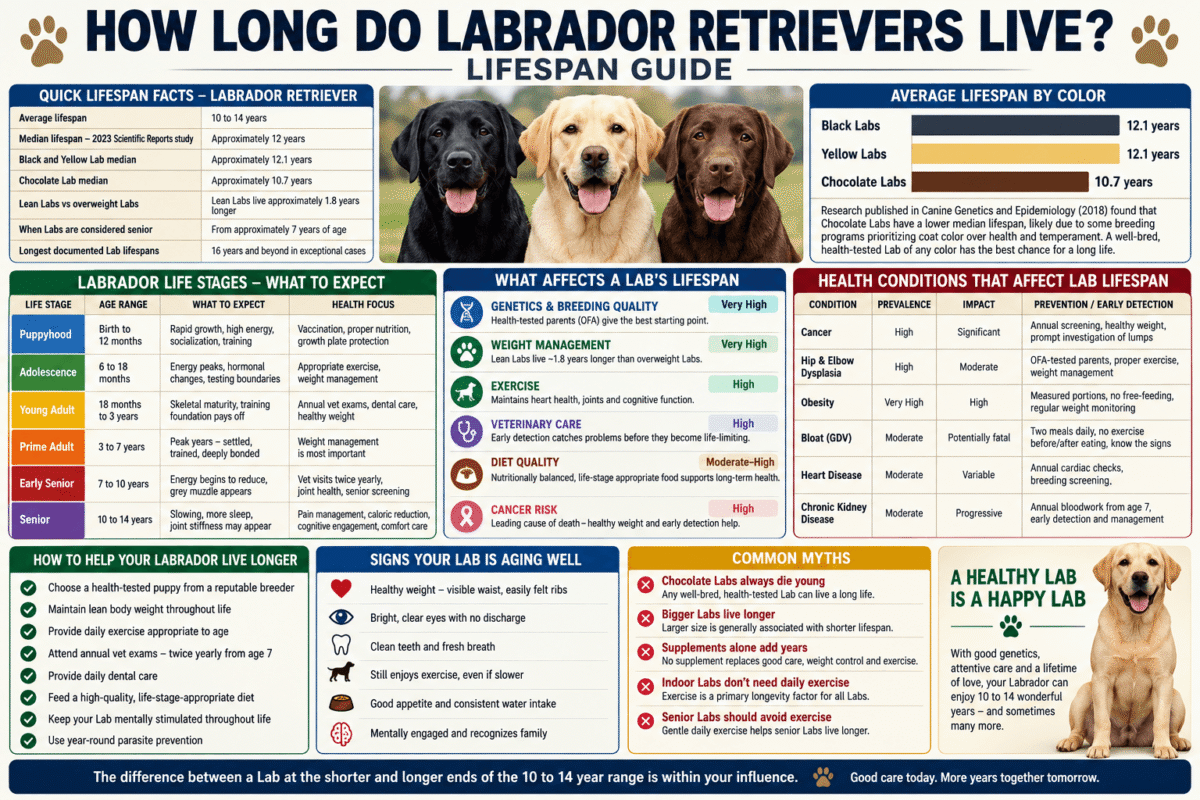
| Median lifespan — 2023 Scientific Reports study | Approximately 12 years |
| Black and Yellow Lab median | Approximately 12.1 years |
| Chocolate Lab median | Approximately 10.7 years |
| Lean Labs vs overweight Labs | Lean Labs live approximately 1.8 years longer |
| When Labs are considered senior | From approximately 7 years of age |
| Longest documented Lab lifespans | 16 years and beyond in exceptional cases |
How Long Do Labrador Retrievers Live – The Numbers
| Lifespan Factor | Detail |
|---|---|
| Average Labrador lifespan | 10 to 14 years — the most commonly cited range across veterinary literature and breed registries. The American Kennel Club lists the Lab’s life expectancy as 10 to 12 years, while well-bred Labs from health-tested lines regularly reach 12 to 14 years |
| Median lifespan in research | A 2023 study published in Scientific Reports analyzing over 30,000 dogs in the UK found the median lifespan of Labrador Retrievers to be approximately 12 years — placing them among the longer-lived large breeds |
| Chocolate Lab lifespan | Research published in Canine Genetics and Epidemiology in 2018 found that Chocolate Labs had a median lifespan of 10.7 years compared to 12.1 years for Black and Yellow Labs — a finding attributed to the health consequences of selecting breeding stock primarily for coat color rather than health and temperament in some Chocolate Lab lines |
| Longest recorded Labs | Individual Labs have been documented living to 16 and beyond — these are outliers but demonstrate what is possible with excellent genetics, diet, and care throughout life |
| Sex and lifespan | Female dogs of most breeds tend to live slightly longer than males on average — though the difference in Labs is not dramatic. Spayed females may have a slightly different health risk profile than intact females depending on the age of spaying |
What Affects How Long a Labrador Retriever Lives
| Factor | Impact on Lifespan | What Owners Can Do |
|---|---|---|
| Genetics and breeding quality | High — the single most significant factor outside owner control. A Lab from health-tested parents with OFA-cleared hips, elbows, and eyes has a meaningfully better starting point than one from untested parents | Choose a breeder who health tests both parents and can show OFA clearances verifiable at ofa.org. Read our guide on how to choose a Labrador breeder |
| Weight management | Very high — obesity is one of the most significant reducers of lifespan in Labs. Research suggests that dogs maintained at a lean body weight live an average of 1.8 years longer than their overweight counterparts | Measure every meal, never free-feed, maintain a visible waist and easily palpable ribs throughout life. Read our guide on how much Labs eat |
| Exercise throughout life | High — appropriate exercise maintains healthy weight, joint function, cardiovascular health, and cognitive sharpness into senior years | Daily exercise appropriate to age — from the 5-minute rule in puppyhood through 60 to 90 minutes in adulthood to gentler exercise in senior years. Read our guide on Labrador exercise needs by age |
| Veterinary care and early disease detection | High — annual veterinary examinations catch developing health problems before they become life-limiting. Many conditions that shorten Lab lifespans are manageable when detected early | Annual veterinary exams — more frequent from age 7 onwards. Dental care, parasite prevention, and age-appropriate screening tests |
| Diet quality | Moderate to high — a nutritionally balanced diet appropriate to life stage supports immune function, organ health, and healthy weight maintenance throughout life | Feed a high-quality, life-stage-appropriate food. Avoid free-feeding. Account for treats in daily caloric intake |
| Cancer risk | High impact when it occurs — cancer is among the leading causes of death in Labs as in most dog breeds. Genetic predisposition exists but lifestyle factors including weight and diet play a role in cancer risk | Regular veterinary screening, prompt investigation of any lumps or unexplained weight loss, and maintaining a healthy weight throughout life |
Labrador Life Stages – What to Expect at Each Age
| Life Stage | Age Range | What to Expect | Health Focus |
|---|---|---|---|
| Puppyhood | Birth to 12 months | Rapid growth, high energy, socialization window, vaccination and parasite prevention program, first veterinary examinations. Foundational habits formed in this stage affect health throughout life | Growth plate protection, appropriate puppy nutrition, vaccination, socialization, crate and housetraining |
| Adolescence | 6 to 18 months | Energy peaks, continued growth, hormonal changes. The most behaviorally challenging period for most owners — and the period when weight management habits either form or do not | Appropriate exercise — not too much on developing joints. Discuss neutering and spaying timing with your veterinarian. Weight management from the start |
| Young adult | 18 months to 3 years | Skeletal maturity reached, energy begins to moderate, training foundation pays off. Labs in this stage are generally at their easiest and most rewarding to own | Annual veterinary exams, dental care, weight monitoring, parasite prevention, continued exercise |
| Prime adult | 3 to 7 years | The peak years of Lab ownership — settled, trained, deeply bonded, and physically healthy in most well-cared-for Labs. Weight tends to creep upward in this stage without active management | Weight management is the most important focus — many Labs gain weight gradually during this period without owners noticing until it is significant |
| Early senior | 7 to 10 years | Energy begins to reduce, grey around the muzzle appears, recovery from exercise takes slightly longer. Many Labs remain highly active and vital through this entire stage | Increase vet visits to twice yearly. Joint health monitoring, dental care, weight management, cognitive engagement. Discuss senior blood panels with your veterinarian |
| Senior | 10 to 14 years | Slowing significantly — sleep increases, exercise tolerance reduces, joint stiffness may appear, cognitive changes possible. This stage requires the most attentive care and the most significant management adjustments | Pain management for arthritis, caloric reduction as activity decreases, cognitive enrichment, twice-yearly vet visits minimum, cancer screening, comfort management |
Health Conditions That Most Commonly Affect Lab Lifespan
| Condition | Prevalence in Labs | Impact on Lifespan | Prevention or Early Detection |
|---|---|---|---|
| Cancer | High — cancer is among the leading causes of death in Labs as in most dog breeds over 10 years of age | Significant — depending on type and stage at detection, cancer can be the primary life-limiting condition | Annual veterinary screening, prompt investigation of lumps, unexplained weight loss, or appetite changes. Maintaining healthy weight throughout life is associated with lower cancer risk |
| Hip and elbow dysplasia | High — Labs show elevated rates of both conditions. OFA data consistently identifies Labs as one of the more frequently affected large breeds | Moderate — dysplasia is rarely directly life-limiting but the pain, reduced mobility, and weight gain from inactivity it causes can significantly reduce quality of life and hasten decline in senior Labs | Health-tested parents with OFA-cleared hips and elbows, appropriate puppy exercise (5-minute rule), weight management throughout life, early diagnosis and management |
| Obesity | Very high — Labs are among the most obesity-prone breeds. Research suggests up to 59% of dogs seen in veterinary practices are overweight or obese | High — obesity accelerates joint deterioration, increases cancer risk, stresses the cardiovascular system, and is associated with significantly shorter lifespan | Measured portions, no free-feeding, regular weight monitoring, body condition scoring at every vet visit |
| Bloat — Gastric Dilatation-Volvulus (GDV) | Moderate — deep-chested breeds including Labs are at elevated risk for bloat, a life-threatening emergency | Potentially fatal without immediate emergency veterinary care — GDV can kill within hours of onset | Feed two meals daily rather than one large meal, avoid vigorous exercise immediately before and after eating, know the signs — distended abdomen, unproductive retching, restlessness — and treat as an emergency |
| Heart disease | Moderate — tricuspid valve dysplasia is a congenital heart condition seen in Labs at higher rates than some other breeds | Variable — mild cases are manageable for many years; severe cases can significantly shorten lifespan | Annual veterinary cardiac auscultation, echocardiogram if murmur detected. Some Labs benefit from cardiac screening as part of their breeding program |
| Chronic kidney disease | Moderate — increases in prevalence with age across all dog breeds including Labs | Progressive — early detection through blood and urine screening allows management that can significantly extend quality and length of life | Annual bloodwork from age 7 onwards to catch early kidney function changes before clinical signs appear |
“Maintaining a lean body weight throughout life is one of the most consistently evidence-supported ways to help a Labrador live longer. It reduces joint stress, cancer risk, and cardiovascular burden — and it is entirely within the owner’s control from the very first day the puppy comes home.”
— A view widely held across veterinary nutrition and canine longevity research
How to Help Your Labrador Live Longer – Practical Steps
| Action | Why It Extends Lifespan | When to Start |
|---|---|---|
| Choose a health-tested puppy from a reputable breeder | Genetics is the foundation — OFA-cleared parents reduce the inherited risk of hip dysplasia, elbow dysplasia, and eye conditions that compromise quality and length of life | Before purchase — non-negotiable |
| Maintain lean body weight throughout life | Research suggests lean dogs live an average of 1.8 years longer than overweight counterparts. Weight is the most modifiable lifespan factor for Lab owners | From 8 weeks — measure every meal |
| Daily exercise appropriate to age | Maintains cardiovascular health, joint function, healthy weight, and cognitive sharpness. An exercised Lab ages better in every measurable way | From 8 weeks — age-appropriate from day one |
| Annual veterinary exams — twice yearly from age 7 | Early detection of cancer, kidney disease, heart disease, and dental disease allows treatment before conditions become life-limiting | Within the first week — establish the relationship immediately |
| Daily dental care | Dental disease left untreated causes systemic bacterial infection that affects the heart, kidneys, and liver — organs whose health directly affects lifespan | From 8 weeks — introduce finger brush from day one |
| Feed a high-quality, life-stage-appropriate diet | Appropriate nutrition supports immune function, organ health, and healthy weight throughout life. Large-breed puppy food during growth, adult food from 12 to 18 months, senior food from 7 to 8 years | From 8 weeks — large breed puppy food |
| Mental stimulation throughout life | Cognitive engagement maintains brain health and reduces the cognitive decline that can accompany aging in dogs — training, puzzle feeders, scent games, and social interaction all contribute | From 8 weeks — training from day one |
| Parasite prevention year-round | Heartworm, tick-borne diseases, and intestinal parasites all compromise organ function over time. Consistent prevention protects long-term health | From first vet visit — discuss appropriate protocol for your region |
Signs Your Lab Is Aging Well
| Sign | What It Indicates |
|---|---|
| Healthy weight maintained — visible waist, easily felt ribs | Weight management throughout life is the clearest indicator of good long-term care and the strongest predictor of a longer lifespan |
| Bright, clear eyes with no discharge | Ocular health is a good general indicator of systemic health in aging Labs |
| Clean teeth and fresh breath | Dental health reflects consistent care and reduces the systemic infection risk that dental disease creates |
| Willingness to exercise — even if slower | A senior Lab that still enjoys daily walks, swimming, and gentle activity is aging well. Reluctance to move or exercise in a previously active dog warrants veterinary attention |
| Good appetite and consistent water intake | Significant changes in appetite or water consumption in a senior Lab are among the earliest signs of kidney disease, diabetes, or other systemic conditions — report both increases and decreases to your veterinarian |
| Mental engagement and recognition | A Lab that remains curious, responsive, and interactive with its family is maintaining cognitive function. Significant disorientation, staring at walls, or loss of house training in a senior Lab may indicate Canine Cognitive Dysfunction — discuss with your veterinarian |
Our Available Lab Puppies
A Labrador’s lifespan starts with responsible breeding. Every puppy from Labrador Today comes from parents with OFA health testing — giving your puppy the genetic foundation for the longest and healthiest life possible. The difference between a Lab at the shorter and longer end of the 10 to 14 year range begins before they are born — with the health decisions made in the breeding program. We provide full health documentation, written health guarantee, and lifetime breeder support:
- Black Lab Puppies
- Yellow Lab Puppies
- Chocolate Lab Puppies
- White English Cream Lab Puppies
- Silver Lab Puppies
- Red Fox Lab Puppies
For further reading on Lab health and care:
- How to Choose a Labrador Breeder
- Labrador Exercise Needs by Age
- How Much Do Labs Eat? Feeding Guide by Age and Weight
- Labrador Grooming Guide
👉 Browse All Available Puppies
👉 Contact Us With Any Questions About Lab Health and Longevity
Common Myths About Labrador Lifespan
| Myth | The Reality |
|---|---|
| ❌ Chocolate Labs always die young | Research shows Chocolate Labs have a lower median lifespan on average — but this reflects historical breeding practices in some lines, not an inevitable outcome. A Chocolate Lab from a reputable, health-tested breeder does not necessarily face a shorter life than a well-bred Black or Yellow Lab |
| ❌ Bigger Labs live longer | The opposite is generally true — larger body size within a breed is associated with shorter lifespan in dogs. A leaner, lighter Lab within the healthy weight range is more likely to live longer than an overweight or heavily built one |
| ❌ Supplements alone can add years to a Lab’s life | No supplement replaces the lifespan benefits of lean body weight, daily exercise, and quality veterinary care. Joint supplements, omega-3s, and antioxidants may support health in specific ways — but they are additions to good care, not substitutes for it |
| ❌ Indoor Labs do not need daily exercise | Exercise is a primary longevity factor regardless of where the dog lives. An indoor Lab that does not get daily exercise gains weight, loses muscle mass, and develops joint and cardiovascular problems faster than an active Lab of any living situation |
| ❌ Senior Labs should rest and avoid exercise | The opposite — gentle daily exercise is one of the most important things for a senior Lab’s joint health, weight management, cardiovascular health, and cognitive function. The type and intensity of exercise should reduce, but stopping exercise entirely accelerates decline |
| ❌ A Lab from a cheap breeder is just as healthy as one from a health-tested program | Genetics is the foundation of health. A puppy from untested parents carries unknown inherited disease risk that no amount of good care can fully compensate for. Health testing both parents before breeding is the most important single step in producing long-lived, healthy Labs |
Frequently Asked Questions
How long do Labrador Retrievers live on average?
The average Labrador lifespan is 10 to 14 years. The AKC lists the expected lifespan as 10 to 12 years, while well-bred Labs from health-tested lines regularly reach 12 to 14 years. A 2023 study published in Scientific Reports found the median lifespan of Labrador Retrievers to be approximately 12 years — placing them among the longer-lived large breeds.
Do Chocolate Labs have a shorter lifespan?
Research published in Canine Genetics and Epidemiology found that Chocolate Labs had a median lifespan of 10.7 years compared to 12.1 years for Black and Yellow Labs. The most widely cited explanation is that Chocolate Lab breeding programs have in some cases selected primarily for coat color rather than health and temperament — reducing the gene pool and inadvertently selecting for some health disadvantages. A Chocolate Lab from a reputable, health-tested breeder is not necessarily at a disadvantage compared to well-bred Black or Yellow Labs.
What is the oldest a Labrador has ever lived?
Individual Labs have been documented living to 16 years and beyond — these are exceptional cases but demonstrate what is possible with excellent genetics combined with attentive lifelong care. The factors that contribute to the longest-lived Labs are consistent across cases: lean body weight maintained throughout life, regular exercise, high-quality diet, and attentive veterinary care from puppyhood.
What shortens a Labrador’s lifespan most?
Obesity is the most significant and most preventable factor — research suggests overweight dogs live an average of nearly 2 years less than dogs maintained at a lean weight. Cancer is the most common cause of death in Labs over 10 years and is partially influenced by weight and genetics. Hip and elbow dysplasia — while rarely directly life-limiting — can significantly reduce quality of life in senior Labs and hasten decline. Choosing a puppy from health-tested parents reduces inherited disease risk at the foundation.
How can I help my Lab live longer?
The five most evidence-supported steps: maintain a lean body weight throughout life (measurable difference of approximately 1.8 years), provide daily age-appropriate exercise, attend annual veterinary exams (twice yearly from age 7), provide daily dental care to prevent systemic infection, and choose a puppy from OFA health-tested parents. These factors are within every owner’s control and collectively represent the difference between a Lab at the shorter and longer ends of the 10 to 14 year range.
At what age is a Labrador considered senior?
Labs are generally considered to enter their senior years at around 7 years of age — the point at which veterinarians typically recommend increasing examination frequency to twice yearly and beginning senior-specific health screening including bloodwork and urinalysis. Many Labs remain highly active and show few signs of aging through their early senior years — being considered senior at 7 does not mean decline is imminent, simply that attentive monitoring becomes more important.
