
How much do Labs eat is one of the most practically important questions a Lab owner can ask — and one where getting it wrong in either direction has real consequences. Underfeeding a growing Lab puppy risks stunted development. Overfeeding a Lab at any age risks obesity — and Labs are among the most obesity-prone breeds in the world. Their legendary food motivation means they will eat whatever is offered without self-regulating, making the owner’s portion control the single most important factor in a Lab’s long-term health.
This guide covers exactly how much to feed a Lab at every life stage — by age and by weight — along with feeding schedules, food type considerations, and the signs that tell you whether your Lab is at a healthy weight. Browse our available Lab puppies if you are still in the planning stage.
- How Much Do Labs Eat – Quick Reference by Age
- How Much Do Labs Eat in Calories – Daily kcal Guide
- How Much Do Labs Eat by Weight – Adult Guide
- Labrador Puppy Feeding Schedule
- When to Switch from Puppy Food to Adult Food
- What to Feed a Labrador – Food Type Comparison
- The Labrador Obesity Problem – Why It Matters
- How to Tell If Your Lab Is the Right Weight
- Feeding Adjustment by Body Condition
- Foods That Are Dangerous for Labs
- Feeding Tips Specific to Labradors
- Our Available Lab Puppies
- Frequently Asked Questions
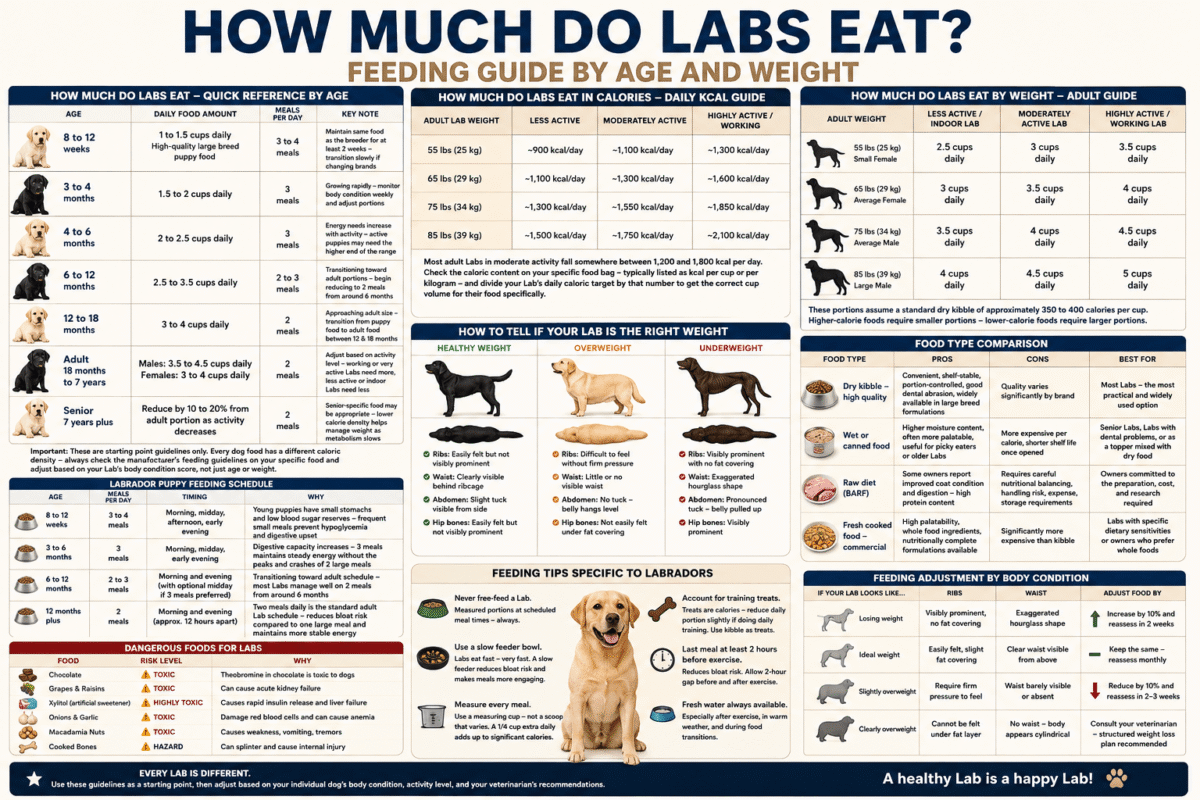
How Much Do Labs Eat – Quick Reference by Age
| Age | Daily Food Amount | Meals Per Day | Key Note |
|---|---|---|---|
| 8 to 12 weeks | 1 to 1.5 cups daily — high-quality large breed puppy food | 3 to 4 meals | Maintain same food as the breeder for at least 2 weeks — transition slowly if changing brands |
| 3 to 4 months | 1.5 to 2 cups daily | 3 meals | Growing rapidly — monitor body condition weekly and adjust portions if ribs are hard to feel or very prominent |
| 4 to 6 months | 2 to 2.5 cups daily | 3 meals | Energy needs increase with activity — active puppies may need the higher end of the range |
| 6 to 12 months | 2.5 to 3.5 cups daily | 2 to 3 meals | Transitioning toward adult portions — begin reducing to 2 meals from around 6 months |
| 12 to 18 months | 3 to 4 cups daily | 2 meals | Approaching adult size — transition from puppy food to adult food between 12 and 18 months |
| Adult — 18 months to 7 years | Males: 3.5 to 4.5 cups daily / Females: 3 to 4 cups daily | 2 meals | Adjust based on activity level — working or very active Labs need more, less active or indoor Labs need less |
| Senior — 7 years plus | Reduce by 10 to 20% from adult portion as activity decreases | 2 meals | Senior-specific food may be appropriate — lower calorie density helps manage weight as metabolism slows |
Important: These are starting point guidelines only. Every dog food has a different caloric density — always check the manufacturer’s feeding guidelines on your specific food and adjust based on your Lab’s body condition score, not just age or weight.
How Much Do Labs Eat in Calories – Daily kcal Guide
Veterinarians think in calories rather than cups — and since cup volume varies significantly between foods, caloric intake is the more accurate measure. As a general starting point:
| Adult Lab Weight | Less Active | Moderately Active | Highly Active / Working |
|---|---|---|---|
| 55 lbs (25 kg) | ~900 kcal/day | ~1,100 kcal/day | ~1,300 kcal/day |
| 65 lbs (29 kg) | ~1,100 kcal/day | ~1,300 kcal/day | ~1,600 kcal/day |
| 75 lbs (34 kg) | ~1,300 kcal/day | ~1,550 kcal/day | ~1,850 kcal/day |
| 85 lbs (39 kg) | ~1,500 kcal/day | ~1,750 kcal/day | ~2,100 kcal/day |
Most adult Labs in moderate activity fall somewhere between 1,200 and 1,800 kcal per day. Check the caloric content on your specific food bag — typically listed as kcal per cup or kcal per kilogram — and divide your Lab’s daily caloric target by that number to get the correct cup volume for their food specifically.
How Much Do Labs Eat by Weight – Adult Guide
| Adult Weight | Less Active / Indoor Lab | Moderately Active Lab | Highly Active / Working Lab |
|---|---|---|---|
| 55 lbs (25 kg) — small female | 2.5 cups daily | 3 cups daily | 3.5 cups daily |
| 65 lbs (29 kg) — average female | 3 cups daily | 3.5 cups daily | 4 cups daily |
| 75 lbs (34 kg) — average male | 3.5 cups daily | 4 cups daily | 4.5 cups daily |
| 85 lbs (39 kg) — large male | 4 cups daily | 4.5 cups daily | 5 cups daily |
These portions assume a standard dry kibble of approximately 350 to 400 calories per cup. Higher-calorie foods require smaller portions — lower-calorie foods require larger portions. Always calculate from the caloric content on the bag rather than cup volume alone.
Labrador Puppy Feeding Schedule
| Age | Meals Per Day | Timing | Why |
|---|---|---|---|
| 8 to 12 weeks | 3 to 4 meals | Morning, midday, afternoon, early evening | Young puppies have small stomachs and low blood sugar reserves — frequent small meals prevent hypoglycemia and digestive upset |
| 3 to 6 months | 3 meals | Morning, midday, early evening | Digestive capacity increases — 3 meals maintains steady energy without the peaks and crashes of 2 large meals |
| 6 to 12 months | 2 to 3 meals | Morning and evening — with optional midday if 3 meals preferred | Transitioning toward adult schedule — most Labs manage well on 2 meals from around 6 months |
| 12 months plus | 2 meals | Morning and evening — approximately 12 hours apart | Two meals daily is the standard adult Lab schedule — reduces bloat risk compared to one large daily meal and maintains more stable energy |
When to Switch from Puppy Food to Adult Food
| Factor | Detail |
|---|---|
| Recommended timing | Between 12 and 18 months for Labs — large breed dogs should stay on puppy food longer than small breeds. Labs are considered a large breed and benefit from the controlled calcium and phosphorus levels in large-breed puppy food throughout the full growth phase |
| Large breed puppy food specifically | Regular puppy food — not specifically formulated for large breeds — can have calcium and phosphorus levels that promote faster bone growth than is ideal for a large breed like a Lab. Large-breed puppy food is formulated to support slower, more controlled skeletal development |
| How to transition | Transition over 7 to 10 days — start with 75% old food and 25% new food for 2 to 3 days, then 50/50 for 2 to 3 days, then 25% old and 75% new for 2 to 3 days, then fully on the new food. Abrupt transitions cause digestive upset in most Labs |
| Signs the transition is not working | Loose stools, vomiting, or significant reduction in appetite during transition — slow the transition further and spend more time at each stage |
What to Feed a Labrador – Food Type Comparison
| Food Type | Pros | Cons | Best For |
|---|---|---|---|
| Dry kibble — high quality | Convenient, shelf-stable, portion-controlled, good dental abrasion, widely available in large breed formulations | Quality varies significantly by brand — cheap kibble can have low protein content and high filler content | Most Labs — the most practical and widely used option for day-to-day feeding |
| Wet or canned food | Higher moisture content, often more palatable, useful for mixing with kibble for picky eaters or older Labs | More expensive per calorie, shorter shelf life once opened, can contribute to faster weight gain if portions are not carefully managed | Senior Labs, Labs with dental problems, or as a topper mixed with dry food |
| Raw diet (BARF) | Some owners and breeders report improved coat condition and digestion — high protein content | Requires careful nutritional balancing, handling risk from raw meat, expense, and storage requirements. The AKC notes both potential benefits and risks of raw feeding that owners should research thoroughly | Owners committed to the preparation, cost, and research required — not recommended without veterinary guidance |
| Fresh cooked food — commercial | High palatability, whole food ingredients, nutritionally complete formulations available | Significantly more expensive than kibble — cost is a practical barrier for many owners of large-breed Labs | Labs with specific dietary sensitivities or owners who prefer whole food ingredients and can manage the cost |
The Labrador Obesity Problem – Why It Matters
According to research published in veterinary literature, Labrador Retrievers are among the most obesity-prone dog breeds in the world — and a specific genetic mutation affecting the POMC gene has been identified in a significant proportion of Labs that impairs the normal feeling of fullness after eating. A 2016 study published in the journal Cell Metabolism found that approximately 23% of Labradors carry at least one copy of this mutation — meaning nearly one in four Labs may be genuinely unable to feel full in the way other dogs do.
This is not just a comfort issue — obesity in Labs directly increases the risk of joint problems, shortens lifespan, and makes the hip and elbow dysplasia the breed is already predisposed to significantly worse. Portion control is not optional for Labs — it is a primary health management responsibility.
| Obesity Risk Factor | What It Means for Owners |
|---|---|
| POMC gene mutation — impaired satiety | Around 23% of Labs may carry a mutation that makes them feel less full after eating — making their food-seeking behaviour a genuine biological drive rather than simply greed |
| High food motivation in all Labs | Every Lab is highly food motivated by breed characteristic — they will eat beyond their needs if food is available. Free feeding is never appropriate for a Labrador |
| Treats and table scraps | Treats should not exceed 10% of daily caloric intake. Table scraps add hidden calories that are not accounted for in the daily portion — a Lab receiving regular table scraps may need their measured portion reduced accordingly |
| Exercise reduction without food adjustment | When a Lab’s exercise reduces — due to weather, injury, or owner schedule — food intake must reduce proportionally. Many Labs gain weight slowly and consistently over months without owners noticing until it becomes significant |
| Spaying and neutering | Spayed and neutered Labs commonly have lower metabolic rates than intact dogs — portions typically need to be reduced by around 10 to 20% after spaying or neutering to maintain healthy weight |
How to Tell If Your Lab Is the Right Weight
The scale alone does not tell you whether your Lab is at a healthy weight — body condition scoring is more accurate:
| Body Condition Check | Healthy Weight | Overweight | Underweight |
|---|---|---|---|
| Ribs | Easily felt but not visibly prominent — slight fat covering | Difficult to feel without firm pressure — significant fat covering | Visibly prominent with no fat covering — easily felt with no pressure needed |
| Waist — viewed from above | Clearly visible waist behind the ribcage | Little or no visible waist — body appears cylindrical | Exaggerated waist — pronounced hourglass shape |
| Abdomen — viewed from the side | Slight abdominal tuck visible behind ribcage | No abdominal tuck — belly hangs level or lower than chest | Pronounced abdominal tuck — belly pulled sharply upward |
| Hip bones | Felt easily but not visibly prominent | Not easily felt under fat covering | Visibly prominent with no fat covering |
A Lab at a genuinely healthy weight often looks slightly thinner than owners expect — because the breed standard calls for a lean, athletic build that many owners have never seen in a real-life Lab that is not overweight. If your veterinarian says your Lab is at a healthy weight and you think they look thin, trust your veterinarian.
Feeding Adjustment by Body Condition
Once you have established a baseline portion, use your Lab’s body condition — not the calendar — to decide whether to adjust:
| If Your Lab Looks Like… | Ribs | Waist | Adjust Food By |
|---|---|---|---|
| Losing weight | Visibly prominent, no fat covering | Exaggerated hourglass shape | Increase by 10% and reassess in 2 weeks |
| Ideal weight | Easily felt, slight fat covering | Clear waist visible from above | Keep the same — reassess monthly |
| Slightly overweight | Require firm pressure to feel | Waist barely visible or absent | Reduce by 10% and reassess in 2 to 3 weeks |
| Clearly overweight | Cannot be felt under fat layer | No waist — body appears cylindrical | Consult your veterinarian — a structured weight loss plan is recommended rather than simple portion reduction |
Reassess body condition every 2 to 4 weeks and adjust portions accordingly. Small, consistent adjustments over weeks produce better results than dramatic short-term cuts that leave a food-motivated Lab feeling unsatisfied.
Foods That Are Dangerous for Labs
| Food | Risk Level | Why |
|---|---|---|
| Chocolate | ⚠️ Toxic — emergency veterinary care required | Theobromine in chocolate is toxic to dogs — dark chocolate and baking chocolate are most dangerous but all chocolate poses a risk. Labs’ food-seeking behaviour makes them particularly likely to consume chocolate left within reach |
| Grapes and raisins | ⚠️ Toxic — can cause acute kidney failure | The toxic mechanism is not fully understood but even small amounts can cause serious kidney damage in some dogs. Do not leave grapes, raisins, or products containing them accessible to a Lab |
| Xylitol — artificial sweetener | ⚠️ Highly toxic — emergency veterinary care required | Found in sugar-free gum, some peanut butters, and baked goods — causes rapid insulin release and potentially liver failure. Always check peanut butter labels before using as a training treat or Kong filling |
| Onions and garlic | ⚠️ Toxic in significant amounts | Damage red blood cells and can cause anaemia — raw, cooked, and powdered forms are all toxic. Labs consuming table scraps with onion or garlic content regularly are at risk |
| Macadamia nuts | ⚠️ Toxic — causes weakness, vomiting, tremors | Even small amounts can cause significant symptoms in dogs — keep macadamia nuts and products containing them out of reach |
| Cooked bones | ⚠️ Physical hazard — can splinter and cause internal injury | Cooked bones of any type — chicken, pork, beef — splinter under chewing and can cause internal lacerations or blockages. Raw meaty bones are handled differently by most veterinary guidance but cooked bones should never be given |
Feeding Tips Specific to Labradors
- Never free-feed a Lab. Measured portions at scheduled meal times — always. A food bowl left out all day is not appropriate for any Lab regardless of how calm their food motivation appears
- Use a slow feeder bowl. Labs eat fast — very fast. Eating too quickly increases the risk of bloat and reduces satiety. A slow feeder bowl or puzzle feeder significantly reduces eating speed and makes the meal more mentally engaging
- Measure every meal. Use a measuring cup — not a scoop that varies in how full it is. A quarter cup of additional food daily adds up to significant extra calories over weeks and months
- Account for training treats. Training treats are calories — if you are doing daily training sessions with treats, reduce the daily meal portion slightly to compensate. Use the Lab’s regular kibble as training treats where possible to avoid adding extra calories
- Last meal at least 2 hours before exercise. Labs are a deep-chested breed with some bloat risk — feeding immediately before or after vigorous exercise is not recommended. Allow at least a 2-hour gap in both directions
- Fresh water always available. Labs should have access to fresh water at all times — particularly after exercise, in warm weather, and during the transition between food types
Our Available Lab Puppies
Every puppy from Labrador Today goes home with a detailed feeding guide covering the first weeks, the exact food the puppy has been raised on, and full breeder support for any feeding questions as your Lab grows:
- Black Lab Puppies
- Yellow Lab Puppies
- Chocolate Lab Puppies
- White English Cream Lab Puppies
- Silver Lab Puppies
- Red Fox Lab Puppies
For further reading on Lab health and care:
- Labrador Exercise Needs by Age
- Labrador Puppy First Week Home
- How to Train a Labrador Puppy
- Average Cost of a Labrador Puppy
👉 Browse All Available Puppies
👉 Contact Us With Any Feeding Questions
Frequently Asked Questions
How much should I feed my Labrador puppy?
At 8 to 12 weeks, approximately 1 to 1.5 cups of high-quality large-breed puppy food daily split across 3 to 4 meals. Increase gradually as the puppy grows — by 6 months most Labs are eating 2.5 to 3.5 cups daily across 2 to 3 meals. Always check the feeding guidelines on your specific food and adjust based on your puppy’s body condition score rather than age alone. Maintain the same food the breeder used for at least the first two weeks to avoid digestive upset.
How much should an adult Labrador eat per day?
Most adult Labs need between 3 and 4.5 cups of dry kibble daily depending on sex, weight, and activity level. Females typically need 3 to 4 cups daily; males typically need 3.5 to 4.5 cups daily. Highly active or working Labs may need more — less active or spayed and neutered Labs may need less. Always calculate from the caloric content on your specific food bag and adjust based on your Lab’s body condition score.
How many times a day should I feed my Lab?
Puppies under 3 months should be fed 3 to 4 times daily. Puppies from 3 to 6 months should be fed 3 times daily. From 6 months onward, most Labs transition to 2 meals daily — morning and evening approximately 12 hours apart. Two meals daily is the standard adult Lab schedule — it reduces bloat risk compared to one large meal and maintains more stable energy throughout the day.
Why is my Lab always hungry?
Labs are genuinely one of the most food-motivated dog breeds in the world — and research has identified a specific genetic mutation in approximately 23% of Labs affecting the POMC gene that impairs the normal feeling of fullness after eating. This means some Labs may be biologically less able to feel satisfied regardless of how much they eat. If your Lab appears to be eating appropriate portions but is always hungry, this genetic factor may be relevant — discuss it with your veterinarian alongside a body condition assessment.
When should I switch my Lab from puppy food to adult food?
Between 12 and 18 months for Labs — large breed dogs should stay on puppy food longer than small breeds. Labs benefit from large-breed puppy food throughout the full growth phase due to its controlled calcium and phosphorus levels. Transition over 7 to 10 days by gradually replacing the old food with the new to avoid digestive upset.
What human foods are dangerous for Labs?
The most important to avoid: chocolate (toxic — theobromine), grapes and raisins (can cause kidney failure), xylitol (found in sugar-free gum and some peanut butters — highly toxic), onions and garlic (damage red blood cells), macadamia nuts (causes weakness and vomiting), and cooked bones of any type (splinter and can cause internal injury). Labs’ high food motivation makes them particularly likely to consume dangerous foods left within reach — secure all food waste and keep kitchen benches clear.
How do I know if my Lab is overweight?
Feel the ribs — you should be able to feel them easily with light pressure but they should not be visibly prominent. View from above — there should be a visible waist behind the ribcage. View from the side — there should be a slight abdominal tuck. If ribs are hard to feel, waist is absent, or belly hangs level with the chest, the dog is likely overweight. A veterinary body condition score assessment is the most accurate tool — ask your vet to score your Lab at every annual visit.
