

How to tell if a Labrador puppy is purebred is a question that matters more than most buyers realize — especially when purchasing from a private seller, a classified ad, or anyone without formal documentation. Labs are consistently one of the most popular breeds in the world, which also makes them one of the most commonly misrepresented. A mixed-breed puppy sold as a purebred Lab is not just a documentation problem — it is a predictability problem. You do not know what size, temperament, coat type, or health risks the puppy will develop.
This guide covers every method available to verify a Lab puppy’s purebred status — from physical traits and AKC papers to DNA testing and breeder verification. All puppies at Labrador Today come with full AKC registration documentation — you will never be asked to take our word for it.
- Method 1 – How to Tell if a Labrador Puppy Is Purebred: Start With AKC Papers
- Method 2 – How to Tell if a Labrador Puppy Is Purebred by Physical Traits
- Method 3 – Verify AKC Papers Independently
- Method 4 – Questions to Ask the Breeder
- Method 5 – DNA Testing
- Common Lab Mixes That Are Often Mistaken for Purebreds
- Red Flags to Watch For When Buying a Lab Puppy
- What Purebred Actually Means for You
- Our Available AKC-Registered Lab Puppies
- Frequently Asked Questions
Method 1 – How to Tell if a Labrador Puppy Is Purebred: Start With AKC Papers
Physical traits can be misleading. Mixed-breed dogs can look remarkably like purebred Labs. The only way to be certain a puppy is purebred is documentation — specifically, AKC registration papers or equivalent kennel club registration from the country of origin.
A legitimate AKC-registered litter means both parents are registered purebred Labradors, the breeder filed the litter with the American Kennel Club, and each puppy is eligible for individual registration. Here is what to check:
| Document | What It Proves | What to Look For |
|---|---|---|
| AKC litter registration certificate | Both parents are registered purebred Labrador Retrievers — the litter is officially recorded in the AKC database | Ask to see the actual certificate — not a photo, not a promise that papers are coming |
| Individual puppy registration application | The specific puppy you are buying can be registered in your name as a purebred Labrador Retriever | Should be provided at or before the time of purchase — not after |
| Parents’ registered names and AKC numbers | Allows you to verify both parents independently in the AKC database | Search both parent names at apps.akc.org/apps/dlr to confirm their registration is current and legitimate |
| Limited vs full registration | Limited registration means the dog is registered but offspring cannot be registered — standard for pet-quality placements. Full registration allows breeding rights | Most pet buyers receive limited registration — this does not affect the puppy’s purebred status, only future breeding eligibility |
Reputable breeders have this documentation ready before you visit or before you send a deposit. If a seller hesitates, makes excuses, or asks you to trust them without paperwork, treat that as a serious red flag.
Method 2 – How to Tell if a Labrador Puppy Is Purebred by Physical Traits
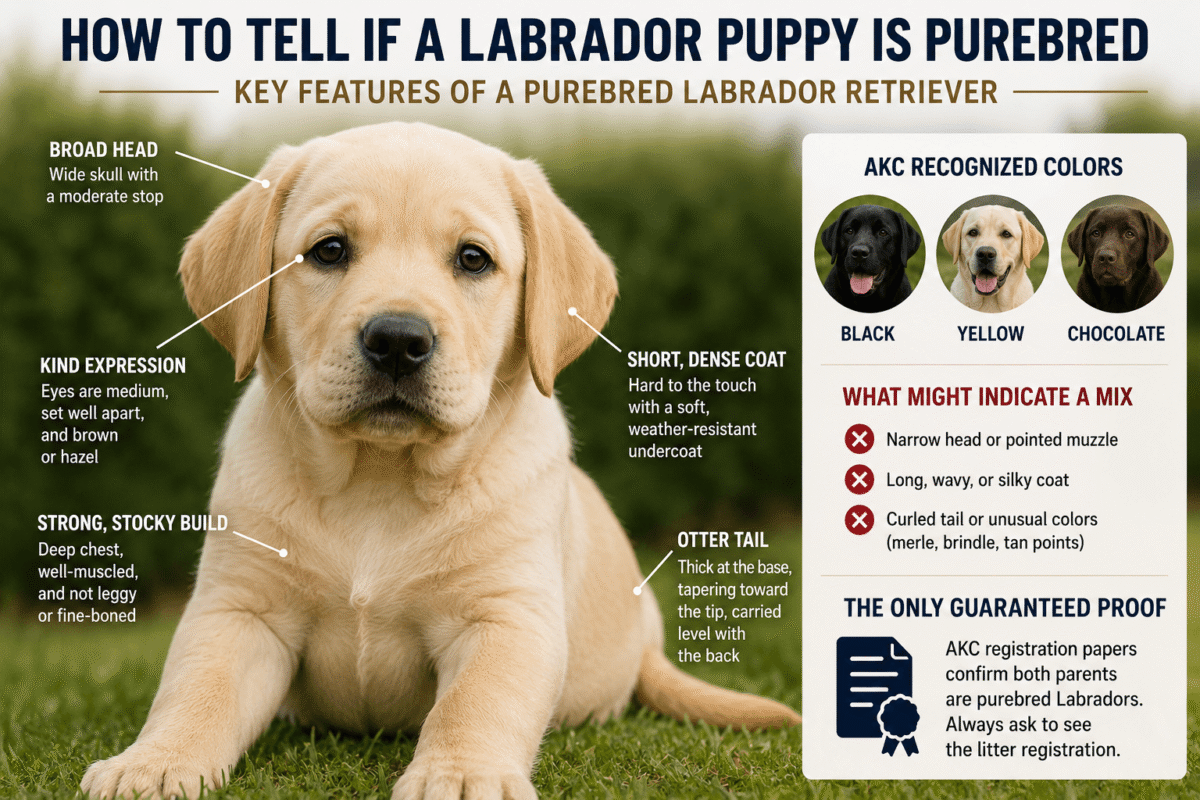
While not a substitute for papers, knowing the correct breed standard helps you spot obvious mismatches. The AKC Labrador Retriever breed standard describes specific traits all purebred Labs should have regardless of color or line:
| Physical Feature | Purebred Lab Standard | Common Mix Indicator |
|---|---|---|
| Head shape | Broad, clean-cut, with a moderate stop between forehead and muzzle — kind and intelligent expression | Narrow or pointed muzzle, overly domed skull, hound-like drop ears — suggests another breed |
| The otter tail | Thick at the base, tapering toward the tip, rounded in cross-section due to dense coat coverage — carried level with the back. This is one of the most distinctive Lab features and hard to fake in a mix | Thin whip-like tail, curled tail, heavily feathered tail — all point to another breed in the mix |
| Coat texture | Short, dense, and hard to the touch with a soft undercoat — feels firm and weather-resistant, not silky or flowing | Wavy, long, silky, or heavily feathered coat — common in Lab-Spaniel, Lab-Golden Retriever, or Lab-Poodle mixes |
| Body and build | Strongly built, short-coupled, medium-sized — wide deep chest, well-sprung ribs, level topline. Males 22.5–24.5 inches at the shoulder; females 21.5–23.5 inches | Excessively leggy or fine-boned build, very narrow chest, or significantly over or under the size range suggests mixed breeding or very poor breeding stock |
| Eyes | Medium-sized, set well apart — brown or hazel in Black and Yellow Labs, brown or hazel in Chocolates. Kind, intelligent expression | Yellow or green eyes in Black or Yellow Labs may suggest another breed. Blue eyes are not a standard Lab trait |
| Color | AKC recognized colors are Black, Yellow, and Chocolate only. White is an extreme pale Yellow — not a separate color. Silver and dilute variants are registered as Chocolate | Merle, brindle, tan points, or parti-color patterns indicate another breed in the mix — Labs do not carry these coat patterns |
| Adult size | Males 65–80 lbs; females 55–70 lbs. English-type Labs may exceed 80 lbs — field-type Labs may be toward the lower end | A significantly smaller adult Lab — under 45 lbs — or an unusually large one over 100 lbs may indicate a mix or health issue |
Method 3 – Verify AKC Papers Independently
Receiving a document with “AKC” printed on it is not the same as verified registration. Here is how to confirm papers are legitimate:
| Verification Step | How to Do It |
|---|---|
| Search the AKC online registry | Go to apps.akc.org/apps/dlr and search the registered name of both parent dogs — you can verify they are registered purebred Labrador Retrievers before committing to a purchase |
| Check the litter registration number | A genuine AKC litter registration certificate will have a specific litter number that can be cross-referenced — ask the breeder to walk you through where to find it on the certificate |
| Verify the breeder’s AKC membership | AKC Breeder of Merit status is searchable — while not required for legitimate breeders, it provides an additional layer of verification for established programs |
| Contact AKC directly if unsure | AKC customer service can verify registration for specific dogs by name or registration number — if a seller’s papers do not match what AKC shows, do not proceed |
Method 4 – Questions to Ask the Breeder
What a breeder can and cannot answer tells you as much as any document:
| Question | What a Reputable Breeder Says | Red Flag Response |
|---|---|---|
| Can I see the AKC litter registration certificate? | Yes — provides it immediately or explains exactly when it will be ready and why | “Papers are coming” or “I can get those for you later” — papers should be in hand |
| What are the registered names of both parent dogs? | Provides the full registered names with AKC numbers so you can verify independently | Cannot or will not provide parent names — or only gives call names like “Bella” and “Max” |
| Have both parents been OFA health tested? | Yes — provides certificates or directs you to ofa.org to verify both parents | Says the parents are healthy without documentation — health claims without testing are not verification |
| Can I see where the puppies are raised? | Arranges a visit or video call without hesitation — home environment visible | Refuses visits, offers only photos, or wants to meet in a parking lot |
| What will the puppies be registered as? | Labrador Retriever — full or limited AKC registration depending on placement | Cannot name the registration clearly or says papers are optional |
Method 5 – DNA Testing
If you have purchased a puppy without papers and want certainty, a canine DNA test is the most reliable non-documentation option available. Tests from companies like Embark or Wisdom Panel analyze hundreds of genetic markers and can identify breed composition with high accuracy.
| DNA Test Factor | What to Know |
|---|---|
| What it confirms | Breed composition percentage — a purebred Lab will show as 100% Labrador Retriever. A mix will show the contributing breeds |
| What it does not replace | AKC papers for breeding purposes — DNA tests are not accepted as registration substitutes by AKC |
| When to use it | Before committing to a puppy sold without papers, or after purchase if you have doubts about a puppy’s lineage |
| Cost | Typically $80–$200 USD depending on the test level — money well spent before a multi-year commitment |
| Health bonuses | Embark’s higher-tier tests also screen for over 200 genetic health conditions — useful even for confirmed purebred Labs |
The Orthopedic Foundation for Animals (OFA) also offers DNA-based health testing that registered breeders use to verify lineage and screen for heritable conditions — a layer of genetic verification beyond breed composition alone.
Common Lab Mixes That Are Often Mistaken for Purebreds
Knowing which mixes are most commonly misrepresented helps you evaluate a puppy more critically:
| Mix | How It Resembles a Purebred Lab | Key Giveaways |
|---|---|---|
| Lab-Golden Retriever (Goldador) | Similar build, friendly temperament, yellow or golden coat — easily mistaken for a Yellow Lab puppy | Slightly wavy or longer coat, feathering on tail and legs, narrower head — coat texture is the clearest giveaway |
| Lab-Border Collie | Active, intelligent, similar body size — occasionally sold as Lab puppies | Merle coat pattern, white markings, longer coat, herding instinct behaviors emerge as the puppy develops |
| Lab-Weimaraner | Short coat, similar size range, athletic build | Grey or silver coat, yellow or amber eyes — not standard Lab eye color, distinctively different head shape |
| Lab-Springer Spaniel | Medium size, friendly temperament, retrieving instinct | Feathered coat on ears, legs, and tail — the feathering is visible even in young puppies. Longer ears than a purebred Lab |
| Lab-Hound | Similar size and short coat in some hound types | Longer ears, longer muzzle, deeper chest drop, different tail set — head shape is usually the clearest difference |
Red Flags to Watch For When Buying a Lab Puppy
Knowing how to tell if a Labrador puppy is purebred goes beyond physical appearance — breeder behavior tells you just as much as the puppy itself. Here are the warning signs that should stop any purchase:
| Red Flag | What It Signals |
|---|---|
| “Papers are coming” or “papers pending” | AKC registration should be in hand at the time of sale — not promised later. This is one of the most common misrepresentations in puppy sales |
| No health testing on parents | Reputable Lab breeders test hips, elbows, eyes, and EIC. No health testing almost always means no serious breeding program — and higher risk of inherited health problems |
| Multiple breeds available from the same seller | A seller offering Labs, Doodles, and other breeds simultaneously is likely a commercial operation prioritizing volume over quality — not a dedicated Lab breeding program |
| Suspiciously low price | Purebred Labs from health-tested lines have real costs behind them — champion-tested parents, OFA testing, vet care, registration fees. Puppies priced well below market almost always have a reason |
| Refuses to show the dam (mother) | The dam should always be available to view — in person or via video call. A seller who cannot or will not show the mother is a serious red flag |
| No questions asked about your home | Good breeders screen buyers. A seller who asks nothing about your lifestyle, family, or experience is not selective about placement — they are just making a sale |
| Wants to meet in a neutral location | Puppies should be picked up from or viewed at the breeder’s actual facility — not a parking lot or other neutral location. This tactic often hides poor living conditions or the absence of parent dogs |
What Purebred Actually Means for You
Purebred does not automatically mean better. A well-raised Lab mix can be a wonderful dog. But when you buy a purebred Labrador from a documented, health-tested breeder, you get something specific: predictability. You know the likely adult size, temperament range, coat type, exercise needs, and health risk profile. That predictability is what you are paying for — and what papers help guarantee.
Mixed-breed dogs are less predictable in all of those areas. That is not a flaw — it is just a different kind of dog. If predictability matters to your household planning, documentation matters too.
Our Available AKC-Registered Lab Puppies
Every puppy at Labrador Today comes with full AKC registration documentation, health-tested parents with OFA clearances verifiable at ofa.org, and a written health guarantee:
- Black Lab Puppies
- Yellow Lab Puppies
- Chocolate Lab Puppies
- White English Cream Lab Puppies
- Silver Lab Puppies
- Red Fox Lab Puppies
👉 Browse All Available Puppies
👉 Contact Us to Verify Any Documentation Before Reserving
Frequently Asked Questions
How can I tell if a Labrador puppy is purebred without papers?
Look for the key physical traits: broad clean-cut head, otter tail (thick at the base, rounded, carried level), short dense hard coat, sturdy medium build, and AKC-recognized color (Black, Yellow, or Chocolate). A canine DNA test from Embark or Wisdom Panel can confirm breed composition with high accuracy. But physical traits alone are not a guarantee — documentation is the only certain proof. If a seller cannot provide AKC papers, a DNA test before purchase is money well spent.
What papers should a purebred Lab puppy come with?
At minimum, an AKC litter registration certificate showing both parents are registered purebred Labrador Retrievers, plus an individual puppy registration application in your name. Ideally also health testing certificates for both parent dogs — OFA hip and elbow evaluations, CAER eye certification, and EIC DNA test results. Papers and health testing documentation are separate things — both matter.
Can a purebred Lab have a wavy coat?
A short, dense, hard-feeling coat is the breed standard for Labrador Retrievers. A noticeably long, silky, or heavily feathered coat is not typical of a purebred Lab and frequently indicates another breed in the mix — most commonly Golden Retriever, Spaniel, or Poodle. Mild waviness occasionally appears in purebred Labs but significant waviness or feathering is a meaningful indicator of mixed ancestry.
Are silver Labs purebred?
Silver Labs can be AKC-registered as Chocolate Labradors carrying a dilution gene (the dd genotype) that dilutes the chocolate coat to a silver-grey shade. Their purebred status within the Labrador breed is accepted by the AKC for registration purposes, though their recognition remains debated within parts of the traditional Lab breeding community. A registered silver Lab will carry AKC Chocolate Labrador Retriever registration. For a full breakdown read our guide on why some buyers avoid silver Labs.
What is the difference between AKC papers and a health guarantee?
AKC papers confirm the dog’s breed lineage — that both parents are registered purebred Labrador Retrievers and the puppy is eligible for individual AKC registration. A health guarantee is a separate breeder commitment about the puppy’s health at the time of sale and protection against certain hereditary conditions. Both matter independently — a health guarantee without AKC papers does not confirm purebred status, and AKC papers without a health guarantee do not confirm the parents were health tested.
What is limited registration for a Lab puppy?
Limited AKC registration means the dog is registered as a purebred Labrador Retriever but any offspring from that dog cannot be AKC registered. It is standard practice for pet-quality placements — it does not affect the puppy’s purebred status, show eligibility in some classes, or your ability to compete in AKC performance events. Most pet buyers receive limited registration and it is completely appropriate for a family companion.
Can I verify AKC papers before I buy?
Yes — and you should. Ask the breeder for the registered names of both parent dogs and their AKC registration numbers. You can search both at apps.akc.org/apps/dlr to verify they are registered as purebred Labrador Retrievers before sending any deposit. A legitimate breeder will provide this information without hesitation.
