

One of the most common questions from buyers considering a Lab is how the breed gets along with existing pets. The honest answer is that Labs and other pets generally co-exist very well — the Labrador Retriever’s low predatory drive, high social tolerance, and people-oriented temperament make them one of the most compatible large breeds for multi-pet households. But compatibility is not automatic and introductions matter enormously regardless of how gentle the breed reputation is.
This guide covers how Labs typically interact with cats, other dogs, small animals, and birds — what to realistically expect, how to do introductions correctly, and what the ongoing management of a multi-pet Lab household looks like. The AKC breed profile consistently describes Labs as one of the most socially tolerant breeds — and the OFA health database confirms that temperament testing is part of responsible Lab breeding. Browse our available Lab puppies if you are still in the planning stage.
Labs and Other Pets – Quick Compatibility Overview
| Pet Type | Typical Lab Compatibility | Main Consideration | Difficulty Level |
|---|---|---|---|
| Other dogs | Excellent — Labs are one of the most dog-social breeds available | Sex pairing — opposite sex pairs are more reliable than same-sex pairs | Easy with correct introduction |
| Cats | Very good — especially with puppy introduction or cat-experienced adult Labs | The cat’s confidence and the Lab’s early exposure both matter significantly | Moderate — requires managed introduction |
| Rabbits | Manageable — with consistent supervised exposure from puppyhood | Labs have a retrieving instinct — chasing is possible without proper introduction and management | Moderate — requires ongoing management |
| Guinea pigs and small rodents | Manageable with consistent supervision — never fully unsupervised | Small fast-moving animals trigger chase instinct in most dogs including Labs | Requires permanent supervision when together |
| Birds — indoor parrots and cage birds | Generally fine — Labs rarely show strong predatory interest in indoor birds | Wagging tails and boisterous movement near cages are the main physical risk | Easy — physical separation of cage from Lab’s reach is the main requirement |
| Chickens and backyard poultry | Variable — some Labs coexist peacefully, others chase persistently | Field-line Labs with stronger prey drive are less reliable with poultry than companion-line Labs | Moderate to challenging — requires consistent training and management |
The scale of multi-pet households makes this a genuinely important question — the American Kennel Club reports that the Labrador Retriever has been one of the most popular dog breeds in the United States for decades. According to the American Pet Products Association, approximately 45% of US households own a dog and around 26% own a cat — with significant overlap between the two. The American Veterinary Society of Animal Behavior (AVSAB) identifies the puppy socialization window as closing at approximately 12 to 16 weeks — making early multi-pet exposure one of the most time-sensitive decisions a new Lab owner can make.
Labs are one of the most dog-social breeds available — their high social tolerance, stable temperament, and history as a pack-working breed makes them naturally inclined toward positive interactions with other dogs. That said, some pairing considerations affect how smoothly multi-dog households work:
| Factor | Detail |
|---|---|
| Sex pairing | Opposite-sex pairs — one male and one female — get along more reliably than same-sex pairs. Two males can develop competition and tension, particularly if both are intact. Two females can occasionally clash more intensely than two males. Opposite-sex pairing is the safest starting point for any multi-dog Lab household |
| Size matching | Labs are medium to large dogs with boisterous play styles — very small breeds can be accidentally injured during enthusiastic play. A Lab playing normally with a Toy Breed can cause unintentional harm without any aggression. Size-appropriate playmates or carefully supervised mixed-size play is recommended |
| Age and energy matching | A Lab puppy’s energy level can overwhelm an elderly or low-energy resident dog. The existing dog’s temperament and physical condition should factor into the timing of introducing a puppy — a 10-year-old dog with arthritis is not an ideal playmate for an 8-week Lab puppy |
| Introducing a second Lab | Two Labs in the same household work very well when correctly introduced — the breed’s social nature means they often become inseparable companions. Follow opposite-sex pairing guidance and introduce on neutral territory first |
| Resource guarding | Even social Labs can guard food, high-value chews, and toys from other dogs. Feed all dogs separately, remove high-value items during shared time, and monitor interactions around anything the Lab considers worth protecting |
How to Introduce a Lab Puppy to a Resident Dog
| Step | How to Do It |
|---|---|
| 1. First meeting on neutral ground | Introduce the dogs in a neutral location — a park, a neighbour’s garden, anywhere neither dog considers their territory. Keep both on loose leashes. Allow sniffing and natural greeting without tension on the lead |
| 2. Parallel walking | Walk both dogs side by side at a comfortable distance before any face-to-face interaction — this allows them to get used to each other’s presence without the pressure of direct greeting |
| 3. Controlled home introduction | Bring the resident dog into the home first, then bring the puppy in. Allow the resident dog to investigate the puppy’s arrival area at their own pace before the puppy enters |
| 4. Supervised shared space | Allow shared space under direct supervision only for the first days. Watch for stress signals from the resident dog — stiff body, hard stare, growling, or hiding — and give them space and rest from the puppy |
| 5. Separate feeding and sleeping areas | Feed all dogs in separate locations from day one. Provide separate sleeping spaces — the puppy’s crate gives the resident dog relief from the puppy’s attention overnight and during rest periods |
| 6. Give the resident dog priority | Feed the resident dog first, greet them first, and ensure they have access to spaces the puppy cannot reach — this reassures the existing dog that their place in the household has not been displaced |
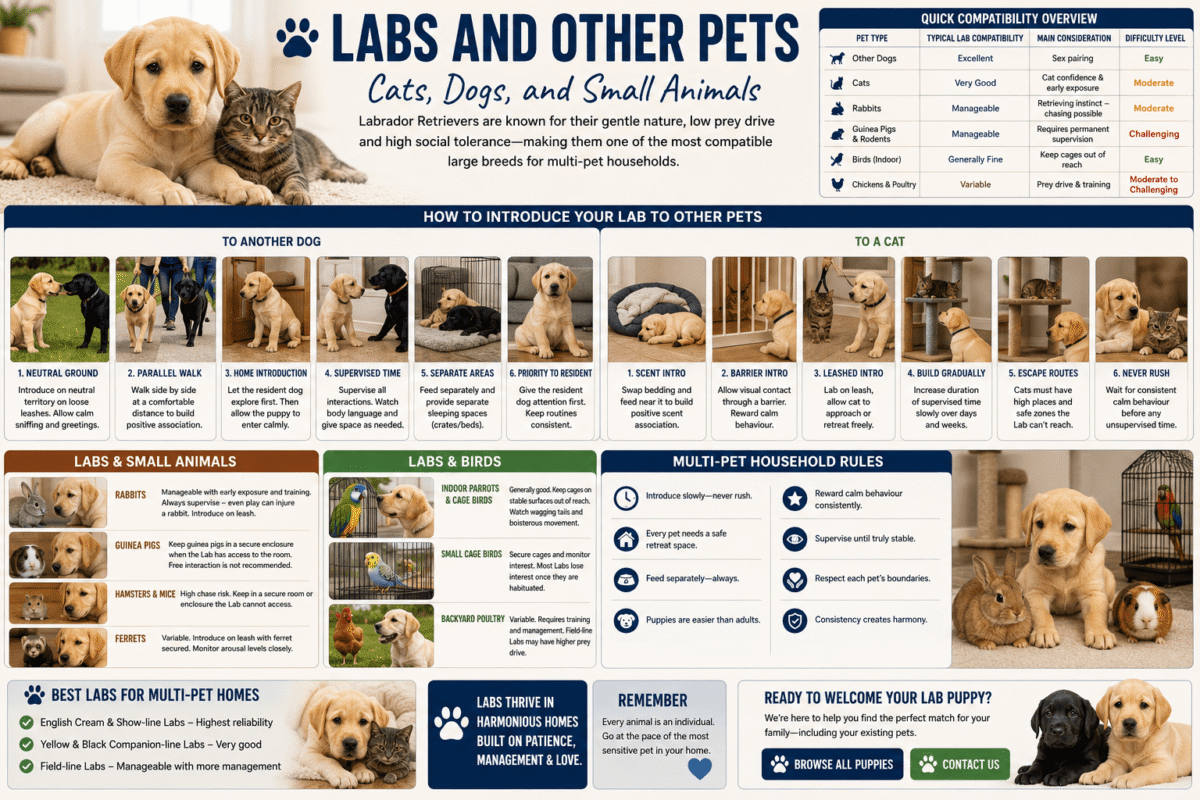
Labs and Cats
Labs and cats can and regularly do live happily together — but the outcome depends significantly on how the introduction is handled, the cat’s confidence level, and whether the Lab was exposed to cats during the socialization window. A Lab puppy raised alongside a cat from 8 weeks will almost always accept that cat as part of the household. An adult Lab meeting a cat for the first time requires more careful management.
| Factor | How It Affects Lab-Cat Compatibility |
|---|---|
| Age of introduction | The earlier the better — a Lab puppy introduced to a resident cat during the socialization window (8 to 16 weeks) has an excellent chance of accepting the cat as part of normal household life. An adult Lab meeting a cat for the first time is manageable but requires more structured introduction |
| The cat’s confidence | A confident cat that stands its ground and asserts itself early tends to fare better with Labs than a fearful cat that runs. Running triggers the Lab’s natural chase instinct — not from predatory intent but from the same instinct that makes them chase a ball. A cat that runs will be chased |
| Lab’s individual prey drive | Labs have a lower prey drive than many other breeds — but individual variation exists. Field-line Labs with stronger working drive require more careful cat introductions than companion or show-line Labs. English Cream and show-line Labs are generally the most reliable with cats |
| The cat’s escape routes | The cat must always have access to elevated spaces, separate rooms, and escape routes the Lab cannot reach. A cat that cannot escape from a boisterous Lab will become chronically stressed regardless of the Lab’s intentions |
| Ongoing management | Even well-established Lab-cat households benefit from permanent management — feeding separately, providing cat-only spaces, and never leaving a new Lab-cat pair fully unsupervised until the relationship is clearly relaxed and stable |
How to Introduce a Lab to a Resident Cat
| Step | How to Do It |
|---|---|
| 1. Scent introduction before visual contact | Swap bedding between the cat and the Lab puppy before they meet — let each get used to the other’s scent in a positive, low-pressure context. Feed both animals near the swapped bedding to build positive association |
| 2. First visual contact through a barrier | Allow the cat and Lab to see each other through a baby gate or cracked door — neither animal can reach the other. Reward the Lab for calm, disinterested behaviour. Allow the cat to observe and retreat at will |
| 3. Controlled shared space — Lab on leash | Allow both animals in the same room with the Lab on a loose leash. Reward the Lab heavily for ignoring the cat or offering calm, relaxed behaviour. Allow the cat to approach or retreat entirely on its own terms |
| 4. Build duration gradually | Increase the duration of shared supervised time over days and weeks — only progress to the next level of freedom when the current level is consistently calm |
| 5. Ensure the cat has permanent escape routes | Cat trees, elevated shelving, baby gates the cat can jump through but the Lab cannot — permanent escape routes must be in place before any unsupervised access is considered |
| 6. Never rush to unsupervised access | Take weeks, not days. The most common cause of Lab-cat problems is moving to unsupervised access before the relationship is genuinely stable |
Labs and Small Animals – Rabbits, Guinea Pigs, and Rodents
Small animals present a different challenge to cats — they are faster, more erratic in movement, and closer in size to what a Lab’s retrieving instinct was originally developed around. A Lab’s interest in a rabbit is not aggressive in intent — it is the same chase-and-retrieve drive that makes them excellent gun dogs. But the outcome for the small animal can be the same regardless of intent.
| Small Animal | Lab Compatibility | Management Required |
|---|---|---|
| Rabbits — indoor house rabbits | Manageable with consistent early exposure and training — many Labs and rabbits coexist calmly when introduced correctly from puppyhood | Introduce on leash with the rabbit in an enclosure first. Build to supervised free interaction over weeks. Never leave unsupervised — even a Lab playing can fatally injure a rabbit without any aggressive intent |
| Guinea pigs | Generally manageable when the guinea pig is safely enclosed — Labs show curiosity more than predatory intent with guinea pigs in most cases | Guinea pigs should always be in a secure enclosure when the Lab has access to the same space. Free interaction with guinea pigs is not recommended regardless of how calm the Lab appears |
| Hamsters and mice | High arousal risk — small, fast, erratic movement strongly triggers chase instinct in most dogs | Strict physical separation at all times — hamsters and mice should be in a secured room or enclosure the Lab cannot access. These animals are at the highest risk in any dog household regardless of breed |
| Ferrets | Variable — some Labs accept ferrets calmly, others remain highly aroused by their movement and scent | Individual assessment required — introduce on leash with the ferret secured and assess the Lab’s arousal level carefully. Ferrets are fast and capable of redirecting to bite if cornered, which can escalate the interaction |
Labs and Birds
| Bird Type | Lab Compatibility | Main Consideration |
|---|---|---|
| Indoor parrots and large cage birds | Generally good — Labs rarely show strong predatory interest in indoor parrots and tend to be more curious than aroused by them | Physical cage placement is the main management requirement — cages should be on surfaces the Lab cannot knock over and in locations where a wagging Lab tail cannot reach the bars. A startled parrot can inflict a serious bite on a curious Lab nose |
| Small cage birds — budgies, canaries, finches | Generally manageable — secure caging is the primary requirement | Secure the cage on a stable elevated surface. Monitor the Lab’s interest level — a Lab that fixates on the cage or paws at it requires management. Most Labs habituate to cage birds quickly and lose interest |
| Backyard chickens and poultry | Variable — some Labs live calmly with backyard poultry, others chase persistently | Field-line Labs with stronger working drive are less reliable with poultry than companion or show-line Labs. Introduce on leash and assess individual arousal level. A Lab that has retrieved live birds in hunting contexts is higher risk with backyard poultry than one without field training |
| Wild birds — garden and yard birds | Labs will investigate, flush, and occasionally chase garden birds — this is breed-normal behaviour | Not a safety concern for the Lab — normal outdoor behaviour. Bird feeders placed where Labs cannot disturb them is the only practical management needed |
General Multi-Pet Household Rules With a Lab
| Rule | Why It Matters |
|---|---|
| Introduce slowly — never rush | The most common cause of multi-pet problems is moving too fast. A rushed introduction that goes badly sets back the relationship significantly — sometimes permanently. Days and weeks of gradual exposure are always worth it |
| Supervise until truly stable | Even well-matched pets should be supervised until the relationship is consistently calm across multiple weeks — not just a few good days. True stability is demonstrated by repeated calm interactions across varied situations |
| Every animal needs a retreat space | Every pet in a multi-animal household needs access to a space the Lab cannot reach — for cats this means elevated areas, for small animals this means secure enclosures in separate rooms, for resident dogs this means a dog-free zone where the Lab cannot follow |
| Feed separately — always | Resource guarding around food is the most common trigger for inter-pet conflict in otherwise stable households. Separate feeding locations for every animal eliminates this trigger entirely |
| The realistic end goal | Many Lab owners report that after the first few weeks, their cat and Lab simply ignore each other for most of the day — which is often the ideal outcome. Peaceful indifference between species is a success, not a failure. Not every Lab-cat pair will become cuddle companions, but calm coexistence in the same household is achievable for the vast majority |
| Reward calm behaviour consistently | Actively rewarding the Lab for calm, disinterested behaviour around other pets reinforces exactly what you want. A Lab that learns that ignoring the cat produces treats will ignore the cat more consistently than one whose calm behaviour is simply taken for granted |
Which Lab Is Best for a Multi-Pet Household
Not all Labs are equally well-suited to multi-pet households — and the differences between lines are worth knowing before you choose:
| Lab Type | Multi-Pet Suitability | Why |
|---|---|---|
| English Cream or show-line Labs | Highest — most reliable across all pet types | Many show-line Labs are commonly described as calmer and less reactive to small animals than working-line Labs, though individual temperament always varies — the most manageable starting point for any existing pet type |
| Yellow or Black Lab from companion lines | Very good — well-suited to multi-pet households | Companion-line Labs have moderate prey drive and good social tolerance — reliable with most pet types when properly introduced |
| Field-line Labs — Black or Chocolate | Manageable but requires more careful monitoring | Working-line Labs are often described by breeders and trainers as having a stronger chase instinct than companion-line Labs — though individual variation is significant. Not a disqualifier for multi-pet living but warrants more structured introduction and ongoing supervision particularly with cats and small animals |
For a full comparison of Lab types and temperament, read our guide on English Lab vs American Lab.
Our Available Lab Puppies
If you have existing pets, let us know when you enquire — we can advise on which of our available puppies from current litters would be the best temperament match for your household’s existing animals:
- White English Cream Lab Puppies — best for multi-pet households
- Yellow Lab Puppies — gentle and cat-friendly
- Black Lab Puppies — versatile and dog-social
- Chocolate Lab Puppies — energetic and social
- Silver Lab Puppies
- Red Fox Lab Puppies
For further reading on Lab temperament and household compatibility:
- Labrador Retriever Temperament with Children
- Male vs Female Labrador
- Which Color Lab Is the Calmest
- Best Labrador for First-Time Owners
👉 Browse All Available Puppies
👉 Contact Us to Discuss Your Existing Pets Before Reserving
Frequently Asked Questions
Do Labs get along with cats?
Yes — Labs and cats can and regularly do live happily together. The outcome depends on how the introduction is handled, the cat’s confidence level, and the Lab’s individual temperament. A Lab puppy introduced to a resident cat during the socialization window is much more likely to accept the cat as part of normal household life than an adult Lab meeting a cat for the first time. The cat must always have access to elevated escape routes the Lab cannot reach.
Are Labs good with other dogs?
Yes — Labs are one of the most dog-social breeds available. Their high social tolerance and stable temperament makes them naturally inclined toward positive interactions with other dogs. Opposite-sex pairs get along most reliably — a male and female together causes less competition than two males or two females. Resource guarding around food and high-value items should always be managed with separate feeding regardless of how well the dogs get along.
Can Labs live with rabbits?
Yes — with consistent management. Many Labs and rabbits coexist calmly when introduced from puppyhood and with gradual supervised exposure. The key is never leaving them fully unsupervised — even a calm Lab playing can fatally injure a rabbit without any aggressive intent. The Lab’s retrieving instinct responds to fast-moving small animals regardless of intent. A Lab puppy introduced to a house rabbit from 8 weeks will generally habituate to it as a household member over time.
Are Labs safe with small animals like guinea pigs?
Manageable — with permanent supervision protocols in place. Guinea pigs should always be in a secure enclosure when the Lab has access to the same space. Free, unsupervised interaction between a Lab and guinea pigs is not recommended regardless of how calm the Lab appears with them. The fast, erratic movement of small rodents triggers chase instinct in most dogs, including Labs.
Which Lab is best for a home with cats?
English Cream or show-line Labs are often described by breeders and trainers as among the most reliable choices for households with cats — many report them as calmer and less reactive to small animals than working-line Labs, though individual temperament always varies. Companion-line Yellow and Black Labs are also generally good with cats when properly introduced. Field-line Labs may require more careful management due to their commonly observed stronger chase instinct.
How long does it take for a Lab to accept a cat?
Most Lab-cat introductions reach a stable, relaxed coexistence within 2 to 8 weeks when managed correctly — but the timeline varies significantly based on the individual animals. A Lab puppy introduced to an existing cat is usually the fastest path to acceptance. An adult Lab meeting a cat for the first time may take longer. Never rush to unsupervised access — the most common cause of Lab-cat problems is moving too quickly through the introduction stages.
