

The Black Lab is the most popular Labrador Retriever color in the world — and for well-understood reasons. Black Labs have been the go-to choice for hunters, service dog programs, search and rescue teams, therapy organizations, and family households for over a century. Their even temperament, high trainability, and consistent character across a wider range of breeding lines than any other Lab color makes them the most versatile and most reliably predictable choice in the breed.
If you are considering a Black Lab, this guide covers everything you need to make the right decision — what makes Black Labs distinctive, how field and show lines differ, what temperament and health to expect, what they cost, and how to find a reputable breeder. Browse our available Black Lab puppies once you have read through.
- What Makes a Black Lab Different from Other Lab Colors
- Black Lab Temperament
- Black Lab Field Lines vs Show Lines – Which Is Right for You
- Black Lab Health – What to Know
- How Much Does a Black Lab Cost?
- Is a Black Lab Right for You?
- Practical Considerations – Black Lab Coat and Shedding
- Red Flags When Searching for a Black Lab
- What to Ask a Black Lab Breeder
- Our Available Black Lab Puppies
- Frequently Asked Questions
What Makes a Black Lab Different from Other Lab Colors
| Factor | Black Lab Reality |
|---|---|
| Coat genetics | Black is the dominant coat color in Labrador Retrievers. A Black Lab carries at least one dominant B allele (for black pigment) and at least one dominant E allele (allowing pigment expression). Black Labs can carry recessive chocolate or yellow genes without expressing them — meaning two Black Labs can produce Yellow or Chocolate puppies if both carry those recessive genes |
| Most consistent temperament across lines | Many experienced breeders and trainers describe Black Labs as the most consistent Lab color across different breeding programs — neither the calmest nor the most energetic by default, but reliably even-tempered regardless of which line they come from. This consistency is a significant practical advantage |
| AKC recognition | Black is one of the three AKC-recognized Labrador Retriever colors — along with Yellow and Chocolate. Black Labs compete fully in all AKC events including conformation showing |
| Most widely used working Lab color | Black Labs are the most commonly selected color in professional working dog programs worldwide — guide dog organizations, service dog programs, search and rescue teams, and detection dog units disproportionately select Black Labs. This reflects decades of observation about consistency and trainability |
| Widest line range available | Black Labs are produced by show lines, companion lines, and field lines — giving buyers the widest range of temperament, energy level, and purpose options within a single color |
Black Lab Temperament
| Temperament Factor | Black Lab Reality |
|---|---|
| Core character | Even-tempered, loyal, affectionate, and highly people-oriented — the fundamental Labrador temperament at its most consistent. Black Labs are devoted family companions with the stable, reliable character that has made the breed the world’s most popular for decades |
| Energy level — by line | Varies significantly by breeding line. Show-line Black Labs are calmer and more settled — comparable to Yellow Labs from show lines. Field-line Black Labs are among the most driven and energetic Labs available — high-intensity working dogs bred for sustained field performance. Companion-line Black Labs fall in between |
| Consistency across lines | The defining temperament characteristic of Black Labs relative to other colors — even a field-line Black Lab typically shows less extreme temperament variation than the most driven field-line Chocolate Labs. The baseline steadiness of the Black Lab holds across a wider range of breeding programs |
| Adolescent phase | Show and companion-line Black Labs settle into calm adult temperament by 18 months to 2 years. Field-line Black Labs may extend to 2.5 to 3 years — the driven working temperament takes longer to mature into reliable consistency |
| With children | Excellent across all lines — patient, gentle, and loyal with children of all ages. The Black Lab’s stable temperament makes it one of the most reliably family-safe large breeds available regardless of which line it comes from |
| With other pets | Generally excellent — Black Labs show high social tolerance with other dogs and manageable temperament with cats and small animals when properly introduced. Field-line Black Labs may require more structured introductions with cats due to higher prey drive |
| Trainability | Among the most trainable dogs in the world — consistently selected for guide dog, service dog, detection, and therapy programs based on their combination of food motivation, people-orientation, stable temperament, and natural focus. Positive reinforcement produces outstanding results from 8 weeks |
Black Lab Field Lines vs Show Lines – Which Is Right for You
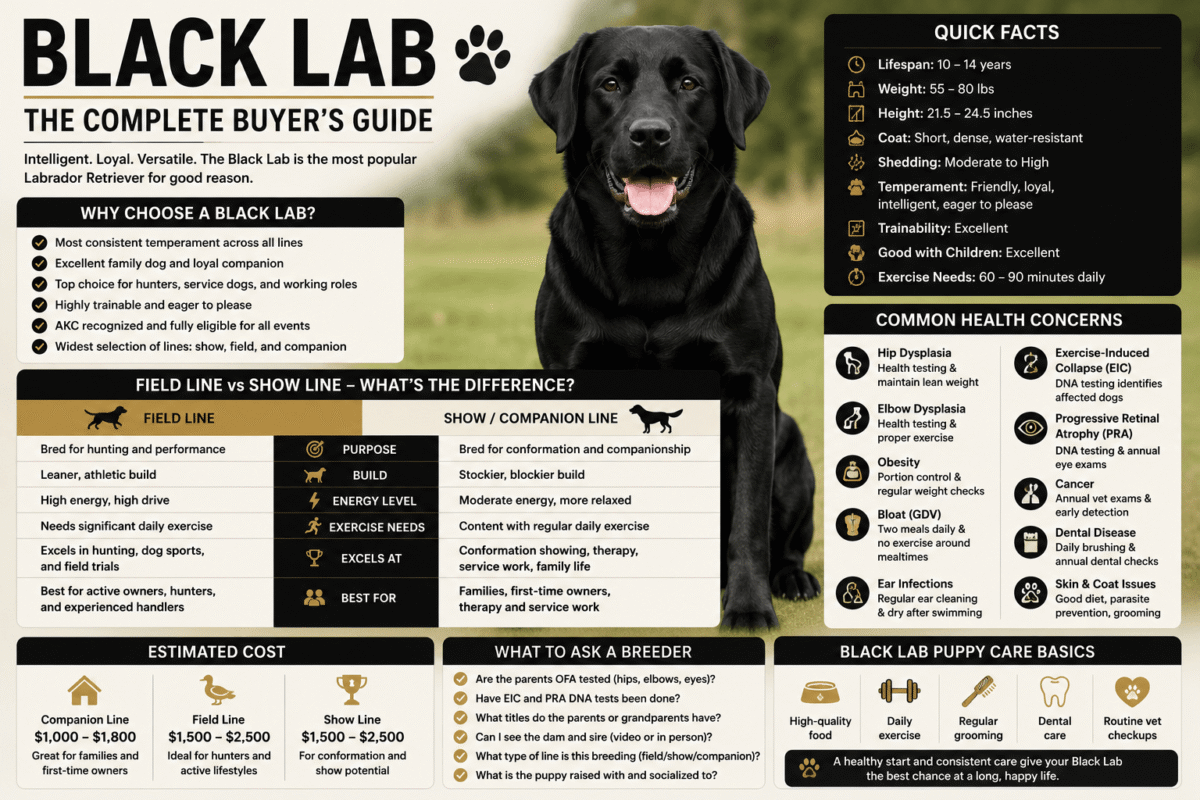
This is the most important decision for Black Lab buyers — the difference between a field-line and show-line Black Lab is more significant than the color difference between any two Lab colors:
| Factor | Black Lab — Field Lines | Black Lab — Show or Companion Lines |
|---|---|---|
| Primary purpose | Hunting and field work — selected for drive, stamina, retrieving intensity, and working ability over many generations | Family companion or conformation showing — selected for calm temperament, stable character, and physical structure |
| Build | Leaner, longer-legged, more athletic — built for speed, endurance, and agility in field conditions | Stockier, broader head, heavier bone — the classic blocky Lab build most people picture |
| Energy level | High to very high — needs significant daily exercise to maintain settled indoor behaviour. An under-exercised field-line Black Lab is a genuinely challenging dog | Moderate — content after consistent daily exercise. Significantly more manageable indoors than field-line dogs |
| Drive | Very high natural retrieving drive — will retrieve obsessively if allowed. Outstanding in hunting, dock diving, and competitive field events | Lower natural drive — still retrieving-oriented but without the intensity that can make field-line dogs difficult to manage in a family home |
| Trainability for hunting | Outstanding — the drive, focus, and natural retrieving instinct make field-line Black Labs the most commonly selected hunting Lab | Capable of hunting but lacks the raw drive that makes field-line dogs instinctively excellent gun dogs |
| Trainability for basic obedience | High — but the drive and distraction level during adolescence makes early training more demanding. Consistent exercise alongside training is essential | Easier — lower distraction level and earlier maturity makes basic obedience training more straightforward in the first year |
| Best for | Hunters, active outdoor families, experienced owners, field trial competitors, sport dog enthusiasts | Families, first-time owners, therapy and service dog programs, households wanting a settled companion |
Black Lab Health – What to Know
| Health Factor | Detail |
|---|---|
| Breed-wide concerns | Black Labs share the same hereditary health concerns as all Labrador Retrievers — hip dysplasia, elbow dysplasia, Progressive Retinal Atrophy (PRA), Exercise-Induced Collapse (EIC), obesity risk, ear infections, and dental disease |
| Any color-specific health concerns? | No — the black coat is produced by dominant pigment genes that carry no documented health risk specific to the color. Black Labs have no equivalent of the Silver Lab’s CDA concern or the Chocolate Lab’s historically narrower gene pool issues |
| Chocolate Lab lifespan comparison | Research published in Canine Genetics and Epidemiology found Black Labs had a median lifespan of approximately 12.1 years — compared to 10.7 years for Chocolate Labs. Black Labs benefit from a broader historical gene pool and fewer selection pressures specifically for coat color |
| EIC consideration for field-line Labs | Exercise-Induced Collapse is particularly relevant for field-line Black Labs used in sustained high-intensity hunting — EIC DNA testing of both parent dogs is essential for working Black Lab breeding programs. Ask specifically about EIC testing when purchasing a field-line Black Lab puppy |
| Required health tests — both parents | OFA or PennHIP hip evaluation, OFA elbow evaluation, CAER eye certification (annual), EIC DNA test, prcd-PRA DNA test — all verifiable at ofa.org before purchase |
| Lifespan | 10 to 14 years — Black Labs from health-tested lines regularly reach the longer end of this range |
How Much Does a Black Lab Cost?
| Source | Typical Price | What You Get | Recommended? |
|---|---|---|---|
| Unverified private seller — Facebook Marketplace, classified ads | $200 – $600 | Likely no health testing, no AKC papers — higher risk of inherited health problems | ❌ Avoid |
| Reputable companion-line breeder | $1,000 – $1,800 | AKC registration, OFA-tested parents, full health documentation, written health guarantee, lifetime breeder support | ✅ Recommended for families and first-time owners |
| Field-line breeder — proven working bloodlines | $1,500 – $2,500 | Field champion or Master Hunter titled ancestry, proven working drive, ideal for hunters and field trial competitors | ✅ Recommended for hunters and field sport enthusiasts |
| Show-line breeder — conformation stock | $1,500 – $2,500 | Show champion lineage, conformationally correct structure, calm stable temperament — suitable for conformation competition | ✅ For buyers wanting show-quality Black Labs |
Why Black Labs Are Often Priced Lower Than English Cream or Silver Labs
| Factor | Detail |
|---|---|
| Higher supply | Black is the dominant Lab color — produced by the widest range of breeding programs across all line types. More breeders producing Black Labs means more supply relative to specialty colors |
| Lower novelty premium | Unlike English Cream, Silver, or Red Fox Labs where visual distinctiveness drives a premium, Black Labs are priced based on breeding quality and bloodline credentials rather than appearance novelty |
| Value proposition | For most buyers, a health-tested Black Lab from companion lines at $1,000 to $1,800 represents the best overall value in the Lab market — broad availability, consistent temperament, no color controversy, full AKC conformation eligibility, and the same fundamental breed quality as more expensive color variations |
For a full breakdown of Lab costs, read our guide on the average cost of a Labrador puppy.
Is a Black Lab Right for You?
| A Black Lab Is an Excellent Choice If… | Consider Another Color or Line If… |
|---|---|
| You want the most consistent and predictable Lab temperament available | You specifically want the calmest possible Lab — an English Cream female from show lines is slightly calmer during adolescence |
| You want a hunting dog — waterfowl, upland, field trial | You want a Lab with maximum visual distinctiveness — Silver, Red Fox, or English Cream offer more unusual appearances |
| You want to compete in AKC conformation showing | You have a strong color preference for yellow, chocolate, or cream — all equally valid choices from the right breeding program |
| You are a first-time owner wanting broad breeding program choice | You want to avoid black hair on light furniture and clothing — the practical reality of Black Lab shedding on pale surfaces |
| You want a therapy, service, or guide dog candidate | Budget is very limited — standard Yellow or Chocolate Labs from companion lines are sometimes slightly less expensive |
| You want the safest all-round choice regardless of lifestyle | You specifically need a guaranteed low-energy dog from day one — English Cream from show lines is the most reliable for this |
Practical Considerations – Black Lab Coat and Shedding
| Practical Factor | Detail |
|---|---|
| Shedding amount | Black Labs shed the same amount as all Labrador Retrievers — moderate year-round with two seasonal blowouts in spring and autumn. The volume of shedding is identical to Yellow and Chocolate Labs |
| Visibility on light surfaces | Black Lab hair is highly visible on light-colored furniture, beige carpets, and light clothing — more so than Yellow or Chocolate Lab hair on the same surfaces. Dark furniture and flooring minimizes the visibility problem significantly |
| Heat and sun | Black Labs absorb more solar heat than lighter-colored Labs in direct sunlight — be mindful of overheating during outdoor exercise on hot summer days. Exercise in the early morning or evening during peak summer heat |
| Grooming requirements | Weekly brushing minimum — daily during blowout periods. The black coat does not show dirt as readily as pale yellow or cream coats — but regular bathing every 6 to 8 weeks keeps the coat healthy and reduces shedding volume |
| Coat appearance over time | Some Black Labs develop grey muzzle hair beginning around 5 to 7 years — an endearing sign of aging that is entirely normal. The main coat remains black throughout life in most Labs |
Red Flags When Searching for a Black Lab
| Red Flag | What It Signals |
|---|---|
| No OFA health testing on parents | Non-negotiable regardless of color or price. The relative affordability of Black Labs from unverified sellers is not a reason to skip health testing — inherited hip and elbow disease in an untested Lab costs significantly more in veterinary bills than the price difference between a tested and untested puppy |
| Cannot describe the breeding line — field, show, or companion | A Black Lab seller who cannot describe their breeding program’s purpose does not understand what they are producing. The line difference is the most important temperament predictor for Black Labs — a seller who cannot describe it cannot help you choose correctly |
| Multiple breeds offered simultaneously | A dedicated Black Lab breeding program does not also produce Doodles, Bulldogs, and Cavapoos. Volume multi-breed operations prioritize sales over quality |
| Field-line pricing for companion-line dogs | Some sellers charge field-line prices ($1,800 to $2,500) without field champion or hunt test titled ancestry to justify it. Ask specifically for titled ancestors in the pedigree if paying field-line prices |
| Cannot show the dam on video | The dam’s build, energy level, and temperament is the most reliable predictor of what her puppies will become — refusal to video the dam is a universal red flag |
What to Ask a Black Lab Breeder
| Question | What a Good Answer Looks Like |
|---|---|
| Is this a field-line, show-line, or companion-line breeding program? | Clear, specific answer — describes what the program selects for and what that means for the puppies’ temperament and energy level |
| Have both parents been OFA tested — hips, elbows, eyes, EIC, PRA? | Yes — provides certificates or directs you to ofa.org to verify by registered name |
| For field-line dogs — what hunt test or field trial titles does the pedigree carry? | Named titles — Master Hunter (MH), Senior Hunter (SH), or Field Champion (FC) ancestors. A field-line program without titled dogs in the pedigree is not a genuine field-line program |
| Can I see the dam and sire on video? | Yes — both dogs shown in real time with their build and energy level clearly visible. The dam’s temperament during the video call tells you more than any description |
| Does this litter carry recessive Yellow or Chocolate genes? | Optional question — but a knowledgeable breeder can tell you whether the litter may produce non-black puppies. Relevant if you specifically want to know whether the bloodline carries these recessive genes |
Our Available Black Lab Puppies
Our Black Lab puppies come from AKC-registered parents with full OFA health testing — raised in a family home environment from birth. Whether you are looking for a devoted family companion or an athletic outdoor partner, our Black Labs bring the consistent, loyal temperament the color is known for.
👉 Browse Available Black Lab Puppies
👉 Contact Us to Ask About Current and Upcoming Litters
Also available:
- Yellow Lab Puppies
- Chocolate Lab Puppies
- White English Cream Lab Puppies
- Silver Lab Puppies
- Red Fox Lab Puppies
For further reading:
- Which Color Lab Is the Calmest?
- English Lab vs American Lab
- Male vs Female Labrador
- How to Choose a Labrador Breeder
- Best Labrador for First-Time Owners
Frequently Asked Questions
Are Black Labs good house dogs?
Yes — Black Labs from show or companion lines adapt very well to indoor family life. They are settled enough to relax indoors after adequate exercise, gentle enough to be safe around children and other pets, and social enough to integrate naturally into family routines. The key qualifier is daily exercise — a Black Lab that gets 60 to 90 minutes of genuine daily activity is an excellent house dog. One that does not will channel that energy into behaviour you will not enjoy indoors. Field-line Black Labs need more exercise than companion-line dogs before they settle indoors.
What are the cons of Black Labs?
The most consistently reported challenges: the adolescent phase between 6 and 18 months is energetic, mouthy, and demanding. The daily exercise requirement of 60 to 90 minutes is non-negotiable for settled indoor behaviour. They shed year-round with two heavy seasonal blowouts — black hair is highly visible on light furniture and clothing. They cannot be left alone for long periods without developing separation anxiety. They are food-obsessed and prone to obesity without strict portion management. And they eat things they should not — foreign body ingestion is a genuine and recurring risk. None of these are unusual for a large, working-bred dog — but all of them catch buyers off guard when they go in with unrealistic expectations.
What problems do Black Labs have?
The main hereditary health concerns in Black Labs are hip dysplasia, elbow dysplasia, Progressive Retinal Atrophy (PRA), and Exercise-Induced Collapse (EIC) — all of which are significantly reduced when both parent dogs carry OFA health clearances. Black Labs also share the breed-wide tendency toward obesity, ear infections, and dental disease. Compared to Chocolate Labs, Black Labs have a broader historical gene pool and a documented longer median lifespan of approximately 12.1 years. For the full health picture read our guide on common Labrador health problems.
Why is my Black Lab turning brown?
A Black Lab coat turning brown or rusty is almost always one of three things: sun bleaching from prolonged UV exposure — the most common cause, particularly in summer months; a nutritional deficiency, most often a lack of tyrosine or phenylalanine which are amino acids that support black pigment production; or a condition called colour dilution which is more common in certain lines. Sun bleaching is harmless and the coat typically deepens back toward black in lower-light months. If the browning is accompanied by skin changes, patchy hair loss, or other symptoms, a veterinary check is worthwhile to rule out thyroid issues or nutritional deficiency.
When is a Black Lab fully grown?
Black Labs typically reach their full height by 9 to 12 months of age. Their skeletal structure is largely complete by 12 to 18 months — the point at which the growth plates close and the bones finish developing. However most Black Labs continue to fill out in muscle mass and chest width until around 2 years of age. Field-line Black Labs tend to remain leaner throughout life. Companion and show-line dogs develop the broader, more muscular adult build more fully between 18 months and 2 years.
When should you neuter a Black Lab?
Many veterinarians now recommend waiting until 12 to 18 months before neutering male Black Labs — later than the traditional 6-month recommendation — based on research suggesting earlier neutering may affect joint development and increase the risk of certain orthopaedic conditions in large breeds. The evidence on optimal timing continues to evolve. Discuss the timing specifically with your veterinarian rather than following a fixed schedule — your vet can advise based on your dog’s individual development, size, and lifestyle. For female Black Labs, spaying timing involves similar considerations alongside the risk of mammary tumours in intact females.
How much should a Black Lab weigh?
Male Black Labradors typically weigh between 65 and 80 pounds at healthy adult weight. Females typically weigh between 55 and 70 pounds. Labs from English show lines tend toward the heavier end of these ranges; field-line Black Labs are typically leaner. The most reliable indicator of healthy weight is body condition rather than the scale — you should be able to feel the ribs with light pressure but not see them. There should be a visible waist when viewed from above and a slight abdominal tuck from the side. Many Labs that appear to be at a normal weight are actually carrying excess condition.
Are Black Labs usually aggressive?
No — Black Labs are consistently among the least aggressive dog breeds. They score exceptionally well on the American Temperament Test Society evaluations and are among the most widely selected breeds for guide dog, service dog, and therapy programs precisely because of their stable, non-aggressive temperament. Unprovoked aggression is genuinely rare in well-bred Black Labs. Fear-based reactivity can occur in any breed when socialization is inadequate — but this is a training and socialization issue rather than a breed characteristic of Black Labs specifically.
Which color Lab is the healthiest?
Research suggests Black and Yellow Labs have a documented lifespan advantage over Chocolate Labs — approximately 12.1 years median compared to 10.7 years in research published in Canine Genetics and Epidemiology. Black Labs benefit from a broader historical gene pool and fewer selection pressures specifically for coat color compared to some Chocolate Lab lines. The healthiest individual Lab of any color is the one from parents with the most comprehensive OFA health testing. Read our guide on how long Labrador Retrievers live.
What time of year do Black Labs shed the most?
Black Labs shed most heavily during their two seasonal coat blowouts — typically in spring as the winter undercoat releases, and again in autumn as the summer coat sheds before the winter coat grows in. During blowout periods daily brushing is the most effective way to manage the volume. Outside of blowouts, moderate year-round shedding continues at a lower level. The black coat is particularly visible on light-coloured surfaces — furniture, carpets, and light clothing — which makes the shedding feel more significant than it actually is relative to other breeds.
What sheds worse — a Lab or a Golden Retriever?
Golden Retrievers generally shed more than Labrador Retrievers — their longer, denser coat produces more visible shedding year-round and during seasonal blowouts. A Lab’s shorter double coat sheds significantly but the volume is typically less than a Golden’s. The practical difference is that Golden Retriever hair is longer and more prone to matting, while Lab hair is shorter and easier to brush out. If shedding management is a priority, a Lab is the lower-maintenance choice between the two breeds.
Are boy or girl Black Labs better?
Neither is objectively better. Female Black Labs are widely regarded as slightly easier during adolescence — they mature earlier, show less dominant behaviour, and tend to be more focused during training in the first year. Males are typically larger, more boisterous during adolescence, and often described as more affectionate and attention-seeking by their owners. In adulthood the temperament difference between a well-raised male and female Black Lab is minimal. Read our full guide on male vs female Labrador for the complete comparison.
Are Black Labs good family dogs?
Yes — Black Labs are consistently ranked among the best family dog breeds available. Their stable, even temperament, patience with children of all ages, loyalty, and trainability make them outstanding family companions from puppyhood through senior years. The Black Lab’s consistency across a wide range of breeding programs means this reliability holds regardless of whether your Lab comes from show, companion, or even moderate field lines.
Are Black Labs calmer than Yellow or Chocolate Labs?
Black Labs are not inherently calmer than Yellow Labs — they are more consistent. From equivalent breeding lines, Black and Yellow Labs have very similar temperaments. Black Labs from show or companion lines are calm and settled; Black Labs from field lines are high-energy and driven. The line matters far more than the color. What distinguishes Black Labs is that this temperament consistency holds across a wider range of lines than is typical for other colors. For the calmest Lab combination overall, an English Cream female from English show lines remains the most reliably settled option.
Are Black Labs the best hunting dogs?
Field-line Black Labs are among the most widely used hunting dogs in the world — consistently selected for waterfowl hunting, upland bird work, and field trial competition. Their drive, cold-water endurance, natural retrieving instinct, and trainability make them outstanding gun dogs. The black coat is also the most traditional hunting Lab color — many experienced hunters consider a field-line Black Lab the benchmark against which other hunting dogs are measured.
Do Black Labs shed a lot?
Black Labs shed the same amount as all Labrador Retrievers — moderate year-round with two seasonal blowouts in spring and autumn. The practical difference is visibility — black hair shows very distinctly on light-colored furniture, carpets, and clothing. Weekly brushing minimum, daily during blowout periods, manages the shedding volume. A good deshedding tool during blowout periods dramatically reduces the amount of hair reaching your home surfaces.
How much does a Black Lab puppy cost?
From a reputable companion-line breeder with AKC registration and full OFA health testing, expect to pay between $1,000 and $1,800. Field-line Black Labs from titled working bloodlines typically range from $1,500 to $2,500. Show-line Black Labs from conformation stock are similarly priced. Black Labs are generally slightly less expensive than English Cream or Silver Labs of equivalent quality — reflecting higher supply rather than any difference in quality. Read our full guide on the average cost of a Labrador puppy.
What is the difference between a field-line and companion-line Black Lab?
A field-line Black Lab is bred for hunting and working performance — high drive, high energy, lean athletic build, outstanding retrieving instinct. A companion-line Black Lab is bred for family temperament — calmer, more settled, broader build, easier to manage indoors. The difference in day-to-day experience between the two is significant — more significant than any color difference. Always ask a Black Lab breeder specifically whether their program is field-line or companion-line before committing to a puppy.
Are Black Labs good for first-time owners?
Yes — companion-line and show-line Black Labs are excellent choices for first-time owners. Their consistent, even temperament and high trainability makes the learning curve of first-time dog ownership significantly more manageable. Field-line Black Labs are better suited to experienced owners who understand and can channel high drive. Read our full guide on the best Labrador for first-time owners.
