
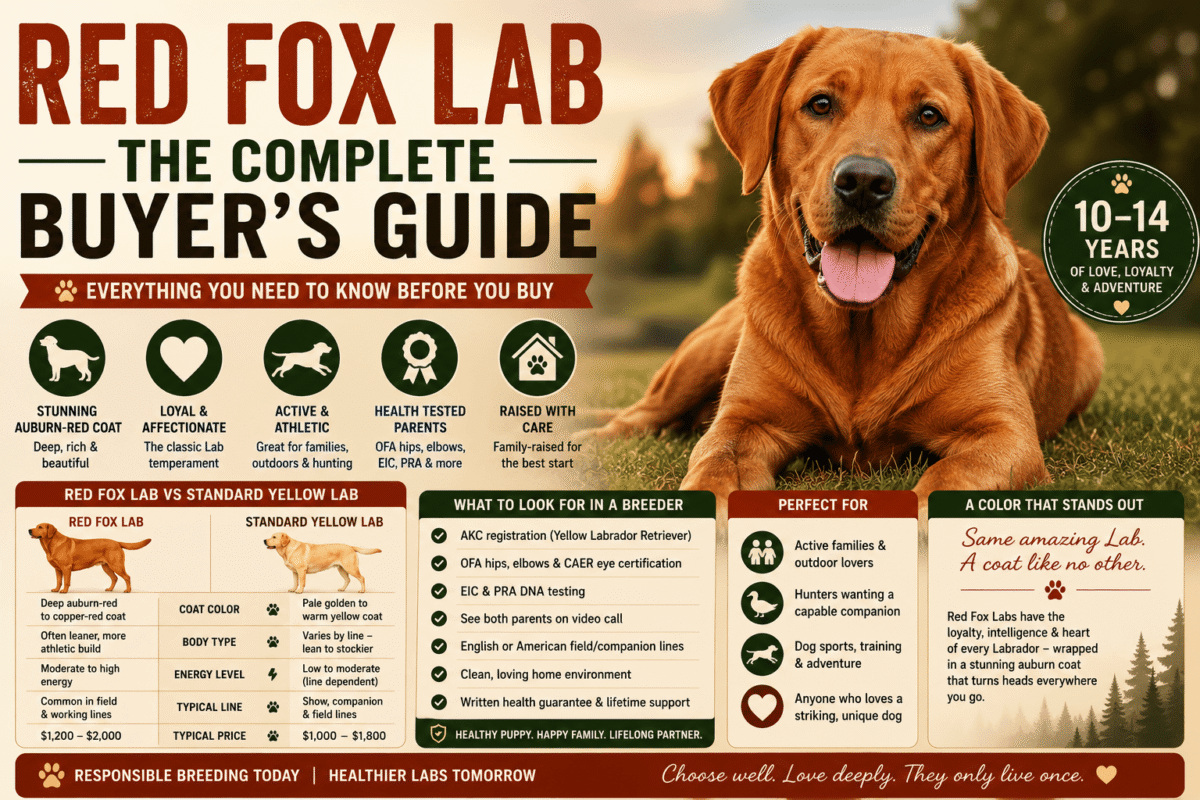
The Red Fox Lab — also known as the Fox Red Lab — is one of the most visually distinctive and increasingly sought-after Labrador Retriever variations. Their deep auburn-red coat stands out sharply from the pale golden Yellow Labs most buyers picture when they think of the breed, and their temperament carries the same patient, loyal character that makes all Labs exceptional family dogs.
Despite their striking appearance, Red Fox Labs are often misunderstood — some buyers assume they are a separate breed, a mix, or a rarer variation than they actually are. This guide covers everything you need to know before buying — what a Red Fox Lab actually is, how they differ from standard Yellow Labs, what their temperament is really like, what they cost, and what to look for in a reputable breeder. Browse our available Red Fox Lab puppies once you have read through.
- What Is a Red Fox Lab?
- Red Fox Lab vs Standard Yellow Lab – Key Differences
- Red Fox Lab Temperament
- Red Fox Lab Genetics – Understanding the Color
- Red Fox Lab Health
- How Much Does a Red Fox Lab Cost?
- Is a Red Fox Lab Right for You?
- Red Fox Lab vs Other Lab Colors – Quick Comparison
- Red Flags When Searching for a Red Fox Lab
- What to Ask a Red Fox Lab Breeder
- Red Fox Lab Care – What to Know
- Our Available Red Fox Lab Puppies
- Frequently Asked Questions
What Is a Red Fox Lab?
| Question | Answer |
|---|---|
| What is a Red Fox Lab? | A Labrador Retriever with a deep auburn-red to dark golden-red coat — the darkest shade within the Yellow Labrador color range. The coat color ranges from a rich copper-red to a deep fox-red depending on the individual dog and the specific genetics behind the litter |
| Is Red Fox Lab a separate breed? | No — Red Fox Labs are Labrador Retrievers. Same breed, same AKC registration, same fundamental temperament and health profile as any other Yellow Lab. The deep red coat is a color variation within the Yellow classification |
| What does the AKC call them? | The American Kennel Club registers Red Fox Labs as Yellow Labrador Retrievers — the deep red shade is the darkest expression of the Yellow color range. No separate “Red Fox” or “Fox Red” AKC classification exists |
| Is it also called Fox Red Lab? | Yes — “Fox Red Lab” and “Red Fox Lab” are used interchangeably. Both refer to the same deep auburn-red coat shade within the Yellow Labrador classification |
| Where does the red coat come from? | The deep red coat is produced by a high concentration of phaeomelanin — the pigment responsible for yellow and red coloring in dogs. The same gene that produces pale cream in English Cream Labs produces the deepest red expression at the opposite end of the Yellow pigment spectrum |
| Are Red Fox Labs rare? | They are less common than standard golden Yellow Labs but not exceptionally rare. Their relative scarcity compared to traditional Yellow Labs, combined with growing buyer demand for their distinctive appearance, drives their modest price premium over standard Yellow Lab pricing |
Red Fox Lab vs Standard Yellow Lab – Key Differences
| Feature | Red Fox Lab | Standard Yellow Lab |
|---|---|---|
| Coat color | Deep auburn-red to dark copper-red — the defining visual characteristic. Rich and warm, often compared to the coat of a fox or Irish Setter | Pale golden yellow to warm golden — the most familiar Lab coat color |
| Genetic basis | Same Yellow (ee genotype) base color as all Yellow Labs — the difference is in the intensity of phaeomelanin expression, not a separate genetic classification | Same ee genotype — lighter phaeomelanin expression producing the familiar golden coat |
| Breeding lines | Red Fox Labs are more commonly associated with American field and working lines — field-bred Labs naturally select for darker pigmentation in some lines. However, companion-line Red Fox Labs also exist | Found in both English show lines and American companion and field lines across the full yellow spectrum |
| Build | Often leaner and more athletic — reflecting the field-line breeding more commonly associated with the red coat. Not a universal rule — companion-line Red Fox Labs may have a broader build | Varies by line — English show lines stockier, American companion lines leaner |
| Energy level | Often higher than English Cream or standard show-line Yellow Labs — reflecting the field-line association. Companion-line Red Fox Labs are more moderate | Varies significantly by line — show and companion lines calmer, field lines higher energy |
| AKC registration | Yellow Labrador Retriever | Yellow Labrador Retriever |
| Price | $1,200 – $2,000 from reputable breeders — modest premium over standard Yellow Lab pricing due to coat popularity | $1,000 – $1,800 from reputable companion-line breeders |
Red Fox Lab Temperament
Red Fox Labs share the same fundamental Labrador temperament as all Yellow Labs — the coat color itself does not alter personality. The temperament variation that does exist between Red Fox Labs comes from their breeding line rather than their coat:
| Temperament Factor | Red Fox Lab Reality |
|---|---|
| Core temperament | Loyal, affectionate, people-oriented, and trainable — the defining characteristics of all Labrador Retrievers. Red Fox Labs are devoted family companions with the same patient, gentle nature the breed is famous for |
| Energy level | Often described as energetic and playful — particularly from field lines where the red coat is more commonly found. A Red Fox Lab from companion lines will be more moderate. Always ask about the breeding line rather than assuming based on coat color alone |
| Adolescent phase | Field-line Red Fox Labs can have an extended, energetic adolescence similar to other working-line Labs — approximately 6 to 18 months of peak energy and distractibility. Companion-line Red Fox Labs settle earlier |
| With children | Excellent — Red Fox Labs are patient, playful, and gentle with children of all ages. Their energy makes them particularly good matches for active families with older children who can engage with a higher-energy dog |
| With other pets | Generally good — same social tolerance as all Labs. Proper introduction and management is always recommended regardless of the existing pet type |
| Trainability | Highly trainable — the same food motivation and people-pleasing nature that makes all Labs easy to train. Field-line Red Fox Labs may have more drive that channels well into retrieving, scent work, and active dog sports |
| Hunting suitability | Field-line Red Fox Labs are capable and enthusiastic hunting companions — their drive, athleticism, and retrieving instinct make them well-suited to waterfowl and upland bird hunting |
Red Fox Lab Genetics – Understanding the Color
| Genetic Factor | Detail |
|---|---|
| The Yellow Lab gene (e locus) | All Yellow Labs — including Red Fox Labs — carry two copies of the recessive e allele at the extension locus (genotype ee). This suppresses black pigment in the coat and allows phaeomelanin (yellow-red pigment) to express |
| What produces the red shade | The intensity of phaeomelanin expression is controlled by additional modifier genes. High phaeomelanin intensity produces the deep auburn-red of a Red Fox Lab. Low phaeomelanin intensity produces the pale cream of an English Cream Lab. Both are ee genotype — the difference is in modifier genes, not the base color gene |
| Can Red Fox Labs produce other colors? | Yes — Red Fox Labs bred to standard Yellow Labs can produce puppies across the full yellow spectrum from pale cream to deep red, depending on the phaeomelanin modifier genes each parent carries. Not every puppy in a Red Fox Lab litter will be red |
| Is the red coat dominant? | The intensity of the red coat is influenced by multiple modifier genes rather than a single dominant gene — making it less predictable to breed for consistently than, for example, the black or chocolate base colors |
| Any link to the dilute gene? | No — unlike Silver Labs where the dilute gene produces the coat variation, Red Fox Labs carry no dilute gene. The deep red coat is the opposite end of the yellow pigment spectrum — maximum intensity rather than dilution |
Red Fox Lab Health
| Health Factor | Detail |
|---|---|
| Breed-wide concerns | Red Fox Labs share the same hereditary health concerns as all Labrador Retrievers — hip dysplasia, elbow dysplasia, Progressive Retinal Atrophy (PRA), Exercise-Induced Collapse (EIC), obesity risk, ear infections, and dental disease. The red coat confers no specific health benefit or disadvantage |
| Any color-specific health concerns? | No — unlike Silver Labs where the dilute gene is associated with Color Dilution Alopecia, the Red Fox Lab’s deep coat color is produced by high phaeomelanin intensity with no documented skin or coat health concerns associated with the color |
| Required health tests — both parents | OFA or PennHIP hip evaluation, OFA elbow evaluation, CAER eye certification (annual), EIC DNA test, prcd-PRA DNA test — all verifiable at ofa.org before purchase |
| Field-line specific consideration | Red Fox Labs from field lines used for hunting have a higher risk of Exercise-Induced Collapse (EIC) in working situations — EIC DNA testing of both parent dogs is particularly important for Red Fox Labs from field lines used in demanding hunting conditions |
| Lifespan | 10 to 14 years — consistent with all Yellow Lab lines. No documented lifespan difference between Red Fox Labs and standard Yellow Labs from equivalent quality breeding programs |
How Much Does a Red Fox Lab Cost?
| Source | Typical Price | What You Get | Recommended? |
|---|---|---|---|
| Unverified private seller | $300 – $700 | Likely no health testing, no AKC papers — unverified coat genetics | ❌ Avoid |
| Reputable companion-line breeder | $1,200 – $1,800 | AKC registration as Yellow Labrador, OFA-tested parents, full health documentation, written health guarantee | ✅ Recommended |
| Field-line Red Fox Lab breeder | $1,500 – $2,500 | Field-capable bloodlines with proven working drive — ideal for hunters wanting a distinctive-colored working dog | ✅ For hunters and active outdoor families |
Why Red Fox Labs Cost More Than Standard Yellow Labs
| Factor | Why It Affects Price |
|---|---|
| Growing buyer demand | The Red Fox Lab’s striking deep auburn coat has attracted significant buyer interest — demand for the color has increased substantially in recent years as more buyers seek distinctive Lab variations beyond the standard golden coat |
| Lower supply than standard Yellow Labs | The deep red coat is produced by specific phaeomelanin modifier genes that are not present in all Yellow Lab breeding programs — fewer breeders consistently produce deep red puppies, keeping supply lower than demand |
| Field-line premium where applicable | Red Fox Labs from proven field-line programs command additional premium based on the working credentials of the bloodline — similar to field-champion Black Lab pricing |
For a full breakdown of Lab costs, read our guide on the average cost of a Labrador puppy.
Is a Red Fox Lab Right for You?
| A Red Fox Lab Is a Great Choice If… | A Red Fox Lab May Not Be Right If… |
|---|---|
| You want a distinctive, striking coat with Yellow Lab temperament | You want the calmest possible Lab — English Cream from show lines is a better fit |
| You are an active family with older children | You have toddlers and want a lower-energy Lab during adolescence — English Cream is more manageable |
| You want a capable hunting dog with an eye-catching appearance | You want the highest-drive field Lab available — a dedicated Black or Chocolate field-line Lab may have more raw working drive |
| You appreciate a coat that stands out at the dog park | Budget is a constraint — standard Yellow Labs from equivalent companion lines are available at lower price points |
| You are an experienced or active first-time owner comfortable with moderate to higher energy | You want a very settled indoor companion from day one — companion-line Yellow or English Cream Labs settle faster |
Red Fox Lab vs Other Lab Colors – Quick Comparison
| Color | Coat | Typical Energy | Common Line | Best For |
|---|---|---|---|---|
| English Cream | Pale ivory to near-white | Low to moderate | English show lines | First-time owners, families with toddlers, apartments |
| Yellow Lab | Golden yellow | Low to moderate | Show and companion lines | Families, first-time owners, all lifestyles |
| Red Fox Lab | Deep auburn-red | Moderate to high | Field and companion lines | Active families, hunters, buyers wanting distinctive coat |
| Black Lab | Solid black | Low to high by line | Show, companion, field | All families — most versatile Lab color |
| Chocolate Lab | Rich chocolate brown | Moderate to high | Companion and field lines | Active families, hunters, outdoor enthusiasts |
| Silver Lab | Silver-grey | Moderate to high | Chocolate Lab lines with dilute gene | Buyers wanting a rare striking appearance |
Red Flags When Searching for a Red Fox Lab
| Red Flag | What It Signals |
|---|---|
| No OFA health testing on parents | Non-negotiable regardless of coat color. A seller using the Red Fox Lab premium price without investing in health testing is not running a quality breeding program |
| Markets as an extremely rare or unique breed | Red Fox Labs are a color variation of Yellow Labrador Retrievers — not a separate breed. A seller claiming otherwise is misrepresenting the dog to justify inflated pricing |
| Cannot describe the breeding line behind the red coat | A knowledgeable breeder can explain whether the red coat comes from field lines, companion lines, or a specific breeding program and what that means for temperament and energy level |
| Cannot show the dam on video | The dam’s coat depth, build, and energy level are the most reliable indicators of what the puppy will become. Refusal to video the dam is a universal red flag |
| Puppy coat looks orangey or very light red | Some puppies sold as Red Fox Labs are standard Yellow Labs with a slightly deeper coat that will fade to standard golden yellow as the adult coat develops. A genuine Red Fox Lab puppy has a distinctly deeper, richer red coat visible from puppyhood that typically deepens rather than lightening with age |
What to Ask a Red Fox Lab Breeder
| Question | What a Good Answer Looks Like |
|---|---|
| Are both parents OFA tested — hips, elbows, eyes, EIC, PRA? | Yes — certificates available or verifiable at ofa.org by registered name |
| What breeding line does the red coat come from — field or companion? | Clear answer about whether the program is field-line, companion-line, or a combination — with an explanation of what that means for the puppies’ temperament and energy level |
| Can I see the dam and sire on video? | Yes — both dogs shown in real time. The dam’s coat depth confirms the breeding program produces genuine deep red puppies consistently |
| Will the puppy’s red coat deepen or lighten with age? | A knowledgeable breeder can show photos of adult dogs from previous litters — the adult coat color is the most reliable guide to what the puppy will look like at maturity |
| What is the puppy registered as? | Yellow Labrador Retriever — the correct AKC classification for all Red Fox Labs regardless of coat depth |
Red Fox Lab Care – What to Know
| Care Area | Red Fox Lab Specific Note |
|---|---|
| Coat care | The deep auburn coat is striking but requires the same care as all Lab coats — weekly brushing, daily during seasonal blowouts, bathing every 6 to 8 weeks. The dark red coat shows lighter debris and dog hair on dark furniture more noticeably than pale yellow Labs |
| Exercise | Field-line Red Fox Labs need significant daily exercise — 60 to 90 minutes minimum for an adult. Companion-line Red Fox Labs are more moderate but still need consistent daily activity. Their energy makes them outstanding outdoor companions |
| Weight management | Same as all Labs — measure every meal, never free-feed. Monitor body condition monthly. The higher energy of field-line Red Fox Labs makes weight management somewhat easier than for less active Lab types |
| Training | Highly trainable — food motivation is strong and the drive of field-line Red Fox Labs channels well into structured training including retrieving, obedience, and dog sports. Positive reinforcement from day one produces excellent results |
| Hunting preparation | Field-line Red Fox Labs can begin water introduction, retrieving concepts, and gun sound exposure from 8 weeks — building the foundation for formal field training. Their drive makes them enthusiastic hunting partners when properly prepared |
Our Available Red Fox Lab Puppies
At Labrador Today, our Red Fox Lab puppies are AKC-registered as Yellow Labrador Retrievers, raised in a family home environment, and sold with full health documentation including OFA clearances on both parent dogs. Their striking deep auburn coat and loyal Labrador temperament make them outstanding companions for active families and hunters alike.
👉 Browse Available Red Fox Lab Puppies
👉 Contact Us to Ask About Current and Upcoming Litters
Also available:
- White English Cream Lab Puppies
- Yellow Lab Puppies
- Black Lab Puppies
- Chocolate Lab Puppies
- Silver Lab Puppies
For further reading:
- Which Color Lab Is the Calmest?
- English Lab vs American Lab
- Best Labrador for First-Time Owners
- How to Choose a Labrador Breeder
- Average Cost of a Labrador Puppy
Frequently Asked Questions
What is a Red Fox Lab?
A Red Fox Lab is a Labrador Retriever with a deep auburn-red to dark copper coat — the darkest shade within the Yellow Labrador color range. They are AKC-registered as Yellow Labrador Retrievers. The red coat is produced by high phaeomelanin intensity — the same pigment that produces yellow in all Yellow Labs, expressed at its maximum depth. They are not a separate breed, carry no dilute gene, and have no coat-color-specific health concerns. The name “Red Fox” and “Fox Red” are used interchangeably and refer to the same dog.
Is a Fox Red Lab a purebred? Are Fox Red Labs real Labradors?
Yes — Red Fox Labs are fully purebred Labrador Retrievers. The deep red coat is produced by modifier genes controlling phaeomelanin intensity within the standard Yellow Lab genotype (ee at the extension locus). There is no dilute gene, no crossbreeding, and no separate genetic classification. The AKC registers Red Fox Labs as Yellow Labrador Retrievers — the same registration as any other Yellow Lab. Unlike Silver Labs where a purebred status debate exists, Red Fox Labs carry no controversy about their origin.
Are Fox Red Labs good dogs?
Yes — Red Fox Labs have the same loyal, trainable, people-oriented temperament as all Yellow Labrador Retrievers. They are patient with children, social with strangers, and adaptable to most living situations. Their energy level depends more on breeding line than coat color — field-line Red Fox Labs are higher drive and more energetic than companion-line dogs. Both make outstanding companions for the right household. Read our guide on whether a Labrador Retriever is right for you.
Are Fox Red Labs cuddly?
Yes — like all Labrador Retrievers, Red Fox Labs are affectionate, people-oriented dogs that form deep bonds with their families. They are not an independent or aloof breed. A Red Fox Lab will follow you from room to room, want to be near you consistently, and seek physical contact — particularly after exercise when they are ready to settle. Their devotion is one of the most consistently reported characteristics by Red Fox Lab owners.
What does a Red Fox Lab look like?
A Red Fox Lab has a deep auburn-red to dark copper coat — noticeably darker than standard golden Yellow Labs and often compared to the coat of a fox or an Irish Setter in color. The coat is short and dense with the water-resistant double coat characteristic of all Labradors. Build varies by line — companion-line Red Fox Labs are stockier with a broader head; field-line dogs are leaner and longer-legged. Eye color is typically brown or hazel. The nose is usually black or dark brown — a pale or flesh-colored nose is an occasional variation similar to a Dudley nose in Yellow Labs.
Can a Red Fox Lab have a pink or brown nose?
Yes — some Red Fox Labs have a pale, flesh-colored, or pinkish nose rather than the standard black nose. This is similar to the Dudley nose variation seen in some Yellow Labs and is caused by reduced eumelanin (dark pigment) in the nose tissue. It is not a health concern and does not affect the dog in any way. Like Yellow Labs, Red Fox Labs can also experience winter nose — a temporary lightening of the nose pigment during cold months that typically darkens again in spring. A brown nose rather than black is also possible in some lines and is a normal pigment variation.
Can a Red Fox Lab have white markings?
A small white spot on the chest is occasionally seen in Labrador Retrievers of all colors including Red Fox Labs — this is a residual marking from ancestral breeding and is generally considered a minor fault under the AKC breed standard for show dogs. It does not affect health, temperament, or the dog’s eligibility for AKC registration. A Red Fox Lab with extensive white markings — on the feet, face, or body — may indicate mixed ancestry and is worth noting when evaluating a breeder’s program.
What are good names for a Red Fox Labrador?
Names that play on the deep auburn-red coat are popular with Red Fox Lab owners — Rusty, Copper, Ember, Sienna, Blaze, Auburn, Hazel, Maple, Fox, Amber, Cinnamon, Clover, Cedar, and Crimson are among the most commonly chosen. Field-line Red Fox Labs often receive hunting-inspired names — Hunter, Duke, Chase, Scout, Ranger, or Gunner. Ultimately the name that suits your dog’s individual personality tends to stick better than one chosen purely for appearance.
What is the 5 minute rule for Labradors?
The 5 minute rule is a puppy exercise guideline — 5 minutes of structured exercise per month of age, twice daily, until skeletal maturity at around 12 to 18 months. A Red Fox Lab puppy at 8 weeks gets 10 minutes twice daily. At 6 months, 30 minutes twice daily. This protects developing growth plates from repetitive impact that can contribute to joint problems in large breeds. Field-line Red Fox Labs with higher natural drive can be particularly difficult to keep calm during puppyhood — the rule is especially important for them. Read our full guide on Labrador exercise needs by age.
What is a Red Fox Lab?
A Red Fox Lab is a Labrador Retriever with a deep auburn-red to dark copper-red coat — the darkest shade within the Yellow Labrador color range. They are AKC-registered as Yellow Labrador Retrievers. The red coat is produced by high phaeomelanin intensity — the same pigment that produces yellow in all Yellow Labs, expressed at maximum depth. They are not a separate breed and carry no dilute gene.
Are Red Fox Labs the same as Yellow Labs?
Genetically yes — Red Fox Labs and standard Yellow Labs share the same base genotype (ee at the extension locus). The difference is in modifier genes that control the intensity of phaeomelanin expression. Both are registered as Yellow Labrador Retrievers by the AKC. The temperament difference that exists between them comes from breeding line — field-line vs companion or show line — rather than coat color directly.
Are Red Fox Labs calmer than Chocolate Labs?
Generally yes — Red Fox Labs come from Yellow Lab lines and typically have a more moderate energy level than Chocolate Labs from comparable lines. They are not as calm as English Cream Labs from English show lines, but most Red Fox Labs from companion lines are more settled than working-line Chocolate Labs. The exact energy level depends heavily on whether the Red Fox Lab comes from field or companion lines — always ask about the breeding program.
How much does a Red Fox Lab puppy cost?
From a reputable breeder with AKC registration and full OFA health testing, expect to pay between $1,200 and $2,000 for a companion-line Red Fox Lab. Field-line Red Fox Labs from proven working programs typically range from $1,500 to $2,500. Puppies priced below $700 from private sellers almost certainly lack health testing and documentation. Read our full guide on the average cost of a Labrador puppy.
Do Red Fox Labs have more health problems than other Labs?
No — Red Fox Labs share the same hereditary health concerns as all Yellow Labrador Retrievers. The deep red coat is not associated with any specific health condition. Unlike Silver Labs where the dilute gene is associated with Color Dilution Alopecia, the Red Fox Lab’s coat color carries no documented additional health risk. OFA health testing of both parent dogs is essential regardless of coat color.
Will my Red Fox Lab puppy’s coat change color?
The adult coat color generally deepens from the puppy coat rather than lightening — genuine Red Fox Lab puppies have a distinctly richer, darker coat than standard Yellow Lab puppies even at 8 weeks. Some deepening occurs as the adult coat fully develops between 12 and 18 months. Ask breeders to show photos of adult dogs from previous litters — this is the most reliable guide to adult coat appearance. Be cautious of puppies with a slightly orange or light yellow coat being sold as Red Fox Labs — a genuine Red Fox Lab has a noticeably deeper coat from birth.
Are Red Fox Labs good hunting dogs?
Field-line Red Fox Labs are capable and enthusiastic hunting companions. Their drive, athleticism, and natural retrieving instinct make them well-suited to waterfowl hunting, upland bird work, and field trial competition. The deep red coat is also highly visible in the field — a practical advantage in some hunting conditions. If hunting suitability is a priority, specify this when enquiring with any Red Fox Lab breeder so they can advise on the most field-capable bloodlines in their program.
