

The first year cost of owning a Labrador surprises most new owners. The puppy price gets all the attention — but the purchase is only the beginning. Vaccinations, veterinary visits, food, training classes, supplies, and ideally pet insurance collectively add up to a figure that often catches buyers off guard. This guide gives you an honest, itemized picture of what the first year cost of owning a Labrador actually totals — so you can plan accurately rather than discover the gap mid-year.
The short answer: budget $3,000 to $7,500 for the first year including the puppy price. Where you land in that range depends on your location, the breeder you choose, your vet’s pricing, and whether you encounter any health events in year one. Here is what drives that number.
- The Puppy Price – Your First and Largest Cost
- Veterinary Costs in the First Year of Owning a Labrador
- Food – A Larger Cost Than Most Buyers Expect
- Training – Worth Every Dollar
- Supplies – One-Time and Ongoing
- Pet Insurance – The Most Important Optional Cost
- First Year Cost of Owning a Labrador – Full Summary
- Labrador Monthly Cost Breakdown – Year One
- What It Costs After Year One
- How to Reduce the First Year Cost of Owning a Labrador Without Cutting the Wrong Corners
- Money-Saving Checklist – Year One
- Our Available Lab Puppies
- Frequently Asked Questions
The Puppy Price – Your First and Largest Cost
The puppy purchase price is typically the single largest cost in year one — and the one most worth getting right. We cover breeder pricing in full — by color, line, and source, including what health testing actually costs breeders and why puppies priced below $800 almost always have something important missing — in our dedicated Labrador puppy cost guide. For first-year budgeting purposes, plan for $1,000 to $3,000 from a reputable health-tested breeder depending on color and line.
Veterinary Costs in the First Year of Owning a Labrador
Year one is the most veterinary-intensive year of Lab ownership. Your puppy arrives having received its first vaccination from the breeder — but the series is not complete. You will return for booster shots at approximately 12 weeks and again at 16 weeks, plus a rabies vaccination at or after 16 weeks. Each visit includes an examination fee alongside the vaccination cost. Most owners make three to four veterinary visits in the first four months alone.
On top of vaccinations, year-round heartworm prevention and flea and tick protection are non-negotiable in most US regions. These are typically prescribed at the first veterinary visit and run $150 to $300 annually depending on the products used and your dog’s weight as they grow.
The spay or neuter decision adds a significant one-time cost if you choose to proceed in year one. Many veterinarians now recommend waiting until 12 to 18 months in Labrador Retrievers — particularly for joint health reasons — so this may fall in year one or year two depending on your timing and your vet’s recommendation. Budget $300 to $800 when it does occur.
Labs are also predisposed to hip and elbow dysplasia — conditions whose inherited risk is significantly reduced when both parent dogs carry OFA health clearances verifiable before purchase. A puppy from untested parents carries unknown joint disease risk that no amount of good care can fully compensate for — and joint surgery is one of the largest potential veterinary costs in a Lab’s life.
Labs also have a well-documented talent for eating things they should not. Foreign body ingestion — socks, toys, corn cobs — is a genuine year-one risk that can result in emergency veterinary visits ranging from a few hundred dollars for induced vomiting to several thousand for surgical removal. This is not budgetable in advance, which is exactly why pet insurance matters for Labs specifically.
Food – A Larger Cost Than Most Buyers Expect
A Labrador Retriever is a large breed with a significant appetite. A growing Lab puppy eating high-quality large-breed puppy food will cost meaningfully more to feed than a small dog — and Labs should eat large-breed puppy food specifically formulated for controlled calcium and phosphorus levels through approximately 12 to 15 months of age to support healthy bone development.
Quality large-breed puppy food from a reputable brand runs $50 to $80 per 30-pound bag, and a Lab will go through roughly one bag per month by the time they reach adolescence. Budget $500 to $700 for food alone in year one — more if you feed a premium or prescription diet. Treats add to this total and should be counted as part of the daily caloric budget rather than extras — particularly important for Labs, who are among the most obesity-prone breeds. Read our guide on how much Labs eat by age and weight for portion guidance.
Training – Worth Every Dollar
A puppy class is not optional for a Labrador Retriever — it is one of the best investments you will make in year one. The socialization window closes at approximately 16 weeks, and a Lab puppy that misses structured exposure to other dogs, people, environments, and stimuli during this period is significantly harder to manage as an adolescent and adult.
A six to eight week positive reinforcement puppy class costs $100 to $300 depending on location and format. Group classes have the added benefit of providing socialization alongside training — both in one investment. If behavioral issues develop during adolescence — a common challenge with Labs between 6 and 18 months — a follow-up obedience class or a few sessions with a private trainer may add another $200 to $500. Budget $200 to $600 for training in year one, and treat it as essential rather than optional. Read our guide on how to train a Labrador puppy for what to cover and when.
Supplies – One-Time and Ongoing
Year one requires a one-time investment in the core equipment your Lab will use for life. The biggest single item is a crate — buy an adult-sized crate with a divider panel from the start rather than a puppy-sized crate you will outgrow in three months. A good quality wire or plastic crate for a large Lab runs $60 to $200. Beyond the crate, you need a properly fitted collar and ID tag, a 6-foot leash, stainless steel food and water bowls, a dog bed or mat, and a selection of toys — Labs are hard on toys and will go through them, so budget for ongoing replacement.
Grooming supplies are a modest but real cost. Labs do not need professional grooming but they do shed — significantly, twice a year in particular. A quality deshedding brush, dog shampoo, nail clippers, and ear cleaning solution are the essentials. Read our Labrador grooming guide for the full toolkit and frequency recommendations. Total supplies in year one: $200 to $600 for initial setup plus ongoing toy and consumable replacement.
Pet Insurance – The Most Important Optional Cost
Pet insurance is not strictly required — but for a Labrador Retriever it is more worth having than for almost any other breed. Labs are predisposed to hip dysplasia and elbow dysplasia, both of which can require surgical intervention costing $3,500 to $7,000 per joint. They are at elevated risk for bloat — a life-threatening emergency requiring surgery costing $3,000 to $7,500. And as noted above, their tendency to eat non-food items makes gastrointestinal foreign body surgery a genuine risk.
A comprehensive pet insurance policy that covers orthopedic conditions, emergency care, and illness runs $40 to $70 per month for a Labrador Retriever — approximately $480 to $840 in year one. The critical rule: take out insurance as soon as the puppy comes home, before any conditions develop. Once a condition is diagnosed, it becomes a pre-existing exclusion on any policy taken out afterward. The window between bringing your puppy home and their first veterinary visit is the ideal moment to enroll.
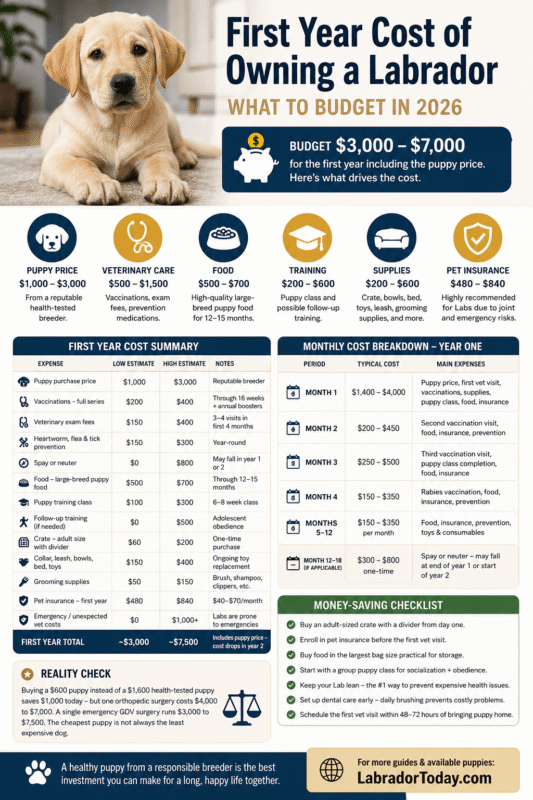
First Year Cost of Owning a Labrador – Full Summary
| Expense | Low Estimate | High Estimate | Notes |
|---|---|---|---|
| Puppy purchase price | $1,000 | $3,000 | From a reputable health-tested breeder |
| Vaccinations — full first-year series | $200 | $400 | Multiple visits through 16 weeks plus annual boosters |
| Veterinary exam fees — year one | $150 | $400 | 3 to 4 visits in first 4 months alone |
| Heartworm, flea, and tick prevention | $150 | $300 | Year-round — varies by region and product |
| Spay or neuter | $0 | $800 | May fall in year one or year two — $0 if deferred |
| Food — large-breed puppy food | $500 | $700 | Quality large-breed puppy formula through 12 to 15 months |
| Puppy training class | $100 | $300 | 6 to 8 week positive reinforcement class — essential |
| Follow-up training if needed | $0 | $500 | Adolescent obedience class or private sessions |
| Crate — adult size with divider | $60 | $200 | One-time purchase — buy adult size from the start |
| Collar, leash, bowls, bed, toys | $150 | $400 | Labs destroy toys — budget for ongoing replacement |
| Grooming supplies | $50 | $150 | Deshedding brush, shampoo, nail clippers, ear cleaner |
| Pet insurance — first year | $480 | $840 | $40–$70/month — enroll immediately on arrival |
| Emergency or unexpected vet costs | $0 | $1,000+ | Foreign body ingestion, injury, illness — Labs are prone |
| First year total | ~$3,000 | ~$7,500 | Includes puppy price — annual cost drops significantly in year two |
Labrador Monthly Cost Breakdown – Year One
For buyers planning month by month, here is how the costs land across the first year. Month one is by far the most expensive — the puppy price, first veterinary visit, vaccinations, supplies, and training enrollment all cluster at the start:
| Period | Typical Cost | Main Expenses |
|---|---|---|
| Month 1 | $1,400 – $4,000 | Puppy price, first vet visit, initial vaccinations, crate and supplies, puppy class enrollment, first month of food and insurance |
| Month 2 | $200 – $450 | Second vaccination visit, food, pet insurance, parasite prevention |
| Month 3 | $250 – $500 | Third vaccination visit, puppy class completion, food, insurance |
| Month 4 | $150 – $350 | Rabies vaccination, food, insurance, parasite prevention |
| Months 5 – 12 | $150 – $350 per month | Food, pet insurance, parasite prevention, toys and consumables — no major vet visits in healthy puppies |
| Month 12 – 18 (if applicable) | $300 – $800 one-time | Spay or neuter — may fall at end of year one or start of year two |
Reality Check
Buying a $600 puppy instead of a $1,600 health-tested puppy saves $1,000 today — but one orthopedic surgery costs $4,000 to $7,000. A single emergency GDV surgery runs $3,000 to $7,500. The cheapest puppy is not always the least expensive dog. The $1,000 you save upfront is the same amount that disappears in the first unexpected veterinary event — and with an unverified puppy, that event is significantly more likely.
What It Costs After Year One
The ongoing annual cost of a Labrador Retriever drops significantly after year one — most of the major one-time setup costs are behind you, the vaccination series is complete, and the spay or neuter is done. Ongoing annual costs typically run $1,500 to $3,000 depending on your location, health events, and lifestyle.
The biggest recurring annual costs are food ($500 to $700), pet insurance ($480 to $840), annual veterinary exam and boosters ($200 to $400), and heartworm and parasite prevention ($150 to $300). Labs that stay healthy and maintain a lean weight — the most important single factor in Lab longevity — can have a remarkably predictable annual cost well into their senior years.
Senior Labs from age 7 onwards typically require more frequent veterinary visits — twice yearly rather than annually — and may develop joint conditions requiring medication, supplements, or physiotherapy that add $500 to $2,000 to annual costs. Early health testing, lean weight, and consistent exercise throughout life are the most reliable ways to minimize those costs. Read our guide on how long Labrador Retrievers live and what affects longevity for the full picture.
How to Reduce the First Year Cost of Owning a Labrador Without Cutting the Wrong Corners
There are places to save money in year one and places where cutting costs creates much larger costs later. The distinction matters:
Worth saving on: home grooming instead of professional, mid-range toys rather than premium (Labs destroy them regardless of price), second-hand crates in good condition, and buying food in larger bags when storage allows — the per-pound cost drops meaningfully at 30 to 40 pound bag sizes.
Not worth cutting: the puppy price itself — buying from an untested breeder to save $500 to $800 is the highest-risk economy available to a new Lab owner. Pet insurance — the window between bringing your puppy home and enrolling is the only time you can get comprehensive coverage before any condition develops. The vaccination series — non-negotiable. Puppy class — the socialization window does not wait for a convenient time to open the budget.
The calculation is simple: the cost difference between a $500 unverified puppy and a $1,500 health-tested puppy is $1,000. A single hip surgery is $3,500 to $7,000. The math favors the health-tested puppy every time.
Money-Saving Checklist – Year One
- ✅ Buy an adult-sized crate with a divider panel from day one — you will not outgrow it and you pay for one crate instead of two
- ✅ Compare pet insurance quotes before your puppy’s first veterinary visit — not after. Some conditions discovered at the first exam can become immediate exclusions
- ✅ Buy food in the largest bag size practical for your storage — per-pound cost is meaningfully lower in 30 to 40 pound bags
- ✅ Start with a group puppy class before considering private training — group classes provide socialization alongside obedience and cost a fraction of private sessions
- ✅ Keep your Lab lean from 8 weeks onwards — maintaining healthy weight throughout life is the single most cost-effective health decision you can make, reducing joint disease, cancer risk, and the veterinary costs both generate
- ✅ Set up dental care from puppyhood — daily brushing prevents the professional cleaning costs and systemic health consequences of untreated dental disease in later years
- ✅ Schedule the first veterinary visit within 48 to 72 hours of bringing your puppy home — catching any issues early costs far less than discovering them later
Estimates in this guide are based on 2026 pricing reported by US veterinary clinics, pet insurance providers, major pet retailers, and reputable AKC Labrador breeders. Actual costs vary by location, breeder program, and individual circumstances — treat ranges as planning benchmarks rather than fixed figures.
Our Available Lab Puppies
Every puppy from Labrador Today comes with full AKC registration, OFA-tested parents verifiable at ofa.org, licensed veterinarian health certificate, age-appropriate vaccinations, deworming records, written health guarantee, and lifetime breeder support — the foundation that makes the rest of your first year as straightforward as possible.
- Black Lab Puppies
- Yellow Lab Puppies
- Chocolate Lab Puppies
- White English Cream Lab Puppies
- Silver Lab Puppies
- Red Fox Lab Puppies
For further reading:
- Average Cost of a Labrador Puppy – Honest Breeder Breakdown
- How to Choose a Labrador Breeder
- Labrador Puppy First Week Home
- How Much Do Labs Eat?
- Common Labrador Health Problems
- Labrador Grooming Guide
👉 Browse All Available Puppies
👉 Contact Us With Any Questions About Pricing or What to Expect
Frequently Asked Questions
What is the 5 minute rule for Labradors?
The 5 minute rule is a puppy exercise guideline — 5 minutes of structured exercise per month of age, twice daily, until skeletal maturity at around 12 to 18 months. An 8-week-old puppy gets 10 minutes twice daily. A 6-month-old gets 30 minutes twice daily. This protects developing growth plates from repetitive impact that can contribute to joint problems later. Following the rule during puppyhood is one of the most cost-effective health decisions a Lab owner can make — joint surgery is among the most expensive veterinary costs a Lab can face. Read our full guide on Labrador exercise needs by age.
Is a Labrador a good dog for first-time owners?
Yes — Labs from show or companion lines are among the most recommended breeds for first-time owners. Their consistent temperament, high trainability, and forgiving nature with training mistakes makes the learning curve of first-time dog ownership more manageable than with reactive or high-drive breeds. The honest caveat is the adolescent phase between 6 and 18 months — and the ongoing daily exercise commitment of 60 to 90 minutes. Both are manageable with realistic expectations going in. Read our full guide on the best Labrador for first-time owners.
What color Lab is most expensive?
English Cream Labs — also called White Labs — are consistently the most expensive, typically ranging from $1,500 to $3,000 from reputable breeders. The premium reflects high buyer demand and limited supply from quality English show line programs. Silver and Red Fox Labs command a modest premium over standard Black, Yellow, and Chocolate Labs. Black Labs from companion lines are generally the most affordable quality option at $1,000 to $1,800.
What is the rarest color of Labrador?
Silver, Charcoal, and Champagne Labs — all produced by the dilute gene — are the rarest Labrador coat variations. Among the standard AKC-recognized colors, Chocolate Labs are less common than Black Labs due to the recessive genetics required to produce the chocolate coat. Red Fox Labs are less common than standard golden Yellow Labs. Read our full guide on Silver Labs for more on the rarest variations.
Which color of Labrador is best?
There is no objectively best Lab color — the right color depends on your household and lifestyle. For the calmest temperament, English Cream from English show lines is the most reliable choice. For the most consistent and versatile dog across all situations, Black Labs are the most widely recommended. For active households that want a higher-energy companion, Chocolate or field-line Red Fox Labs are a strong fit. For a visually distinctive dog with the same fundamental Lab temperament, Silver or Red Fox Labs are worth considering. Read our guide on which color Lab is the calmest.
Are Labs easy to own?
Easier than most large breeds — but not effortless. Labs are forgiving of training mistakes, consistent in temperament, and genuinely people-oriented in a way that makes ownership rewarding. What catches people off guard is the daily exercise requirement (60 to 90 minutes), the adolescent phase between 6 and 18 months, and the shedding. Labs that get consistent exercise, training, and human contact are among the easiest large dogs to live with. Labs that do not get these things are genuinely difficult. The difference is almost entirely in owner commitment rather than the breed itself.
Are boy or girl Labs better?
Neither is objectively better — both make outstanding companions. Female Labs are widely regarded as slightly easier during adolescence — they mature earlier, show less dominant behaviour, and tend to be more focused during training in the first year. Males are typically larger, more boisterous during adolescence, and often described as more affectionate and attention-seeking. In adulthood the temperament difference between a well-raised male and female Lab is minimal. Read our full guide on male vs female Labrador for the complete comparison.
How much does it cost to own a Labrador in the first year?
Budget $3,000 to $7,500 for the first year including the puppy price from a reputable breeder. The wide range reflects variation in puppy price by color and line, regional veterinary costs, whether spaying or neutering falls in year one, and whether any unexpected health events occur. The ongoing annual cost from year two drops to approximately $1,500 to $3,000 for a healthy, well-maintained Lab.
What is the biggest cost of owning a Lab in year one?
The puppy purchase price is typically the single largest cost — $1,000 to $3,000 from a reputable breeder. After that, veterinary costs in the first four months are the most intensive, with three to four visits required to complete the vaccination series. Pet insurance, food, and training each add meaningfully to the first-year total.
Is pet insurance worth it for a Labrador puppy?
Yes — more than for most breeds. Labs are predisposed to hip dysplasia, elbow dysplasia, and bloat, all of which can require surgical intervention costing thousands of dollars. Their tendency to eat non-food items makes gastrointestinal emergency surgery a real additional risk. A comprehensive policy enrolled before any conditions develop costs $40 to $70 per month and can pay for itself many times over. The critical window is immediately after the puppy comes home — before any conditions can be classified as pre-existing exclusions.
How much does a Lab puppy cost per month?
In the first four months — the most expensive period — monthly costs including veterinary visits, vaccinations, food, training, and supplies typically run $300 to $600 per month on top of the upfront puppy price. From month five onwards, monthly costs settle to approximately $150 to $300 covering food, parasite prevention, pet insurance, and incidentals. The average across the full first year works out to roughly $170 to $380 per month excluding the puppy purchase price.
How much does a Lab cost to feed per month?
A growing Labrador puppy on quality large-breed puppy food costs approximately $40 to $70 per month in food — more for premium brands or prescription diets. An adult Lab from 12 to 18 months typically costs $50 to $80 per month to feed at appropriate portions. Labs are prone to obesity — measured portions rather than free feeding is both the healthiest and most cost-effective approach. Read our full guide on how much Labs eat by age and weight.
When should I budget for spaying or neutering my Lab?
Many veterinarians now recommend waiting to spay or neuter Labrador Retrievers until 12 to 18 months of age — later than the traditional 6-month recommendation — based on research suggesting earlier neutering may affect joint development in large breeds. This means the cost may fall in year one or year two depending on your vet’s recommendation and your timing. Budget $300 to $800 and discuss timing at your first veterinary visit rather than assuming a fixed schedule.
