
The best Labrador for first time owners is not the same dog for every household — and getting this decision right from the start makes the difference between a genuinely enjoyable first year and a frustrating one. Labradors as a breed are one of the most forgiving dogs available for new owners. But within the breed, there are meaningful differences in energy level, temperament, and manageability that matter enormously when you do not yet have experience reading a dog’s behavior or managing a high-drive adolescent.
This guide gives you an honest picture of which Lab color, sex, and breeding line is realistically the best starting point — and what to expect in the first two years regardless of which Lab you bring home. Browse our currently available Lab puppies once you have read through and made your decision.
- Is a Labrador Good for First Time Owners?
- Best Labrador Color for First-Time Owners
- Best Lab Sex for First Time Owners – Male or Female?
- Best Lab Breeding Line for First-Time Owners
- The Optimal Combination for First-Time Owners
- What First-Time Lab Owners Should Realistically Expect
- The Biggest Mistakes First-Time Lab Owners Make
- Essential Preparation Before Your Lab Puppy Comes Home
- Why Labs Are Forgiving for First-Time Owners
- Our Available Puppies – The Best Lab for First-Time Owners
- Frequently Asked Questions
Is a Labrador Good for First Time Owners?
Yes — Labrador Retrievers are consistently among the top recommendations for first-time dog owners, and for well-understood reasons:
| Lab Characteristic | Why It Helps First-Time Owners |
|---|---|
| High trainability | Labs are food motivated and eager to please from 8 weeks — they respond quickly to positive reinforcement and are forgiving of the inevitable early training mistakes every new owner makes |
| Stable, predictable temperament | Labs do not have the unpredictability of high-anxiety or reactive breeds — their emotional stability makes them significantly safer and easier to manage in new situations |
| People-oriented nature | Labs genuinely want to be near and please their owners — this makes the bonding process faster and the motivation for training more accessible than independent or aloof breeds |
| Resilience to early mistakes | New owners will miss timing cues, inconsistency training commands, and misread their dog’s signals — Labs are more forgiving of these early mistakes than most breeds |
| Well-documented breed characteristics | Because Labs are so widely owned, resources on training, health, feeding, and behavior are abundant. The AKC breed profile and the OFA health database provide extensive information on what to expect — new owners are never without guidance |
The honest caveat: Labs are not a no-effort breed. Their energy level during the first two years requires a genuine daily exercise commitment — and their size means a boisterous adolescent Lab can be genuinely difficult to manage without consistent early training.
Best Labrador Color for First-Time Owners
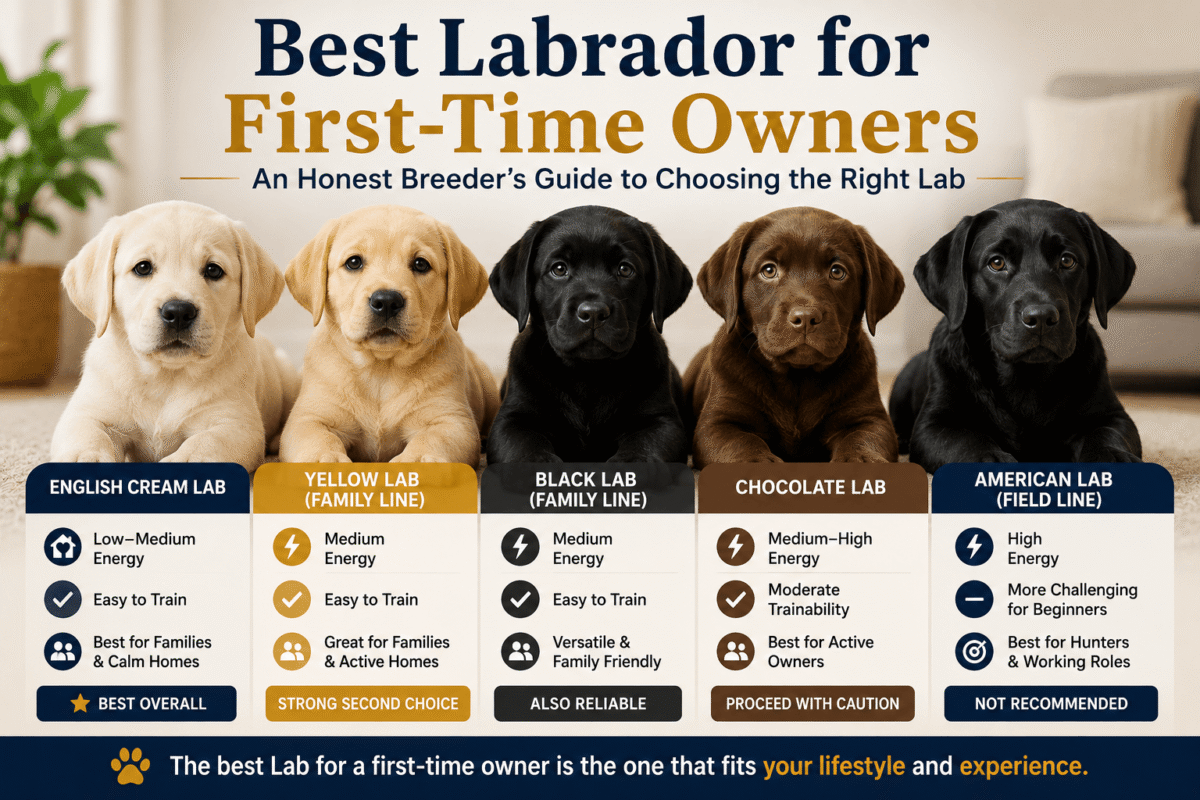
Here is how each color typically performs for first-time owners:
| Color | Typical Line | First-Time Owner Rating | Why |
|---|---|---|---|
| English Cream / White | English show or European lines | ⭐⭐⭐⭐⭐ Excellent | Earlier maturity, lower baseline energy, more settled adolescence — the most manageable combination for first-time owners across the board |
| Yellow Lab | Show or companion lines | ⭐⭐⭐⭐⭐ Excellent | Gentle, patient, and widely regarded as one of the most reliably family-friendly Lab colors — particularly from show or companion lines |
| Black Lab | Show, companion, or field lines | ⭐⭐⭐⭐ Very good | The most consistent Lab color across lines — even-tempered and predictable. From companion lines an excellent first-time choice. From field lines more demanding |
| Red Fox Lab | Yellow Lab lines | ⭐⭐⭐⭐ Very good | Same temperament as Yellow Labs — calm, patient, and family-oriented. A good first-time choice for buyers who want something visually distinctive |
| Silver Lab | Chocolate Lab lines | ⭐⭐⭐ Good | Shares the Chocolate Lab’s more energetic tendencies — manageable for first-time owners who are prepared for the exercise commitment |
| Chocolate Lab | Companion or field lines | ⭐⭐⭐ Good with preparation | Often described as the most energetic Lab color — excellent for active first-time owners who can commit to daily exercise. More challenging for those expecting a calm indoor companion from day one |
Best Lab Sex for First Time Owners – Male or Female?
For first-time owners, a female Lab has a practical edge — not because of any difference in loyalty or affection, but because of timing:
| Factor | Female Lab | Male Lab |
|---|---|---|
| Adolescent phase length | Shorter — most females settle into calmer adult temperament by 18 months to 2 years | Longer — males can stay in a boisterous, easily distracted adolescent phase until 2.5 to 3 years |
| Early training focus | More consistent focus in training sessions — less easily distracted in the first year | More easily distracted — particularly by scent and other dogs between 6 and 18 months |
| Size and physical management | Smaller — 55 to 70 lbs — easier to manage on leash during adolescence | Larger — 65 to 80+ lbs — harder to manage on leash during adolescent pulling phase |
| First-time owner recommendation | More commonly recommended for first-time owners — more manageable early experience | Absolutely manageable with consistent training — but the extended adolescence requires more patience |
For the full male vs female comparison, read our guide on male vs female Labrador.
Best Lab Breeding Line for First-Time Owners
Breeding line is the most important variable for first-time owners — more important than color and more important than sex:
| Breeding Line | Energy Level | First-Time Owner Suitability | Best For |
|---|---|---|---|
| English show or conformation lines | Low to moderate | ⭐⭐⭐⭐⭐ Best | Any first-time owner — particularly those in apartments, smaller homes, or with young children. Shorter adolescence, more settled indoors, earlier trainability |
| American companion lines | Moderate | ⭐⭐⭐⭐ Very good | First-time owners with a yard and active lifestyle — good balance of trainability and energy without the extreme drive of field lines |
| American field or working lines | High | ⭐⭐ Challenging | Experienced owners, hunters, or very active households — the drive and energy that makes a field Lab an outstanding hunting dog makes the first year with an inexperienced owner significantly harder |
For a full explanation of what these line differences mean in practice, read our guide on English Lab vs American Lab.
The Optimal Combination for First-Time Owners
Putting color, sex, and line together — here is what we most commonly recommend when buyers ask us about the best Labrador for first-time owners, ranked from most to least manageable:
| Rank | Combination | Why |
|---|---|---|
| 1st | English Cream female from English show lines | The calmest, most settled, fastest-maturing combination available — shorter adolescence, lower energy, easier leash management, most forgiving of the early training learning curve |
| 2nd | Yellow female from show or companion lines | Very similar to English Cream in temperament — gentle, patient, and family-oriented. Slightly more variation by line than English Cream but still an excellent first-time choice |
| 3rd | Black female from companion lines | Even-tempered, highly trainable, consistent across lines — the most versatile Lab for first-time owners who want a reliable all-rounder |
| 4th | English Cream male from English show lines | Calmer than American-line males due to show line breeding — but the extended adolescence still applies. Larger and more boisterous during years one and two than a female from the same line |
| 5th | Yellow male from companion lines | Good family temperament but more energy and a longer adolescent phase than a female from equivalent lines — manageable with consistent training |
| 6th | Chocolate female from companion lines | More energetic than Yellow or Black Labs — the female’s earlier maturity helps, but Chocolate Labs require a higher daily exercise commitment regardless of sex |
What First-Time Lab Owners Should Realistically Expect
Even the calmest Lab combination requires honest preparation. Here is what the first two years genuinely look like:
| Stage | Age | What to Expect | What Helps Most |
|---|---|---|---|
| Early puppyhood | 8 to 12 weeks | Biting and mouthing everything — this is normal puppy behavior, not aggression. Bladder control is limited — expect frequent accidents. Short attention span — training sessions of 3 to 5 minutes maximum | Consistent crate training from day one. Redirect biting to toys immediately. Establish a feeding and toilet schedule before the puppy arrives home |
| Late puppyhood | 3 to 6 months | Energy increases significantly. Teething peaks between 3 and 5 months — chewing is at its most intense. Socialization window closes at 16 weeks — the most critical period for exposure to people, places, and sounds | Daily exercise appropriate to age — no forced running or jumping before 12 months. Basic obedience training three times daily — sit, down, come, leave it. Puppy class enrollment ideally before 12 weeks |
| Adolescence | 6 to 18 months | This is the most challenging period for first-time owners. Labs seem to forget commands they knew confidently at 12 weeks. Selective hearing increases dramatically. Energy level peaks. Many first-time owners describe this phase as a genuine test of patience | Consistent exercise — a tired Lab is a well-behaved Lab. Maintain training routines even when the dog seems to regress. This phase passes — most Labs emerge from adolescence as genuinely wonderful companions |
| Young adult | 18 months to 3 years | Energy begins to moderate. Training consistency pays off — the dog that seemed impossible at 9 months becomes the calm, devoted companion the breed is famous for. English and show-line Labs settle earlier; field-line Labs may stay in this transition longer | Maintain daily exercise and mental stimulation. Reinforce training commands regularly. The effort invested in months 6 to 18 directly determines how settled and reliable the adult dog becomes |
| Adult | 3 years onwards | The Lab owners describe when they recommend the breed to friends. Calm, devoted, reliably trained, and deeply bonded to the whole family. Worth every difficult moment of adolescence | Daily exercise and continued engagement keep adult Labs settled and healthy throughout their 10 to 14 year lifespan |
The Biggest Mistakes First-Time Lab Owners Make
Understanding what goes wrong helps first-time owners avoid it. The best Labrador for first-time owners still requires consistent management — here are the most common pitfalls:
Mistake What Happens What to Do Instead
Not exercising enough An under-exercised Lab channels energy into destructive behavior — chewing furniture, jumping, pulling on leash, barking. Most first-year behavioral problems are exercise problems At minimum 60 minutes of active exercise daily — broken into two sessions. A tired Lab is a well-behaved Lab. Exercise before expecting good behavior indoors Skipping crate training Without a crate, puppies get into everything unsupervised — accidents happen throughout the house, chewing escalates, and housetraining takes much longer Introduce the crate on day one as a positive, safe space — not a punishment. Most Labs accept crate training readily within the first week when introduced positively Waiting too long to start training The puppy that seemed easy at 8 weeks is significantly harder to train at 6 months once habits have formed. Bad habits established in puppyhood are much harder to undo in adolescence Begin basic obedience — sit, down, come, leave it — from day one. Training sessions of 3 to 5 minutes, three times daily. Enroll in a puppy class before 16 weeks if possible Free feeding Labs will eat until they cannot move if food is left out. Obesity is the most preventable health problem in Labs and dramatically shortens lifespan and quality of life Measure every meal. Feed twice daily. Put the bowl down for 15 minutes and remove it whether or not it is finished. Never free-feed a Lab Misreading adolescence as a permanent personality change Many first-time owners give up on training or consider rehoming during the adolescent phase — not realizing the difficult phase is temporary and entirely normal Understand that adolescence — typically 6 to 18 months — is temporary. Maintain consistency during this period. The calm, devoted adult Lab is on the other side of it Choosing a field-line Lab without knowing it A field-line Lab has significantly more drive and energy than a companion-line Lab — first-time owners who do not realize this often find the first year overwhelming Always ask the breeder specifically whether the puppies come from show, companion, or field lines. Choose companion or show lines for a first-time experience unless you specifically need a hunting dog
Essential Preparation Before Your Lab Puppy Comes Home
| Preparation Item | Why It Matters |
|---|---|
| Crate — appropriately sized | The single most useful tool for housetraining and puppy management. Get a size the adult dog can stand, turn, and lie down in |
| Puppy-proof the house | Labs chew — anything at floor level is fair game in the first months. Secure cords, remove toxic plants, block off rooms before the puppy arrives |
| Identify a veterinarian before arrival | Book a first vet appointment within the first week. Establish a vaccination schedule, discuss heartworm and tick prevention, and get a microchip if not already done |
| Research puppy classes in your area | Enroll before the puppy arrives — good puppy classes fill quickly. The socialization window closes at 16 weeks — early enrollment is not optional for an optimally socialized dog |
| Decide on a feeding schedule and food | Maintain the same food the breeder used for at least the first two weeks — abrupt food changes cause digestive upset in puppies. Transition slowly if changing brands |
| Agree on house rules as a family | Decide before the puppy arrives whether it will be allowed on furniture, in bedrooms, and which rooms are off-limits. Inconsistency between family members is one of the most common causes of training confusion |
Why Labs Are Forgiving for First-Time Owners
The Labrador Retriever’s reputation as the ideal first dog is earned — but understanding specifically why helps you leverage that forgiving nature effectively:
| Why Labs Are Forgiving | What It Means in Practice |
|---|---|
| High food motivation | Training with treats works immediately and reliably from 8 weeks — you do not need perfect timing or technique to get early results. Food motivation creates training opportunities every meal |
| Strong desire to please | Labs are not trying to dominate or outwit their owners — they genuinely want to do the right thing. When they make mistakes it is almost always confusion or insufficient exercise, not defiance |
| Low aggression baseline | The breed’s consistently low predatory drive and high social tolerance means Labs are very unlikely to react aggressively to the handling mistakes, inconsistent signals, and boundary testing that new owners inevitably produce |
| Responds well to positive reinforcement | Labs do not need dominance-based training methods — positive reinforcement alone is highly effective. This is important for first-time owners who may not yet have the confidence for more assertive handling styles |
Our Available Puppies – The Best Lab for First-Time Owners
Based on everything in this guide, the best Labrador for first-time owners is most commonly an English Cream or Yellow Lab female from English show or companion lines. Here are our current options:
- White English Cream Lab Puppies — top recommendation for first-time owners
- Yellow Lab Puppies — gentle, patient, widely recommended
- Black Lab Puppies — most consistent and versatile
- Chocolate Lab Puppies — best for active first-time owners
- Silver Lab Puppies — rare and striking
- Red Fox Lab Puppies — Yellow Lab temperament, distinctive coat
Contact us to discuss which specific puppy from available litters best matches your household situation — we take matching seriously and are happy to advise.
👉 Browse All Available Puppies
👉 Contact Us to Find the Best Lab for Your Household
Frequently Asked Questions
Is a Labrador a good dog for first-time owners?
Yes — Labrador Retrievers are consistently among the top recommendations for first-time dog owners. Their high trainability, stable temperament, people-oriented nature, and resilience to early training mistakes make them significantly more forgiving than most breeds. The main considerations for first-time owners are the energy level during the first two years, which requires a genuine daily exercise commitment, and the importance of choosing the right breeding line — show or companion lines rather than field lines.
Which Lab color is best for first-time owners?
English Cream or Yellow Labs from English show or companion lines are most widely recommended for first-time owners. Their earlier maturity, lower baseline energy, and more settled adolescence make the first two years significantly more manageable. Black Labs from companion lines are also excellent. Chocolate Labs are manageable for active first-time owners but require a higher daily exercise commitment. Read our full guide on which color Lab is the calmest.
Is a male or female Lab better for first-time owners?
A female Lab is generally the more manageable starting point for first-time owners. Females mature faster — typically settling into calm adult temperament by 18 months to 2 years compared to 2.5 to 3 years for males. They are also smaller and easier to manage on leash during the adolescent pulling phase. Males are absolutely manageable but require more patience during the extended adolescence. Read our full guide on male vs female Labrador.
How much exercise does a first-time owner need to give a Lab puppy?
At least 60 minutes of active exercise daily — ideally broken into two sessions. The most common cause of behavioral problems in first-year Labs is insufficient exercise rather than training failures. A tired Lab is a well-behaved Lab. During puppyhood, avoid forced running or jumping before 12 months — stick to free play, walking, and swimming which are lower-impact on developing joints.
What is the hardest part of owning a Lab for the first time?
Adolescence — typically from 6 to 18 months. Labs in this phase seem to forget commands they knew confidently as puppies, become easily distracted, and test limits consistently. Many first-time owners describe this period as genuinely challenging. The most important thing to understand is that it is temporary and normal — and that consistency in training and daily exercise during this period directly determines how settled and reliable the adult dog becomes. English Cream and Yellow Labs from show lines have a noticeably shorter and less intense adolescent phase.
Do Labs need a lot of space for first-time owners?
Not necessarily — Labs adapt to apartments and smaller homes when their daily exercise needs are consistently met. A condo or apartment Lab with guaranteed daily exercise and regular off-leash time will be calmer and more settled indoors than a suburban Lab that does not get enough activity. If you live in an apartment, an English Cream or Yellow Lab from show lines is the most manageable choice — their lower baseline energy makes the smaller-space commitment more realistic.
Should a first-time Lab owner get a puppy or an adult?
Both are valid — each with genuine trade-offs. A puppy gives you the full socialization window and the opportunity to build the dog’s habits from day one, but requires significantly more time and management in the first year. An adult Lab — from a rescue or rehoming situation — may already be past the most demanding adolescent phase, housetrained, and with a known temperament. If time availability in the first year is a genuine concern, an adult Lab from a rescue program is worth considering seriously alongside a puppy.
