
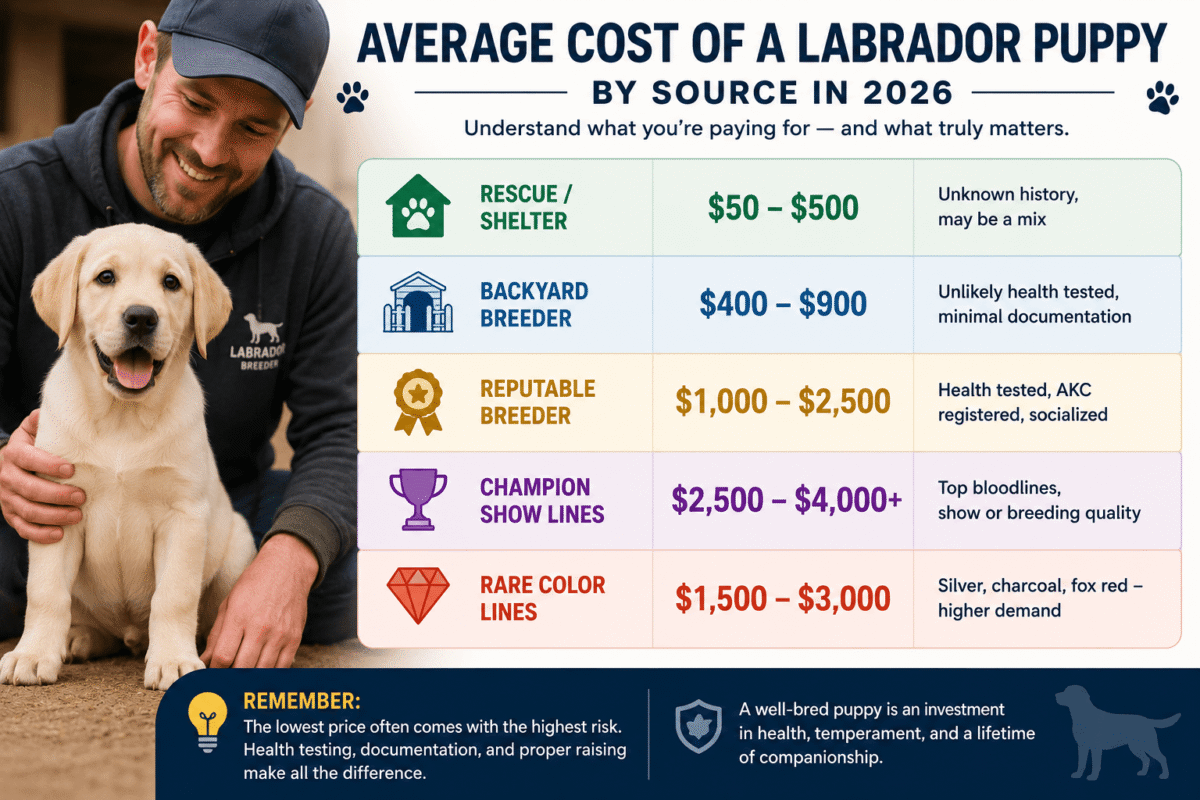
The average cost of a Labrador puppy is one of the first questions prospective buyers ask — and one of the hardest to answer cleanly, because the range is genuinely wide. Lab puppy prices in 2026 range from under $500 from unverified private sellers to over $3,000 from imported European show lines. Understanding what drives that range protects you from both overpaying and from buying a puppy with hidden health or documentation problems that cost significantly more to resolve later.
This guide covers everything — price by color and line, what drives breeder pricing, first-year ownership costs, what a reputable breeder actually includes at each price point, and the red flags that explain why some Lab puppies are priced far below market. Browse our available Lab puppies once you understand what you should be paying.
- Average Cost of a Labrador Puppy in 2026 – Quick Reference
- Average Lab Puppy Price by Color – 2026
- Average Lab Puppy Price by Color – Visual Guide
- What Makes One Labrador Puppy Cost $1,200 and Another $3,000?
- What a Reputable Breeder Includes at Each Price Point
- First Year Cost of Owning a Labrador Puppy
- Why Some Lab Puppies Are Priced Below $800 – And Why to Avoid Them
- Is a Higher Price Always Better?
- How to Verify You Are Getting What You Pay For
- Further Reading – Plan Your Full Lab Ownership Budget
- Our Available Lab Puppies – What Is Included
- Final Thoughts
- Frequently Asked Questions
Average Cost of a Labrador Puppy in 2026 – Quick Reference
Prices below reflect current US market observations based on AKC-registered breeders with OFA health testing in place. Unverified private seller pricing is included for comparison only.
| Buyer Type | Best Source | Typical Budget |
|---|---|---|
| Open to adult or older Lab | Breed-specific rescue or shelter | $50 – $500 |
| Family companion — Black, Yellow, or Chocolate | Reputable companion-line breeder | $1,000 – $1,800 |
| English Cream — calmer temperament priority | Documented English show line breeder | $1,500 – $3,000 |
| Hunting or field work | Field-line breeder with titled ancestry | $1,500 – $2,500 |
| Silver or Red Fox Lab | Specialty color breeder with OFA and full documentation | $1,200 – $2,500 |
| Imported European bloodlines | Importer with European KC documentation | $2,500 – $4,500+ |
Rescue or shelter adoption $50 – $500 Adult or older Labs primarily — some puppies available through breed-specific rescue. Adoption fee covers spay/neuter, basic vaccinations, microchip ✅ Excellent if flexible on age and history Unverified private seller — Facebook Marketplace, Craigslist, Kijiji $300 – $800 Usually no health testing, no AKC papers, unverified parentage — the lowest upfront cost but highest long-term risk ❌ Avoid Reputable breeder — companion lines — Black, Yellow, Chocolate $1,000 – $1,800 AKC registration, OFA-tested parents, health guarantee, full documentation, lifetime breeder support ✅ Recommended starting point for most buyers Field-line breeder — proven working bloodlines $1,500 – $2,500 AKC registration, OFA testing, field champion or hunt test titled ancestry, proven working drive ✅ For hunters and field sport enthusiasts English Cream or show-line Labs $1,500 – $3,000 Documented English show or European line breeding, AKC registration, full OFA health testing, calmer temperament ✅ For buyers specifically wanting English show lines Silver Lab — reputable breeder $1,200 – $2,500 AKC registration as Chocolate Lab, OFA testing, CDA history disclosed, full documentation ✅ From a breeder transparent about the controversy Imported European bloodlines $2,500 – $4,500+ European KC registration, imported show champion lineage, highest documentation standards ✅ For buyers specifically wanting imported lines
Average Lab Puppy Price by Color – 2026
| Color | Typical Price Range | Why This Price |
|---|---|---|
| Black Lab | $1,000 – $2,500 | Most widely produced Lab color — highest supply keeps base prices lower than specialty colors. Field-line and show-line Black Labs command the higher end |
| Yellow Lab — standard golden | $1,000 – $1,800 | Widely produced from companion lines — pricing comparable to Black Labs from equivalent programs |
| English Cream / White Lab | $1,500 – $3,000 | Premium driven by high demand and limited genuine supply from documented English show lines. The most consistently premium-priced Lab variation |
| Chocolate Lab | $1,000 – $2,000 | Comparable to Black and Yellow from companion lines — field-line Chocolate Labs at higher end |
| Red Fox Lab | $1,200 – $2,500 | Modest premium over standard Yellow due to growing buyer demand and lower supply of the deep red shade |
| Silver Lab | $1,200 – $2,500 | Premium over standard Chocolate due to visual distinctiveness and the recessive gene combination required to produce the dilute coat |
Average Lab Puppy Price by Color – Visual Guide
From reputable health-tested breeders — 2026 US market
Black Lab
$1,000 – $2,500
$1,000–$2,500
Yellow Lab
$1,000 – $1,800
$1,000–$1,800
Chocolate Lab
$1,000 – $2,000
$1,000–$2,000
Red Fox Lab
$1,200 – $2,500
$1,200–$2,500
English Cream
$1,500 – $3,000
$1,500–$3,000
Silver Lab
$1,200 – $2,500
$1,200–$2,500
What Makes One Labrador Puppy Cost $1,200 and Another $3,000?
Several factors drive Lab puppy pricing — and understanding them protects you from both overpaying and from buying a puppy that looks affordable until the veterinary bills arrive.
A responsible breeder invests heavily before a puppy is even born. Health testing alone — OFA hip and elbow evaluations, annual CAER eye certification, and DNA tests for Exercise-Induced Collapse and Progressive Retinal Atrophy — can cost well over $1,000 for a breeding pair. Add prenatal veterinary care, AKC litter registration, licensed veterinarian health certificates for each puppy, age-appropriate vaccinations, deworming, and eight weeks of high-quality nutrition for the dam and her litter, and the production cost of each puppy rises quickly. That is before accounting for the hundreds of hours a quality breeder spends on daily care, individual handling, and early socialization from birth to placement.
Then there are the unpredictable costs — emergency veterinary care during whelping, a caesarean section when needed, or a puppy that requires additional medical attention before placement. Most small breeders absorb these without passing them to buyers.
Responsible breeders often invest well over $1,000 per puppy before accounting for their own time. When a puppy is advertised for $400 or $500, something has almost certainly been cut — and that cut almost always falls on health testing, documentation, or veterinary care. The cost of that omission transfers entirely to the buyer.
Beyond health testing, what drives price variation within the reputable breeder range is color demand, breeding line, and bloodline credentials. English Cream Labs command a premium because buyer demand for the pale coat and calmer temperament consistently exceeds supply from quality English show line programs. Field-line Labs with titled ancestors — Master Hunter or Field Champion credentials in the pedigree — command a premium for the proven working bloodline. Imported European dogs add the cost of import documentation and European KC registration. These are genuine price drivers, not inflation.
What a Reputable Breeder Includes at Each Price Point
| Price Range | What Should Be Included | What to Watch For |
|---|---|---|
| $1,000 – $1,500 — companion lines | AKC registration, OFA hip and elbow clearances on both parents, health certificate from licensed vet, age-appropriate vaccinations, deworming records, written health guarantee, puppy starter kit | CAER eye certification, EIC and PRA DNA tests may not always be included at this price — ask specifically |
| $1,500 – $2,000 — mid-range companion and field lines | Everything above plus CAER eye certification, EIC and PRA DNA tests, full health testing documentation for both parents, video call viewings before deposit, more extensive socialization program | For field lines — ask for hunt test or field champion titled ancestors in the pedigree to justify field-line pricing |
| $2,000 – $3,000 — English show lines and premium programs | Full documentation as above plus documented English show or European line breeding, photos and pedigrees of multiple generations, often longer waitlists reflecting demand, more selective buyer screening | A high price alone does not confirm English show line breeding — verify the line specifically through dam photos and pedigree documentation |
| $3,000 – $4,500+ — imported European bloodlines | European KC registration alongside AKC, documented show champion imported ancestry, highest documentation standards, often the longest waitlists | Legitimate at this price only with verifiable European KC documentation — not simply a US breeder claiming European lines without documentation |
First Year Cost of Owning a Labrador Puppy
The puppy purchase price is just the beginning. Here is a realistic picture of what the first year actually costs:
| First Year Expense | Approximate Cost | Notes |
|---|---|---|
| Puppy purchase price | $1,000 – $3,000 | From a reputable health-tested breeder |
| First veterinary visit | $150 – $300 | Comprehensive examination, confirm vaccination status, establish care relationship |
| Vaccination series — first year | $200 – $400 | Multiple visits through the first 16 weeks plus annual boosters |
| Heartworm, flea, and tick prevention | $150 – $300 annually | Year-round prevention — cost varies by region and product |
| Spay or neuter | $300 – $800 | If applicable — cost varies significantly by location and clinic. Many vets now recommend waiting to 12 to 18 months in Labs |
| Food — large breed puppy food | $400 – $700 annually | High-quality large breed puppy food through 12 to 18 months — cost varies significantly by brand |
| Crate — appropriately sized | $60 – $200 | One-time cost — buy adult size with divider rather than a puppy-sized crate you will outgrow |
| Puppy class enrollment | $100 – $300 | 6 to 8 week positive reinforcement puppy class — strongly recommended before 16 weeks |
| Basic supplies — bowls, collar, leash, toys, bed | $150 – $400 | One-time purchases — Labs are hard on toys and will need ongoing replacement |
| Grooming supplies or professional grooming | $50 – $200 annually | Labs do not require professional grooming but deshedding tools, shampoo, and nail clippers are needed |
| Pet insurance — first year | $400 – $800 annually | Strongly recommended for Labs given their predisposition to joint issues and their tendency to eat things they should not. A policy covering orthopedic conditions can pay for itself many times over |
| First year total estimate | $3,000 – $7,000 | Includes puppy price. Ongoing annual cost after first year: approximately $1,500 – $3,000 depending on lifestyle and health |
Why Some Lab Puppies Are Priced Below $800 – And Why to Avoid Them
The most common reason a Lab puppy is priced well below the reputable breeder range is missing health testing. OFA evaluations cost money — skipping them makes puppies significantly cheaper to produce, and the financial risk of untested genetics transfers entirely to the buyer. Hip dysplasia surgery costs $3,500 to $7,000 per hip. Elbow surgery runs $2,000 to $4,000. Annual management costs for a dog with joint disease add hundreds to thousands more. The $600 you saved on a cheaper puppy rarely survives the first significant veterinary event.
Missing AKC papers are the second most common signal. Without registration documentation, a puppy’s parentage is unverified — and this is how mixed-breed puppies are routinely sold as purebred Labs, with no way for the buyer to confirm what they actually purchased.
High-volume operations — sometimes called puppy mills — produce Lab puppies at scale with minimal individual care, socialization, or veterinary investment. Their puppies may arrive with AKC papers but without the early handling, individual attention, and environmental enrichment that reputable small breeders invest in during the critical first eight weeks. The behavioral consequences of inadequate early socialization can be long-lasting and expensive to address.
The most dangerous low-price scenario is the outright scam — particularly common for English Cream and Silver Labs, where high buyer demand and premium pricing make them attractive targets. Stolen photos, fabricated documentation, and payment requested before any live viewing are the hallmarks. Never send money for a puppy you have not seen on a live video call in real time. Reverse image search every photo before you send a deposit.
The one exception worth noting: a reputable breeder occasionally discounts an older puppy past 12 weeks that was not placed as planned. This can be a legitimate opportunity — but only if the health testing and documentation are fully in place. Ask all the same questions regardless of price.
Is a Higher Price Always Better?
No — and this is worth being direct about. Price is a reliable signal at the low end: below $800, something is almost certainly missing. But above the reputable breeder floor of $1,000 to $1,200, price does not reliably distinguish quality.
Within the $1,000 to $1,800 range, you are paying for documentation and health testing that should be in place across the entire range. What differentiates breeders at this level is not price — it is experience, the quality of their socialization program, the transparency of their communication, and the support they offer after placement. A $1,100 puppy from an experienced, hands-on breeder with decades in Labs and a thorough socialization program may be a significantly better purchase than a $1,700 puppy from a less experienced breeder at the top of the same price range.
At $1,800 to $3,000, the premium should be verifiable. Documented English show line breeding, field champion or Master Hunter titled ancestors in the pedigree, or imported European bloodlines are legitimate reasons for the higher price — and all three can be confirmed with documentation before you commit. A high price without a verifiable justification is simply inflation.
Above $3,000, the same rule applies with more urgency. This price is legitimate only with European KC documentation or multiple generations of titled show champions that can be verified. Sellers charging above $3,000 for unverified “rare” English Cream or Silver Lab puppies are exploiting buyer demand rather than delivering proportionate value.
How to Verify You Are Getting What You Pay For
Before committing to any Lab puppy at any price, five steps protect you. First, search both parent dogs by registered name at ofa.org — OFA health clearances are publicly searchable, free, and the single most important verification available. Hip and elbow clearances, eye results, and DNA test results all appear in the same database search. Second, confirm both parent dogs’ AKC registration at apps.akc.org by registered name — this confirms they are registered purebred Labrador Retrievers, not simply represented as such.
Third, request a live video call before sending any money — see the puppy, the dam, and the whelping environment in real time. A breeder confident in their program welcomes this without hesitation. Fourth, ask for the written health guarantee before placing a deposit — specific terms in writing, not a verbal assurance. Fifth, reverse image search every photo the seller sends before committing any funds, particularly for English Cream and Silver Labs where stolen photos appear regularly across multiple listings.
Buying Tip
If a breeder advertises AKC-registered puppies but cannot provide OFA numbers for both parent dogs, verify the registered names yourself before placing a deposit. Health clearances are publicly searchable at ofa.org and take only a few minutes to confirm. A breeder with nothing to hide will give you the registered names without hesitation — and a breeder who hesitates has told you something important.
For the complete framework — green flags, red flags, questions to ask, and how to assess any breeder — read our dedicated guide on how to choose a Labrador breeder.
Further Reading – Plan Your Full Lab Ownership Budget
Puppy price is one part of Lab ownership planning. These guides cover what comes next:
- How Much Do Labs Eat? Feeding Guide by Age and Weight — ongoing food cost planning
- Labrador Grooming Guide — tools, frequency, and what you can do at home vs professionally
- Common Labrador Health Problems — what conditions to budget for and how health testing reduces inherited risk
- How Long Do Labrador Retrievers Live? — lifespan by color and line, and what affects longevity
- Male vs Female Labrador — how sex affects temperament, cost, and long-term care commitment
- Which Color Lab Is the Calmest? — temperament by color and line before you choose
- Best Labrador for First-Time Owners — the combination most likely to succeed for a new Lab owner
- How to Tell if a Labrador Puppy Is Purebred — AKC verification, DNA testing, and what to look for
Our Available Lab Puppies – What Is Included
Every puppy from Labrador Today comes with full AKC registration, OFA-tested parents verifiable at ofa.org, licensed veterinarian health certificate, age-appropriate vaccinations, deworming records, written health guarantee, puppy starter kit, and lifetime breeder support. Our pricing reflects the full investment in health testing and documentation — never cut corners to hit a price point.
- Black Lab Puppies
- Yellow Lab Puppies
- Chocolate Lab Puppies
- White English Cream Lab Puppies
- Silver Lab Puppies
- Red Fox Lab Puppies
👉 Browse All Available Puppies
👉 Contact Us With Any Questions About Pricing or Availability
Final Thoughts
The cheapest Labrador puppy is rarely the least expensive dog you will own. Health testing, responsible breeding, early socialization, and lifetime breeder support all cost money — but they dramatically reduce the likelihood of expensive veterinary problems and behavioral issues down the line. A single hip dysplasia surgery costs more than the price difference between a $500 private seller puppy and a $1,500 health-tested puppy from a reputable breeder.
Whether you choose a Black, Yellow, Chocolate, English Cream, Red Fox, or Silver Lab, focus on the breeder first and the color second. The color determines what your puppy looks like. The breeder determines what your puppy is made of — genetically, temperamentally, and structurally. A healthy, well-socialized puppy from a transparent breeder who stands behind their dogs is almost always a better investment than saving a few hundred dollars upfront with a seller who cannot answer basic questions about health testing.
The prices in this guide reflect 2026 US market observations from AKC-registered breeders with OFA health testing in place. Prices vary by region, individual program, and demand — treat the ranges as a calibration tool rather than fixed figures, and use them to identify when a price is suspiciously low rather than to negotiate with reputable breeders who have earned their pricing.
Frequently Asked Questions
What is the average cost of a Labrador puppy in 2026?
From a reputable, health-tested breeder, the average cost of a Labrador puppy in 2026 falls between $1,000 and $2,500 depending on color, line, and breeding program. The middle of that range — $1,200 to $1,800 — is where most quality companion-line breeders in the United States currently sit. English Cream and Silver Labs from documented specialty programs typically range from $1,500 to $3,000. Puppies priced below $800 from private sellers almost always lack health testing, AKC documentation, or both.
Why are some Lab puppies so cheap?
Puppies priced well below market almost always have one or more of the following missing: OFA health testing on parent dogs, AKC registration papers, licensed veterinarian health certificate, adequate socialization, or documentation of parentage. The upfront saving is typically outweighed by the potential veterinary costs of inherited health conditions — hip dysplasia surgery alone can cost $3,500 to $7,000 per hip. In some cases a very low price signals an outright scam — stolen photos and no puppy at all.
Why are English Cream Labs more expensive than standard Yellow Labs?
English Cream Labs command a premium because buyer demand for their pale coat and commonly reported calmer temperament consistently exceeds the supply from quality English show line breeding programs. Genuine English show line breeding requires maintaining documented bloodlines from UK or European breeding stock — an additional investment that is reflected in the puppy price. Many sellers use the “English Cream” label without the show line documentation to justify it — verify the breeding line before paying the premium.
How much does a Lab puppy cost per month in the first year?
After the purchase price, first-year monthly costs for a Lab puppy typically run between $200 and $400 per month — covering food, veterinary visits, vaccinations, parasite prevention, training classes, and supplies. Pet insurance adds $35 to $70 per month but is strongly recommended given Labs’ predisposition to joint conditions. Total first-year cost including purchase price is typically $3,000 to $7,000 depending on location, health events, and what is included with the puppy.
Is pet insurance worth it for a Labrador?
Yes — more so than for most breeds. Labs are predisposed to hip dysplasia, elbow dysplasia, and bloat — all of which can require expensive surgical intervention. Labs also have a strong tendency to eat things they should not, making gastrointestinal foreign body surgery a real risk. A policy that covers orthopedic conditions taken out before any symptoms develop can pay for itself many times over. Take out insurance as soon as the puppy comes home — before any conditions can be classified as pre-existing.
What is included with a Lab puppy from a reputable breeder?
At minimum: AKC litter registration certificate, individual puppy registration application, licensed veterinarian health certificate, age-appropriate vaccination records, deworming records, and a written health guarantee. A strong program also includes OFA health test certificates for both parent dogs, puppy starter kit with food samples, and lifetime breeder support for feeding, training, and health questions after your puppy comes home.
Are Lab puppies from Facebook Marketplace or Craigslist safe to buy?
Not reliably — the majority of Lab puppies listed on classified ad sites and social media marketplaces are from sellers who have not invested in OFA health testing, AKC registration, or proper veterinary care. While some genuine rehoming situations do appear on these platforms, the default assumption should be caution. Always verify OFA clearances at ofa.org and AKC registration at apps.akc.org before sending any money, and always conduct a live video call before committing. Never pay by wire transfer, e-transfer, or gift card for a puppy listed on a classified ad site.
